












Solvent processable and recyclable covalent adaptable organogels based on dynamic trans-esterification chemistry: separation of toluene from azeotropic mixtures
Literature Information
Publication Date
2020-01-29
DOI
10.1039/C9PY01807G
Impact Factor
5.582
Authors
Suman Debnath, Swaraj Kaushal, Subhankar Mandal, Umaprasana Ojha
View Original
Abstract
New covalent adaptable networks (CANs) possessing processability and recyclability to monomers are desirable as an alternative to traditional plastics to address plastic waste-related issues. Moreover, conventional polymeric networks are generally insoluble in organic solvents. Herein, we report a set of CANs that can be dissolved in alcoholic solvents via reactive depolymerization and fully recycled to monomers. In this study, we have utilized trans-esterification of α-substituted β,β′-diesters with multi-hydroxy compounds under moderate temperature conditions (110–140 °C) to develop a set of polyester-based CANs. The synthesized CANs showed ultimate tensile strength (UTS) and elongation at break values up to ∼1.1 MPa and ∼595%, respectively. These CANs showed thermal stability up to 215 °C. The films were stable under acidic and basic conditions. These CANs readily depolymerized and dissolved in an alcoholic solvent at ∼120 °C within 15 h via competitive trans-esterification with the solvent. The films re-formed on evaporation of the solvent followed by curing at 140 °C. The reprocessed CANs exhibited UTS (∼1.0 MPa) and Young's modulus (∼1.8 MPa) values comparable to the original samples. Due to their simple synthesis, solvent processability, recyclability, economically reliable starting materials and moderate processing temperature, these polyester CANs may be suitable for various commercial applications. The CANs swiftly and selectively absorbed aromatic compounds compared to other organic solvents and swelled by ∼750 wt% in toluene within 90 min. These properties were utilized to efficiently separate aromatics from various azeotropic mixtures involving toluene, methanol and water.
Related Literature
Nuclear size effects in vibrational spectra
Adel Almoukhalalati, Avijit Shee, Trond Saue
2016-05-09
Paper
DOI: 10.1039/C6CP01913G
Enhanced electrical properties and field emission characteristics of AZO/ZnO-nanowire core–shell structures
Jheng-Ming Huang, Shang-You Tsai, Ching-Shun Ku, Chih-Ming Lin, San-Yuan Chen
2016-05-09
Paper
DOI: 10.1039/C6CP01011C
Pair correlations that link the hydrophobic and Hofmeister effects
Quinn Alexander Besford, Maoyuan Liu, Angus Gray-Weale
2016-02-29
Paper
DOI: 10.1039/C5CP05132K
The S1 ← S0 fluorescence excitation spectrum and structure of propanal in the S1 excited electronic state
I. A. Godunov, N. N. Yakovlev, R. V. Terentiev, D. V. Maslov, A. V. Abramenkov
2016-05-03
Paper
DOI: 10.1039/C6CP02138G
II. Dissociation free energies in drug–receptor systems via nonequilibrium alchemical simulations: application to the FK506-related immunophilin ligands
Francesca Nerattini, Riccardo Chelli, Piero Procacci
2016-04-27
Paper
DOI: 10.1039/C5CP05521K
Enhancement of island size by dynamic substrate disorder in simulations of graphene growth
Gwilym Enstone, Gavin R. Bell
2016-05-10
Paper
DOI: 10.1039/C6CP00788K
Pressure-induced structural and valence transition in AgO
Xu Zhang, Xianlong Wang
2016-05-10
Paper
DOI: 10.1039/C6CP02627C
On the gas phase fragmentation of protonated uracil: a statistical perspective
Emilio Martínez-Núñez
2016-05-05
Paper
DOI: 10.1039/C6CP01657J
Non-injection synthesis of monodisperse Cu–Fe–S nanocrystals and their size dependent properties
Grzegorz Gabka, Piotr Bujak, Jan Żukrowski, Damian Zabost, Kamil Kotwica, Karolina Malinowska, Andrzej Ostrowski, Ireneusz Wielgus, Wojciech Lisowski, Janusz W. Sobczak, Adam Pron
2016-05-05
Paper
DOI: 10.1039/C6CP01887D
You might also like
Compound Q&A
Is 4-Benzyl-2,2-dimethylmorpholine (CAS: 84761-04-6) safe?
4-Benzyl-2,2-dimethylmorpholine is generally considered safe when handled under ...
84761-04-64-Benzyl-2,2-dimethy...
Compound Q&A
What is (5,6-Dimethoxy-3-pyridinyl)boronic acid (CAS: 1346526-61-1)?
(5,6-Dimethoxy-3-pyridinyl)boronic acid is a chemical compound with the molecula...
1346526-61-1(5,6-Dimethoxy-3-pyr...
Compound Q&A
How is 1,1,3,3-Tetramethyl-1,3-bis(2-methyl-2-propanyl)disiloxane (CAS: 67875-55-2) typically synthesized?
1,1,3,3-Tetramethyl-1,3-bis(2-methyl-2-propanyl)disiloxane is synthesized throug...
67875-55-21,1,3,3-Tetramethyl-...
Compound Q&A
What are the main uses of (2R,4S)-1-Boc-4-methylpyrrolidine-2-carboxylic acid (CAS: 1018818-04-6)?
(2R,4S)-1-Boc-4-methylpyrrolidine-2-carboxylic acid is primarily used as a build...
1018818-04-6(2R,4S)-1-Boc-4-meth...
Compound Q&A
What precautions should be taken when handling 2,3-Dichloroacrylonitrile (CAS: 22410-58-8)?
When handling 2,3-Dichloroacrylonitrile, it is crucial to wear appropriate perso...
22410-58-82,3-Dichloroacryloni...
Compound Q&A
How should (S)-1-(o-Tolyl)ethanamine hydrochloride (CAS: 1332832-16-2) be stored?
(S)-1-(o-Tolyl)ethanamine hydrochloride should be stored in a cool, dry place to...
1332832-16-2(S)-1-(o-Tolyl)ethan...
Compound Q&A
What are the physical and chemical properties of Benzyl [1-(hydroxyamino)-1-imino-2-methyl-2-propanyl]carbamate (CAS: 518047-98-8)?
Benzyl [1-(hydroxyamino)-1-imino-2-methyl-2-propanyl]carbamate (CAS: 518047-98-8...
518047-98-8Benzyl [1-(hydroxyam...
Compound Q&A
What industries use 2-Methyloxazole-5-carbaldehyde (CAS: 885273-42-7)?
2-Methyloxazole-5-carbaldehyde is used in the pharmaceutical industry for the sy...
885273-42-72-Methyloxazole-5-ca...
Compound Q&A
What is the market or research trend for 2-Methyl-2-propanyl 4-[(1S)-1-hydroxyethyl]-1-piperidinecarboxylate (CAS: 389889-82-1)?
The market for 2-Methyl-2-propanyl 4-[(1S)-1-hydroxyethyl]-1-piperidinecarboxyla...
389889-82-12-Methyl-2-propanyl ...
Compound Q&A
Is 1-Butyl-3-methylpyridinium bromide (CAS: 26576-85-2) safe?
1-Butyl-3-methylpyridinium bromide is generally considered safe for laboratory u...
26576-85-21-Butyl-3-methylpyri...
Source Journal
Polymer Chemistry

CiteScore:
8.6
Self-citation Rate:
7.3%
Articles per Year:
457
Polymer Chemistry welcomes submissions in all areas of polymer science that have a strong focus on macromolecular chemistry. Manuscripts may cover a broad range of fields, yet no direct application focus is required.
Recommended Compounds
![2-benzyl-2,6-diazaspiro[3.3]heptane structure](https://static.chemtradehub.com/structs/119/1194508-28-5-ef9e.webp "2-benzyl-2,6-diazaspiro[3.3]heptane structure")
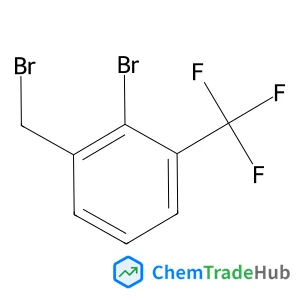
2-Bromo-1-(bromomethyl)-3-(trifluoromethyl)benzene
CAS Number:
1214372-35-6
Molecular Formula:
C8H5Br2F3
Recommended Suppliers




Disclaimer
This page provides academic journal information for reference and research purposes only. We are not affiliated with any journal publishers and do not handle publication submissions. For publication-related inquiries, please contact the respective journal publishers directly.
If you notice any inaccuracies in the information displayed, please contact us at support@chemtradehub.com. We will promptly review and address your concerns.