












Mesochiral phases from the self-assembly of chiral block copolymers
Literature Information
Publication Date
2020-01-22
DOI
10.1039/C9PY01797F
Impact Factor
5.582
Authors
Kai-Chieh Yang, Po-Ting Chiu, Rong-Ming Ho
View Original
Abstract
Herein, we aim to create new phases with chiral sense from the self-assembly of block copolymers (BCPs). The main idea is to create a BCP with a chiral block, yielding BCPs with a helical polymer chain for self-assembly in the bulk; this BCP system is denoted as a chiral BCP (BCP*). With the introduction of chirality effects in BCP self-assembly, a helical phase (H*) with hexagonally packed twisted cylinders can be obtained. By taking advantage of the homochiral evolution from a monomer to a polymer chain and further extending to a hierarchical superstructure, controlled chirality of H* can be achieved; this phase is, therefore, referred to as one of the mesochiral phases from the self-assembly of BCPs*. A methodology to scrutinize chirality transfers at different length scales for BCP* self-assembly was, therefore, developed by using electronic circular dichroism, vibrational circular dichroism, and electron microscopy tomography for the examination of monomer chirality (optical activity of the molecule), polymer chain chirality (intrachain chiral interactions), and hierarchical chirality (twisting of multichain mesodomain attributable to interchain chiral interactions), respectively. The chirality effects and the corresponding homochiral evolution during BCP self-assembly have been proven to be experimentally generic and supported by the tilted chiral lipid bilayer model and orientational self-consistent field theory. Most interestingly, the formed helical cylinder can serve as the stepping stone for the formation of a network phase, namely, a gyroid, via twisting to yield a wide region for the formed network phase. With the easy development of the gyroid phase, a platform technology, referred as templated syntheses, for the fabrication of nanonetwork-structured materials was, therefore, developed. Consequently, various gyroid-structured materials could be fabricated via templated atomic layer deposition, electroplating, electroless plating, sol–gel reaction, and polymerization to yield well-ordered nanonetwork semiconductive, metallic, ceramic, and polymeric materials after template removal. Note that the hidden chirality of the gyroid can be defined by using the dihedral (torsion) angle concept from the simplified building unit with a tripod texture. With the controlled chirality of the helical cylinder and chiral network, it is appealing and promising to fabricate chiral materials by combining the mesochiral self-assembly and platform technology of templated syntheses, yielding well-ordered nanohybrids and nanoporous materials with helical sense. By taking advantage of the deliberate structuring, the fabrication of chiral metamaterials with appealing applications in negative refractive index materials, devices with giant optical activity, and beam splitters can be expected.
Related Literature
Photoinduced charge-transfer dynamics simulations in noncovalently bonded molecular aggregates
Carlos R. Medrano, M. Belén Oviedo, Cristián G. Sánchez
2016-05-11
Paper
DOI: 10.1039/C6CP00231E
Structural and surface coverage effects on CO oxidation reaction over carbon-supported Pt nanoparticles studied by quadrupole mass spectrometry and diffuse reflectance FTIR spectroscopy
Seng Kian Cheah, Véronique P. Bernardet, Alejandro A. Franco, Olivier Lemaire, Patrick Gelin
2016-05-11
Paper
DOI: 10.1039/C6CP01845A
The S1 ← S0 fluorescence excitation spectrum and structure of propanal in the S1 excited electronic state
I. A. Godunov, N. N. Yakovlev, R. V. Terentiev, D. V. Maslov, A. V. Abramenkov
2016-05-03
Paper
DOI: 10.1039/C6CP02138G
Salt effects on the picosecond dynamics of lysozyme hydration water investigated by terahertz time-domain spectroscopy and an insight into the Hofmeister series for protein stability and solubility
Katsuyoshi Aoki, Kentaro Shiraki, Toshiaki Hattori
2016-05-19
Paper
DOI: 10.1039/C5CP06324H
Vacuum ultraviolet photodissociation of hydrogen bromide
Yvonne Dorenkamp, Shengrui Yu, Alec M. Wodtke, Dongxu Dai, Kaijun Yuan, Xueming Yang
2016-05-06
Paper
DOI: 10.1039/C6CP01956K
Synthesis, photophysical, electrochemical and electrochemiluminescence properties of A2B2 zinc porphyrins: the effect of π-extended conjugation
Elizabeth K. Galván-Miranda, Hiram M. Castro-Cruz, J. Arturo Arias-Orea, Matteo Iurlo, Giovanni Valenti, Massimo Marcaccio, Norma A. Macías-Ruvalcaba
2016-05-03
Paper
DOI: 10.1039/C6CP01926A
Markedly different adsorption behaviors of gas molecules on defective monolayer MoS2: a first-principles study
Min Huang, Gengyu Cao
2016-05-03
Paper
DOI: 10.1039/C6CP01362G
First-principles study of thermal properties of borophene
Hongyi Sun, Qingfang Li, X. G. Wan
2016-05-03
Paper
DOI: 10.1039/C6CP02029A
Electronic state-lifetime interference in resonant Auger spectra: a tool to disentangle overlapping core-excited states
Gildas Goldsztejn, Denis Céolin, Rajesh K. Kushawaha, Ralph Püttner
2016-05-06
Paper
DOI: 10.1039/C6CP01998F
You might also like
Compound Q&A
Is 4-Benzyl-2,2-dimethylmorpholine (CAS: 84761-04-6) safe?
4-Benzyl-2,2-dimethylmorpholine is generally considered safe when handled under ...
84761-04-64-Benzyl-2,2-dimethy...
Compound Q&A
What is (5,6-Dimethoxy-3-pyridinyl)boronic acid (CAS: 1346526-61-1)?
(5,6-Dimethoxy-3-pyridinyl)boronic acid is a chemical compound with the molecula...
1346526-61-1(5,6-Dimethoxy-3-pyr...
Compound Q&A
How is 1,1,3,3-Tetramethyl-1,3-bis(2-methyl-2-propanyl)disiloxane (CAS: 67875-55-2) typically synthesized?
1,1,3,3-Tetramethyl-1,3-bis(2-methyl-2-propanyl)disiloxane is synthesized throug...
67875-55-21,1,3,3-Tetramethyl-...
Compound Q&A
What are the main uses of (2R,4S)-1-Boc-4-methylpyrrolidine-2-carboxylic acid (CAS: 1018818-04-6)?
(2R,4S)-1-Boc-4-methylpyrrolidine-2-carboxylic acid is primarily used as a build...
1018818-04-6(2R,4S)-1-Boc-4-meth...
Compound Q&A
What precautions should be taken when handling 2,3-Dichloroacrylonitrile (CAS: 22410-58-8)?
When handling 2,3-Dichloroacrylonitrile, it is crucial to wear appropriate perso...
22410-58-82,3-Dichloroacryloni...
Compound Q&A
How should (S)-1-(o-Tolyl)ethanamine hydrochloride (CAS: 1332832-16-2) be stored?
(S)-1-(o-Tolyl)ethanamine hydrochloride should be stored in a cool, dry place to...
1332832-16-2(S)-1-(o-Tolyl)ethan...
Compound Q&A
What are the physical and chemical properties of Benzyl [1-(hydroxyamino)-1-imino-2-methyl-2-propanyl]carbamate (CAS: 518047-98-8)?
Benzyl [1-(hydroxyamino)-1-imino-2-methyl-2-propanyl]carbamate (CAS: 518047-98-8...
518047-98-8Benzyl [1-(hydroxyam...
Compound Q&A
What industries use 2-Methyloxazole-5-carbaldehyde (CAS: 885273-42-7)?
2-Methyloxazole-5-carbaldehyde is used in the pharmaceutical industry for the sy...
885273-42-72-Methyloxazole-5-ca...
Compound Q&A
What is the market or research trend for 2-Methyl-2-propanyl 4-[(1S)-1-hydroxyethyl]-1-piperidinecarboxylate (CAS: 389889-82-1)?
The market for 2-Methyl-2-propanyl 4-[(1S)-1-hydroxyethyl]-1-piperidinecarboxyla...
389889-82-12-Methyl-2-propanyl ...
Compound Q&A
Is 1-Butyl-3-methylpyridinium bromide (CAS: 26576-85-2) safe?
1-Butyl-3-methylpyridinium bromide is generally considered safe for laboratory u...
26576-85-21-Butyl-3-methylpyri...
Source Journal
Polymer Chemistry

CiteScore:
8.6
Self-citation Rate:
7.3%
Articles per Year:
457
Polymer Chemistry welcomes submissions in all areas of polymer science that have a strong focus on macromolecular chemistry. Manuscripts may cover a broad range of fields, yet no direct application focus is required.
Recommended Compounds
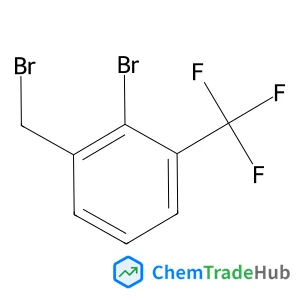
2-Bromo-1-(bromomethyl)-3-(trifluoromethyl)benzene
CAS Number:
1214372-35-6
Molecular Formula:
C8H5Br2F3
![1-{2-[(4-Chlorobenzyl)sulfanyl]-2-(2,4-dichlorophenyl)ethyl}-1H-imidazole structure](https://static.chemtradehub.com/structs/613/61318-90-9-6785.webp "1-{2-[(4-Chlorobenzyl)sulfanyl]-2-(2,4-dichlorophenyl)ethyl}-1H-imidazole structure")
1-{2-[(4-Chlorobenzyl)sulfanyl]-2-(2,4-dichlorophenyl)ethyl}-1H-imidazole
CAS Number:
61318-90-9
Molecular Formula:
C18H15Cl3N2S
![3-({2-[(2R,4S)-4-Fluoro-2-methyl-1-pyrrolidinyl]-2-oxoethyl}amino)-3-methyl-1-(1-pyrrolidinyl)-1-butanone structure](https://static.chemtradehub.com/structs/118/1186426-66-3-b2e9.webp "3-({2-[(2R,4S)-4-Fluoro-2-methyl-1-pyrrolidinyl]-2-oxoethyl}amino)-3-methyl-1-(1-pyrrolidinyl)-1-butanone structure")
3-({2-[(2R,4S)-4-Fluoro-2-methyl-1-pyrrolidinyl]-2-oxoethyl}amino)-3-methyl-1-(1-pyrrolidinyl)-1-butanone
CAS Number:
1186426-66-3
Molecular Formula:
C16H28FN3O2
Recommended Suppliers




Disclaimer
This page provides academic journal information for reference and research purposes only. We are not affiliated with any journal publishers and do not handle publication submissions. For publication-related inquiries, please contact the respective journal publishers directly.
If you notice any inaccuracies in the information displayed, please contact us at support@chemtradehub.com. We will promptly review and address your concerns.