


Organocatalyzed ring opening polymerization of regio-isomeric lactones: reactivity and thermodynamics considerations
Literature Information
Publication Date
2020-05-05
DOI
10.1039/C9PY01777A
Impact Factor
5.582
Authors
Marie A. F. Delgove, Aleksandra A. Wróblewska, Jules Stouten, Christian A. M. R. van Slagmaat, Jurrie Noordijk, Stefaan M. A. De Wildeman, Katrien V. Bernaerts
View Original
Abstract
Organocatalysts are increasingly gaining attention for the ring opening polymerization (ROP) of lactones due to numerous advantages. In this work, the goal is to expand the scope of catalysts for the ROP of alkyl substituted caprolactones: a mixture of β,δ-trimethyl-ε-caprolactones (TMCL). Several organocatalysts were evaluated, with a focus on bifunctional organophosphorus catalysts including two novel categories, namely phosphonic acids and phosphinic acids. The effects of initial monomer concentration, temperature, catalyst loading and catalyst type on the monomer conversion at equilibrium and the reaction kinetics were addressed. The ceiling temperature of TMCL is 302 °C in bulk and 34 °C at 1 M, as determined experimentally. During polymerization, higher conversion and reaction rates were observed for the most substituted lactone (proximal lactone). This difference of reactivity between the two regio-isomeric lactones was greater for lower reaction temperatures. Density functional theory (DFT) calculations on the ring opening of the lactones demonstrated that the difference of reactivity can be attributed to a lower enthalpic contribution of the proximal lactone making the ring opening of this lactone more energetically favored. The difference in calculated Gibbs free energy was found to increase with lower temperature.
Recommended Journals

Medicinal Chemistry Research

Bioorganic & Medicinal Chemistry

Heteroatom Chemistry

Acta Metallurgica Sinica-English Letters

Journal of Asian Natural Products Research

Critical Reviews in Solid State and Materials Sciences

Herald of the Russian Academy of Sciences

Polycyclic Aromatic Compounds

Electroanalysis

Chinese Journal of Chemistry
Related Literature
Cyclisation strategies for stabilising peptides with irregular conformations
Quynh Ngoc Vu, Reginald Young, Haritha Krishna Sudhakar, Tianyi Gao, Tiancheng Huang, Yaw Sing Tan, Yu Heng Lau
2021-04-28
Review Article
DOI: 10.1039/D1MD00098E
Discovery of sustainable drugs for Alzheimer's disease: cardanol-derived cholinesterase inhibitors with antioxidant and anti-amyloid properties
Giselle de Andrade Ramos, Andressa Souza de Oliveira, Manuela Bartolini, Marina Naldi, Irene Liparulo, Christian Bergamini, Elisa Uliassi, Ling Wu, Paul E. Fraser, Monica Abreu, Alessandra Sofia Kiametis, Ricardo Gargano, Edilberto Rocha Silveira, Guilherme D. Brand, Lukas Prchal, Maria Laura Bolognesi, Luiz Antonio Soares Romeiro
2021-05-05
Research Article
DOI: 10.1039/D1MD00046B
Drugging the undruggable: a computational chemist's view of KRASG12C
Michael S. Bodnarchuk, Doyle J. Cassar, Jason G. Kettle, Graeme Robb, Richard A. Ward
2021-03-29
Research Article
DOI: 10.1039/D1MD00055A
Synthesis and antitumour evaluation of indole-2-carboxamides against paediatric brain cancer cells
Shahinda S. R. Alsayed, Amreena Suri, Anders W. Bailey, Samuel Lane, Chiang-Ching Huang, Li-Fang Yu, Michael Kassiou, Hendra Gunosewoyo
2021-08-23
Research Article
DOI: 10.1039/D1MD00065A
A mimotope attached to an ITIM–SHP-1 interaction inhibitory peptide boosts immune response and efficacy
Koushik Roy, Syamal Roy, Siddhartha Roy
2021-05-19
Research Article
DOI: 10.1039/D1MD00099C
Pharmacological inhibition of NF-κB-inducing kinase (NIK) with small molecules for the treatment of human diseases
Feilong Zhou, Jin-Ming Yang
2021-01-22
Review Article
DOI: 10.1039/D0MD00361A
Recent advances in the development of covalent inhibitors
Hyunsoo Kim, Yoon Soo Hwang, Mingi Kim
2021-05-04
Review Article
DOI: 10.1039/D1MD00068C
The modulatory role of sulfated and non-sulfated small molecule heparan sulfate-glycomimetics in endothelial dysfunction: absolute structural clarification, molecular docking and simulated dynamics, SAR analyses and ADMET studies
Daniel M. Gill, Sabrina A. Shamir, Fiona L. Wilkinson, M. Yvonne Alexander, Marinonio L. Cornelio, Alan M. Jones
2021-04-23
Research Article
DOI: 10.1039/D0MD00366B
Cucurbit[8]uril-based supramolecular hydrogels for biomedical applications
Zeyu Wang, Mingju Shui, Ian W. Wyman, Qing-Wen Zhang, Ruibing Wang
2021-03-10
Review Article
DOI: 10.1039/D1MD00019E
You might also like
Compound Q&A
How should waste containing 6-Chloro-5-(2'-hydroxy-3'-methoxy-4-biphenylyl)-3-(3-methoxyphenyl)-1H-pyrrolo[3,2-d]pyrimidine-2,4(3H,5H)-dione (CAS: 1346607-05-3) be handled?
Waste containing 6-Chloro-5-(2'-hydroxy-3'-methoxy-4-biphenylyl)-3-(3-methoxyphe...
1346607-05-36-Chloro-5-(2'-hydro...
Compound Q&A
What are the main uses of (3alpha,5alpha)-3-Hydroxypregnane-11,20-dione (CAS: 23930-19-0)?
(3alpha,5alpha)-3-Hydroxypregnane-11,20-dione is primarily used in the pharmaceu...
23930-19-0(3alpha,5alpha)-3-Hy...
Compound Q&A
What is the market or research trend for 4-Amino-6-chloro-2-pyridinecarboxylic acid (CAS: 546141-56-4)?
The market for 4-Amino-6-chloro-2-pyridinecarboxylic acid (CAS: 546141-56-4) is ...
546141-56-44-Amino-6-chloro-2-p...
Compound Q&A
Are there alternatives to (2-Benzoylethyl)trimethylammonium chloride (CAS: 24472-88-6) in synthesis?
Alternatives to (2-Benzoylethyl)trimethylammonium chloride (CAS: 24472-88-6) in ...
24472-88-6(2-Benzoylethyl)trim...
Compound Q&A
Is N-[4-Nitro-3-(trifluoromethyl)phenyl]acetamide (CAS: 393-12-4) safe?
N-[4-Nitro-3-(trifluoromethyl)phenyl]acetamide (CAS: 393-12-4) is generally safe...
393-12-4N-[4-Nitro-3-(triflu...
Compound Q&A
Are there alternatives to [(4R,5R,6S)-5-hydroxy-10-imino-3,7-dioxa-1,9-diazatricyclo[6.4.0.02,6]dodeca-8,11-dien-4-yl]methyl dihydrogen phosphate (CAS: 39679-56-6) in synthesis?
Alternative reagents such as other phosphates or similar functional groups can b...
39679-56-6[(4R,5R,6S)-5-hydrox...
Compound Q&A
Are there alternatives to N,N'-Bis(3-aminopropyl)-1,3-propanediamine (CAS: 4605-14-5) in synthesis?
There are alternatives to N,N'-Bis(3-aminopropyl)-1,3-propanediamine (CAS: 4605-...
4605-14-5N,N'-Bis(3-aminoprop...
Compound Q&A
What precautions should be taken when handling Aluminium trihexadecanoate (CAS: 555-35-1)?
When handling Aluminium trihexadecanoate, it is important to use appropriate per...
555-35-1Aluminium trihexadec...
Compound Q&A
What is (1,1-Dioxido-3-oxo-1,2-benzothiazol-2(3H)-yl)acetic acid (CAS: 52188-11-1)?
(1,1-Dioxido-3-oxo-1,2-benzothiazol-2(3H)-yl)acetic acid is a chemical compound ...
52188-11-1(1,1-Dioxido-3-oxo-1...
Compound Q&A
Are there alternatives to 5,5-dimethyloxolan-2-one (CAS: 3123-97-5) in synthesis?
Several alternatives to 5,5-dimethyloxolan-2-one (CAS: 3123-97-5) can be used in...
3123-97-55,5-dimethyloxolan-2...
Source Journal
Polymer Chemistry

CiteScore:
8.6
Self-citation Rate:
7.3%
Articles per Year:
457
Polymer Chemistry welcomes submissions in all areas of polymer science that have a strong focus on macromolecular chemistry. Manuscripts may cover a broad range of fields, yet no direct application focus is required.
Recommended Compounds
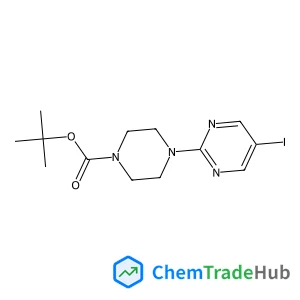
2-Methyl-2-propanyl 4-(5-iodo-2-pyrimidinyl)-1-piperazinecarboxylate
CAS Number:
1027616-32-5
Molecular Formula:
C13H19IN4O2
Recommended Suppliers





Disclaimer
This page provides academic journal information for reference and research purposes only. We are not affiliated with any journal publishers and do not handle publication submissions. For publication-related inquiries, please contact the respective journal publishers directly.
If you notice any inaccuracies in the information displayed, please contact us at support@chemtradehub.com. We will promptly review and address your concerns.