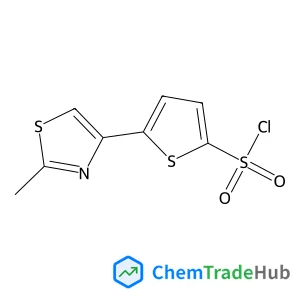
5-(2-Methyl-1,3-thiazol-4-yl)-2-thiophenesulfonyl chloride
CAS Number:
215434-25-6
Molecular Formula:
C8H6ClNO2S3
Helen Yao, Kai Sheng, Jialing Sun, Shupeng Yan, Yingqin Hou, Hua Lu, Bradley D. Olsen
Protein–polymer bioconjugates represent a class of materials that integrate protein functionality with polymer material properties and block copolymer self-assembly. To investigate the effect of polymer block secondary structure and chirality on self-assembly of globular protein–helix diblock copolymers, four types of bioconjugates consisting of a poly(amino acid) and enhanced green fluorescent protein (eGFP) were synthesized and compared: two homochiral, α-helix-forming bioconjugates incorporating either L- or D-type poly(amino acids), a 1 : 1 blend of the L- and D-type bioconjugates, and a bioconjugate incorporating structureless, achiral poly(amino acids). Poly(amino acids) (PAAs) were synthesized via N-carboxy anhydride (NCA) polymerization, and PAAs were conjugated to eGFP via native chemical ligation. All bioconjugates with a helical block self-assembled into lamellae at all concentrations measured (20 to 60 wt%). In contrast, the random copolymer of L- and D-type monomers did not self-assemble at any concentration or temperature. This was shown to be an effect of a non-repulsive interaction between the flexible PAA and the eGFP blocks, which is strong enough to affect the protonation state of the eGFP chromophore in water. Therefore, secondary structure of the polymer block can modulate the effective segregation strength between blocks and drive self-assembly even in systems with non-repulsive blocks.
Ivana Cacciatore, Hasan Turkez, Annalisa Di Rienzo, Michele Ciulla, Antonio Di Stefano
DOI: 10.1039/D1MD00177A
Clément Bechtler, Christina Lamers
DOI: 10.1039/D1MD00083G
Lewis L. Brayshaw, Carlos Martinez-Fleites, Takis Athanasopoulos, Thomas Southgate, Laurent Jespers, Christopher Herring
DOI: 10.1039/D0MD00221F
William L. Neumann, Karin E. Sandoval, Shirin Mobayen, Mahsa Minaeian, Stephen G. Kukielski, Khush N. Srabony, Rafael Frare, Olivia Slater, Susan A. Farr, Michael L. Niehoff, Audrey Hospital, Maria Kontoyianni, A. Michael Crider, Ken A. Witt
DOI: 10.1039/D1MD00044F
Dagmar Stumpfe, Alexander Hoch, Jürgen Bajorath
DOI: 10.1039/D1MD00056J
Hyunsoo Kim, Yoon Soo Hwang, Mingi Kim
DOI: 10.1039/D1MD00068C
Anchal Singh, Mingze Gao, Michael W. Beck
DOI: 10.1039/D1MD00073J
Waste containing 6-Chloro-5-(2'-hydroxy-3'-methoxy-4-biphenylyl)-3-(3-methoxyphe...
(3alpha,5alpha)-3-Hydroxypregnane-11,20-dione is primarily used in the pharmaceu...
The market for 4-Amino-6-chloro-2-pyridinecarboxylic acid (CAS: 546141-56-4) is ...
Alternatives to (2-Benzoylethyl)trimethylammonium chloride (CAS: 24472-88-6) in ...
N-[4-Nitro-3-(trifluoromethyl)phenyl]acetamide (CAS: 393-12-4) is generally safe...
Alternative reagents such as other phosphates or similar functional groups can b...
There are alternatives to N,N'-Bis(3-aminopropyl)-1,3-propanediamine (CAS: 4605-...
When handling Aluminium trihexadecanoate, it is important to use appropriate per...
(1,1-Dioxido-3-oxo-1,2-benzothiazol-2(3H)-yl)acetic acid is a chemical compound ...
Several alternatives to 5,5-dimethyloxolan-2-one (CAS: 3123-97-5) can be used in...

Polymer Chemistry welcomes submissions in all areas of polymer science that have a strong focus on macromolecular chemistry. Manuscripts may cover a broad range of fields, yet no direct application focus is required.
![4-{[4-(Trifluoromethoxy)benzyl]oxy}benzonitrile structure](https://static.chemtradehub.com/structs/103/1036629-63-6-2172.webp "4-{[4-(Trifluoromethoxy)benzyl]oxy}benzonitrile structure")
![1-(2-Chlorophenyl)-6-[(2S)-3,3,3-trifluoro-2-methylpropyl]-1,7-dihydro-4H-pyrazolo[3,4-d]pyrimidin-4-one structure](https://static.chemtradehub.com/structs/794/794568-91-5-0c34.webp "1-(2-Chlorophenyl)-6-[(2S)-3,3,3-trifluoro-2-methylpropyl]-1,7-dihydro-4H-pyrazolo[3,4-d]pyrimidin-4-one structure")