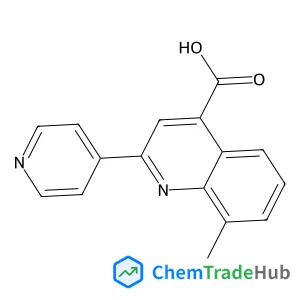
8-Methyl-2-pyridin-4-ylquinoline-4-carboxylic acid
CAS Number:
107027-42-9
Molecular Formula:
C16H12N2O2
Anchal Singh, Mingze Gao, Michael W. Beck
Human carboxylesterases (CESs) are serine hydrolases that are responsible for the phase I metabolism of an assortment of ester, amide, thioester, carbonate, and carbamate containing drugs. CES activity is known to be influenced by a variety of factors including single nucleotide polymorphisms, alternative splicing, and drug–drug interactions. These different factors contribute to interindividual variability of CES activity which has been demonstrated to influence clinical outcomes among people treated with CES-substrate therapeutics. Detailed exploration of the factors that influence CES activity is emerging as an important area of research. The use of fluorescent probes with live cell imaging techniques can selectively visualize the real-time activity of CESs and have the potential to be useful tools to help reveal the impacts of CES activity variations on human health. This review summarizes the properties of the five known human CESs including factors reported to or that could potentially influence their activity before discussing the design aspects and use considerations of CES fluorescent probes in general in addition to highlighting several well-characterized probes.
Holly J. Butler, Martin R. McAinsh
DOI: 10.1039/C6AN00392C
Hiroki Segawa, Takao Fukuoka, Tamitake Itoh, Yuichi Imai, Yuko T. Iwata, Tadashi Yamamuro, Kenji Kuwayama, Kenji Tsujikawa, Tatsuyuki Kanamori, Hiroyuki Inoue
DOI: 10.1039/C9AN01512D
Wanyu Zhang, Lihua Jia, Rui Yang, Yu Zhang, Zhenlong Zhao
DOI: 10.1039/C9AN01953G
Jennifer Wild, Meera Shanmuganathan, Mika Hayashi, Murray Potter
DOI: 10.1039/C9AN01642B
Yao Qin, Daxiu Li, Ruo Yuan, Yun Xiang
DOI: 10.1039/C9AN01674K
Jonathan Sjögren, Fredrik Olsson, Alain Beck
DOI: 10.1039/C6AN00071A
Madalena C. C. Areias, Kenichi Shimizu, Richard G. Compton
DOI: 10.1039/C6AN00550K
Hui Hun Cho, Si Hyun Kim, Jun Hyuk Heo, Young Eel Moon, Young Hun Choi, Dong Cheol Lim, Kwon-Hoon Han
DOI: 10.1039/C6AN00744A
Bruno Pagano, Nunzia Iaccarino, Anna Di Porzio, Antonio Randazzo, Jussara Amato
DOI: 10.1039/C9AN01463B
Chen Zhou, Yingmei Chen, Pengxiang Shang, Yuwu Chi
DOI: 10.1039/C6AN00664G
Waste containing 6-Chloro-5-(2'-hydroxy-3'-methoxy-4-biphenylyl)-3-(3-methoxyphe...
(3alpha,5alpha)-3-Hydroxypregnane-11,20-dione is primarily used in the pharmaceu...
The market for 4-Amino-6-chloro-2-pyridinecarboxylic acid (CAS: 546141-56-4) is ...
Alternatives to (2-Benzoylethyl)trimethylammonium chloride (CAS: 24472-88-6) in ...
N-[4-Nitro-3-(trifluoromethyl)phenyl]acetamide (CAS: 393-12-4) is generally safe...
Alternative reagents such as other phosphates or similar functional groups can b...
There are alternatives to N,N'-Bis(3-aminopropyl)-1,3-propanediamine (CAS: 4605-...
When handling Aluminium trihexadecanoate, it is important to use appropriate per...
(1,1-Dioxido-3-oxo-1,2-benzothiazol-2(3H)-yl)acetic acid is a chemical compound ...
Several alternatives to 5,5-dimethyloxolan-2-one (CAS: 3123-97-5) can be used in...
![2-Methyl-2-propanyl (2E)-5-chloro-2-[3-methoxy-4-(4-methyl-1H-imidazol-1-yl)benzylidene]pentanoate structure](https://static.chemtradehub.com/structs/122/1225232-42-7-ee03.webp "2-Methyl-2-propanyl (2E)-5-chloro-2-[3-methoxy-4-(4-methyl-1H-imidazol-1-yl)benzylidene]pentanoate structure")