












Photopolymerization with AIE dyes for solid-state luminophores
Literature Information
Publication Date
2020-01-13
DOI
10.1039/C9PY01671F
Impact Factor
5.582
Authors
Di Zhao, Jian You, Hongyuan Fu, Tanlong Xue, Tingting Hao, Xiaoning Wang
View Original
Abstract
Two anthracene-based dyes (MPA-H and MPA-E) with aggregation-induced emission (AIE) and photosensitization characteristics were prepared to obtain solid-state luminophores by photoinitiating the photopolymerization of acrylic monomers with iodonium salt under visible light-emitting diodes (LEDs). The photoinitiating activities of MPA-H/iodonium salt and MPA-E/iodonium salt were evaluated in the photopolymerization of acrylic monomers under 405, 460, and 520 nm LED sources. The aggregation-induced enhanced emission of MPA-H and MPA-E occurred during photocuring. MPA-H and MPA-E showed potential as fluorescent molecular probes to monitor the progress of free radical photopolymerization.
Related Literature
Time dependent DFT investigation of the optical properties of artificial light harvesting special pairs
Neha Agnihotri, Ronald P. Steer
2016-05-12
Paper
DOI: 10.1039/C6CP00300A
Explanation of the size dependent in-plane optical resonance of triangular silver nanoprisms
Andrea Knauer, J. Michael Koehler
2016-05-20
Paper
DOI: 10.1039/C6CP00953K
Ligand-to-ligand charge transfer in heteroleptic Ir-complexes: comprehensive investigations of its fast dynamics and mechanism
Yang-Jin Cho, So-Yoen Kim, Minji Cho, Kyung-Ryang Wee, Ho-Jin Son, Won-Sik Han, Sang Ook Kang
2016-05-06
Paper
DOI: 10.1039/C6CP02087A
Final rotational state distributions from NO(vi = 11) in collisions with Au(111): the magnitude of vibrational energy transfer depends on orientation in molecule–surface collisions
Bastian C. Krüger, Nils Bartels, Tim Schäfer
2016-05-19
Paper
DOI: 10.1039/C6CP02100J
Ammonia as an efficient catalyst for decomposition of carbonic acid: a quantum chemical investigation
Biman Bandyopadhyay, Partha Biswas, Pradeep Kumar
2016-05-19
Paper
DOI: 10.1039/C6CP02407F
Pressure-induced structural and valence transition in AgO
Xu Zhang, Xianlong Wang
2016-05-10
Paper
DOI: 10.1039/C6CP02627C
Phase transitions in hydrophobe/phospholipid mixtures: hints at connections between pheromones and anaesthetic activity
Silvia Borsacchi, Marco Geppi, Sara Macchi, Emiliano Fratini, Moira Ambrosi
2016-05-06
Paper
DOI: 10.1039/C6CP00659K
Charge carrier kinetics of carbon nitride colloid: a femtosecond transient absorption spectroscopy study
Huiyu Zhang, Yaping Chen, Rong Lu, Ruiyu Li, Anchi Yu
2016-05-05
Paper
DOI: 10.1039/C6CP01600F
Can betaine pyridinium derivatives be used to control the photoejection of cation?
S. Aloïse, Y. Ruan, I. Hamdi, A. K. Tiwari, G. Buntinx, I. Leray
2016-05-11
Paper
DOI: 10.1039/C6CP01755J
Fabrication of freestanding silk fibroin films containing Ag nanowires/NaYF4:Yb,Er nanocomposites with metal-enhanced fluorescence behavior
Bing Zhao, Ning Qi, Ke-Qin Zhang, Xiao Gong
2016-05-09
Paper
DOI: 10.1039/C6CP02024K
You might also like
Compound Q&A
Is 4-Benzyl-2,2-dimethylmorpholine (CAS: 84761-04-6) safe?
4-Benzyl-2,2-dimethylmorpholine is generally considered safe when handled under ...
84761-04-64-Benzyl-2,2-dimethy...
Compound Q&A
What is (5,6-Dimethoxy-3-pyridinyl)boronic acid (CAS: 1346526-61-1)?
(5,6-Dimethoxy-3-pyridinyl)boronic acid is a chemical compound with the molecula...
1346526-61-1(5,6-Dimethoxy-3-pyr...
Compound Q&A
How is 1,1,3,3-Tetramethyl-1,3-bis(2-methyl-2-propanyl)disiloxane (CAS: 67875-55-2) typically synthesized?
1,1,3,3-Tetramethyl-1,3-bis(2-methyl-2-propanyl)disiloxane is synthesized throug...
67875-55-21,1,3,3-Tetramethyl-...
Compound Q&A
What are the main uses of (2R,4S)-1-Boc-4-methylpyrrolidine-2-carboxylic acid (CAS: 1018818-04-6)?
(2R,4S)-1-Boc-4-methylpyrrolidine-2-carboxylic acid is primarily used as a build...
1018818-04-6(2R,4S)-1-Boc-4-meth...
Compound Q&A
What precautions should be taken when handling 2,3-Dichloroacrylonitrile (CAS: 22410-58-8)?
When handling 2,3-Dichloroacrylonitrile, it is crucial to wear appropriate perso...
22410-58-82,3-Dichloroacryloni...
Compound Q&A
How should (S)-1-(o-Tolyl)ethanamine hydrochloride (CAS: 1332832-16-2) be stored?
(S)-1-(o-Tolyl)ethanamine hydrochloride should be stored in a cool, dry place to...
1332832-16-2(S)-1-(o-Tolyl)ethan...
Compound Q&A
What are the physical and chemical properties of Benzyl [1-(hydroxyamino)-1-imino-2-methyl-2-propanyl]carbamate (CAS: 518047-98-8)?
Benzyl [1-(hydroxyamino)-1-imino-2-methyl-2-propanyl]carbamate (CAS: 518047-98-8...
518047-98-8Benzyl [1-(hydroxyam...
Compound Q&A
What industries use 2-Methyloxazole-5-carbaldehyde (CAS: 885273-42-7)?
2-Methyloxazole-5-carbaldehyde is used in the pharmaceutical industry for the sy...
885273-42-72-Methyloxazole-5-ca...
Compound Q&A
What is the market or research trend for 2-Methyl-2-propanyl 4-[(1S)-1-hydroxyethyl]-1-piperidinecarboxylate (CAS: 389889-82-1)?
The market for 2-Methyl-2-propanyl 4-[(1S)-1-hydroxyethyl]-1-piperidinecarboxyla...
389889-82-12-Methyl-2-propanyl ...
Compound Q&A
Is 1-Butyl-3-methylpyridinium bromide (CAS: 26576-85-2) safe?
1-Butyl-3-methylpyridinium bromide is generally considered safe for laboratory u...
26576-85-21-Butyl-3-methylpyri...
Source Journal
Polymer Chemistry

CiteScore:
8.6
Self-citation Rate:
7.3%
Articles per Year:
457
Polymer Chemistry welcomes submissions in all areas of polymer science that have a strong focus on macromolecular chemistry. Manuscripts may cover a broad range of fields, yet no direct application focus is required.
Recommended Compounds
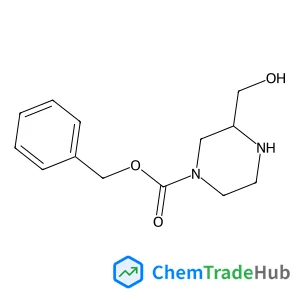
Benzyl 3-(hydroxymethyl)-1-piperazinecarboxylate
CAS Number:
191739-40-9
Molecular Formula:
C13H18N2O3
Recommended Suppliers






Disclaimer
This page provides academic journal information for reference and research purposes only. We are not affiliated with any journal publishers and do not handle publication submissions. For publication-related inquiries, please contact the respective journal publishers directly.
If you notice any inaccuracies in the information displayed, please contact us at support@chemtradehub.com. We will promptly review and address your concerns.