


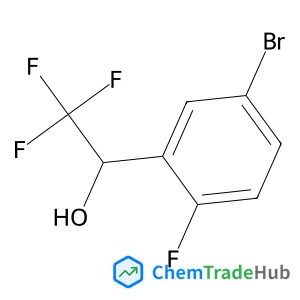
1-(5-Bromo-2-fluorophenyl)-2,2,2-trifluoroethanol
CAS Number:
1039827-16-1
Molecular Formula:
C8H5BrF4O
Neha Agnihotri, Ronald P. Steer
Computational modeling of selected artificial special pairs has been carried out. The structures chosen are bio-inspired molecular models of the light harvesting system II that have been previously investigated experimentally. Time-dependent density functional theory calculations have been employed to characterize the inter-macrocycle interactions resulting from two zinc porphyrins that are covalently linked with rigid linkers that vary the inter-porphyrin distance and the inter-planar angle in a C2v framework. The effects of varying the linker structure have been explored for electronic states with energies up to and including the Soret-correlated states in the dimer. An expansion of the Gouterman four orbital model for the monomers to an eight orbital model in the dimers provides a reasonable explanation of the inter-macrocycle interactions and provides insight into their experimental properties.

Biocatalysis and Biotransformation

Herald of the Russian Academy of Sciences

NDT & E International

Medicinal Chemistry Research

Journal of Asian Natural Products Research

Critical Reviews in Solid State and Materials Sciences

Bioorganic & Medicinal Chemistry Letters

Bioorganic & Medicinal Chemistry

Journal of the Indian Institute of Science

Journal of Chemical Sciences
Hui Xu, Fei Yu, Ronglu Huang, Mingyue Weng, Hong Chen, Ze Zhang
DOI: 10.1039/D0QO00709A
Jessica A. Hutchinson, Ian W. Hamley, Charlotte J. C. Edwards-Gayle, Valeria Castelletto, Cristian Piras, Rainer Cramer, Radoslaw Kowalczyk, Jani Seitsonen, Janne Ruokolainen, Robert P. Rambo
DOI: 10.1039/C9OB00550A
Bartłomiej Pigulski, Marta Ximenis
DOI: 10.1039/D0QO00968G
Li-Wen Jin, Fei Jiang, Ke-Wei Chen, Bai-Xiang Du, Guang-Jian Mei, Feng Shi
DOI: 10.1039/C9OB00432G
Yuanzhi Xia, Sunwoo Lee
DOI: 10.1039/D0QO00797H
Stéphane Le Gac, Elsa Caytan, Vincent Dorcet, Bernard Boitrel
DOI: 10.1039/C9OB00489K
Nagesh Jatangi, Radha Krishna Palakodety
DOI: 10.1039/C9OB00349E
Alexander Gorbunov, Julia Kuznetsova, Ilya Deltsov, Anastasia Molokanova, Dmitry Cheshkov, Stanislav Bezzubov, Vladimir Kovalev, Ivan Vatsouro
DOI: 10.1039/D0QO00650E
2-(2-Chloroacetamido)-3-phenylpropanoic acid (CAS: 7765-11-9) is generally consi...
2-(Benzyloxy)-5-bromobenzoic acid can be handled safely if appropriate precautio...
(4-Methyl-1,2,5-oxadiazol-3-yl)methanamine hydrochloride is a chemical compound ...
2-(5-Hexylthiophen-2-yl)-4,4,5,5-tetramethyl-1,3,2-dioxaborolane (CAS: 917985-54...
While 4-(8-Methyl-9H-1,3-dioxolo[4,5-h][2,3]benzodiazepin-5-yl)benzenamine (CAS:...
The market for tert-butyl 3-hydroxy-4,5,7,8-tetrahydro-2H-pyrazolo[3,4-d]azepine...
Waste containing 3,5-Diamino-1H-pyrazole-4-carbonitrile (CAS: 6844-58-2) should ...
(6-Fluoro-3-pyridinyl)boronic acid can be synthesized through the reaction of 6-...
Dibenzyl carbonimidoylbiscarbamate (CAS: 10065-79-9) finds applications in vario...
The market for (beta,beta,2,3,4,5,6-~2~H_7_)Phenylalanine (CAS: 74228-83-4) is g...

Physical Chemistry Chemical Physics (PCCP) is an international journal co-owned by 19 physical chemistry and physics societies from around the world. This journal publishes original, cutting-edge research in physical chemistry, chemical physics and biophysical chemistry. To be suitable for publication in PCCP, articles must include significant innovation and/or insight into physical chemistry; this is the most important criterion that reviewers and Editors will judge against when evaluating submissions. The journal has a broad scope and welcomes contributions spanning experiment, theory, computation and data science. Topical coverage includes spectroscopy, dynamics, kinetics, statistical mechanics, thermodynamics, electrochemistry, catalysis, surface science, quantum mechanics, quantum computing and machine learning. Interdisciplinary research areas such as polymers and soft matter, materials, nanoscience, energy, surfaces/interfaces, and biophysical chemistry are welcomed if they demonstrate significant innovation and/or insight into physical chemistry. Joined experimental/theoretical studies are particularly appreciated when complementary and based on up-to-date approaches.
![Heptadecanoic Acid 3-[2-[4-(6-Fluoro-1,2-benzisoxazol-3-yl)-1-piperidinyl]ethyl]-6,7,8,9-tetrahydro-2-methyl-4-oxo-4H-pyrido[1,2-a]pyrimidin-9-yl Ester structure](https://static.chemtradehub.com/structs/140/1404053-62-8-9da4.webp "Heptadecanoic Acid 3-[2-[4-(6-Fluoro-1,2-benzisoxazol-3-yl)-1-piperidinyl]ethyl]-6,7,8,9-tetrahydro-2-methyl-4-oxo-4H-pyrido[1,2-a]pyrimidin-9-yl Ester structure")
![3,7-Di(1,1':3',1''-terphenyl-5'-yl)-10,11,12,13-tetrahydrodiindeno[7,1-de:1',7'-fg][1,3,2]dioxaphosphocin-5-ol 5-oxide structure](https://static.chemtradehub.com/structs/135/1352810-38-8-3f10.webp "3,7-Di(1,1':3',1''-terphenyl-5'-yl)-10,11,12,13-tetrahydrodiindeno[7,1-de:1',7'-fg][1,3,2]dioxaphosphocin-5-ol 5-oxide structure")
![(3S,4aS,8aS)-2-[(2R,3S)-3-Amino-2-hydroxy-4-phenylbutyl]-N-(2-methyl-2-propanyl)decahydro-3-isoquinolinecarboxamide structure](https://static.chemtradehub.com/structs/136/136522-17-3-4d77.webp "(3S,4aS,8aS)-2-[(2R,3S)-3-Amino-2-hydroxy-4-phenylbutyl]-N-(2-methyl-2-propanyl)decahydro-3-isoquinolinecarboxamide structure")



