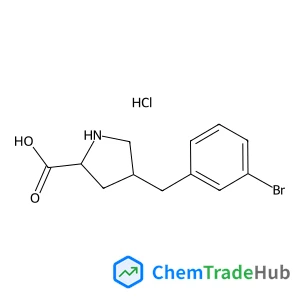
(2S,4R)-4-(3-Bromobenzyl)pyrrolidine-2-carboxylic acid hydrochloride
CAS Number:
1049734-10-2
Molecular Formula:
C12H15BrClNO2
S. Aloïse, Y. Ruan, I. Hamdi, A. K. Tiwari, G. Buntinx, I. Leray
Using a combination of advanced DFT/TDDFT calculations together with ultrafast and stationary spectroscopies we have investigated the photochemistry and cationic complexation ability of 1-pyridinio-benzimidazolate (PyB) and analogs substituted by 15-aza-5-crown (PyB–Aza) or dimethyl-amino groups (PyB–DiMe). Focusing on PyB–Aza, the first aim was to assess the competitive complexation of the imidazole bridge vs. the macrocycle. In acetonitrile, it was found by absorption and emission that the imidazole moiety binds efficiently through lateral electrostatic interaction of high charge density cations and especially Ca2+ to form a 1 : 1, metal : ligand (M : L) complex. Modulation of the complexation toward para substitution of the phenyl ring with a donor group is reported with values ranging from log K = 3.4 to 6.8. Complexation values are properly predicted by DFT calculations. From a photochemical point of view, for the same series, the trend is parallel to the rate of the photo-release process, found to be less than 200 femtosecond (fs), the fastest photorelease characteristic time reported so far. Unlike photoinduced charge transfer molecules linked with an aza-crown group, the mechanism appears simpler with no participation of loose complexes due to the macrocavity effect. Relaxation mechanisms after cation ejection are discussed as well. Finally, even if any photoinduced translocation of cation is reported for the PyB–Aza molecule between two complexation sites, a discussion about the use of betaine pyridinium as a molecular tool for the smart manipulation of cation systems is initiated.
Alexander Gorbunov, Julia Kuznetsova, Ilya Deltsov, Anastasia Molokanova, Dmitry Cheshkov, Stanislav Bezzubov, Vladimir Kovalev, Ivan Vatsouro
DOI: 10.1039/D0QO00650E
Guo-bin Yang, Yong-po Zhang, Dong-dong Guo, Jin-zhong Zhao, Guang-xun Li, Zhuo Tang
DOI: 10.1039/D0QO00722F
Jiapian Huang, Feng Ding, Pornchai Rojsitthisak, Fu-Sheng He
DOI: 10.1039/D0QO00563K
David Schönbauer, Manuel Spettel, Ernst Pittenauer, Michael Schnürch
DOI: 10.1039/C9OB00243J
Bartłomiej Pigulski, Marta Ximenis
DOI: 10.1039/D0QO00968G
Li Zhou, Huating Yan, Xin-Qi Hao
DOI: 10.1039/D0QO00780C
Biao Nie, Wanqing Wu, Yingjun Zhang, Huanfeng Jiang, Ji Zhang
DOI: 10.1039/D0QO00510J
Arumugam Mariappan, Kandasamy Rajaguru, Shanmugam Muthusubramanian, Nattamai Bhuvanesh
DOI: 10.1039/C9OB00300B
2-(2-Chloroacetamido)-3-phenylpropanoic acid (CAS: 7765-11-9) is generally consi...
2-(Benzyloxy)-5-bromobenzoic acid can be handled safely if appropriate precautio...
(4-Methyl-1,2,5-oxadiazol-3-yl)methanamine hydrochloride is a chemical compound ...
2-(5-Hexylthiophen-2-yl)-4,4,5,5-tetramethyl-1,3,2-dioxaborolane (CAS: 917985-54...
While 4-(8-Methyl-9H-1,3-dioxolo[4,5-h][2,3]benzodiazepin-5-yl)benzenamine (CAS:...
The market for tert-butyl 3-hydroxy-4,5,7,8-tetrahydro-2H-pyrazolo[3,4-d]azepine...
Waste containing 3,5-Diamino-1H-pyrazole-4-carbonitrile (CAS: 6844-58-2) should ...
(6-Fluoro-3-pyridinyl)boronic acid can be synthesized through the reaction of 6-...
Dibenzyl carbonimidoylbiscarbamate (CAS: 10065-79-9) finds applications in vario...
The market for (beta,beta,2,3,4,5,6-~2~H_7_)Phenylalanine (CAS: 74228-83-4) is g...

Physical Chemistry Chemical Physics (PCCP) is an international journal co-owned by 19 physical chemistry and physics societies from around the world. This journal publishes original, cutting-edge research in physical chemistry, chemical physics and biophysical chemistry. To be suitable for publication in PCCP, articles must include significant innovation and/or insight into physical chemistry; this is the most important criterion that reviewers and Editors will judge against when evaluating submissions. The journal has a broad scope and welcomes contributions spanning experiment, theory, computation and data science. Topical coverage includes spectroscopy, dynamics, kinetics, statistical mechanics, thermodynamics, electrochemistry, catalysis, surface science, quantum mechanics, quantum computing and machine learning. Interdisciplinary research areas such as polymers and soft matter, materials, nanoscience, energy, surfaces/interfaces, and biophysical chemistry are welcomed if they demonstrate significant innovation and/or insight into physical chemistry. Joined experimental/theoretical studies are particularly appreciated when complementary and based on up-to-date approaches.
![{3-[Bis(4-hydroxyphenyl)methyl]-1-[2-(dimethylamino)ethyl]-1H-indol-2-yl}[4-(2-chlorophenyl)-1-piperazinyl]methanone structure](https://static.chemtradehub.com/structs/170/170365-25-0-e4d7.webp "{3-[Bis(4-hydroxyphenyl)methyl]-1-[2-(dimethylamino)ethyl]-1H-indol-2-yl}[4-(2-chlorophenyl)-1-piperazinyl]methanone structure")
![(1R)-N-((1R)-1-Phenylethyl)-1-[4-(tert-butyldimethylsilyloxymethyl)cyclohexyl]ethan-1-amine structure](https://static.chemtradehub.com/structs/672/672314-45-3-47ef.webp "(1R)-N-((1R)-1-Phenylethyl)-1-[4-(tert-butyldimethylsilyloxymethyl)cyclohexyl]ethan-1-amine structure")