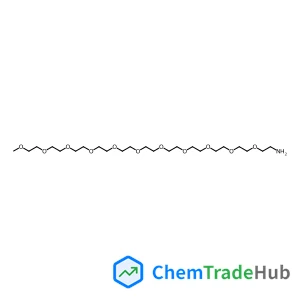
2,5,8,11,14,17,20,23,26,29,32-Undecaoxatetratriacontan-34-amine
CAS Number:
854601-60-8
Molecular Formula:
C23H49NO11
A systematic study on the directed Pd-catalyzed (hetero)arylation of 26 substituted cyclic α-amino acids at the C(3)-atom was performed. For the first time, the 7- and 8-membered cyclic amino acids were introduced to C–H activation. 8-Aminoquinoline was used as a directing group. Effects of the ring size and the substituents on the reaction efficacy and stereoselectivity were studied.
Kai-Jun Yuan, André D. Bandrauk
DOI: 10.1039/C7CP05067D
Georg Ehlers, Joerg C. Neuefeind, Souleymane O. Diallo, Christopher B. Stanley, Luke Daemen
DOI: 10.1039/C7CP04013J
K. Lambropoulos, C. Simserides
DOI: 10.1039/C7CP05134D
Piti Treesukul, Jakkapan Sirijaraensre, Jumras Limtrakul
DOI: 10.1039/C7CP04229A
DOI: 10.1039/C7CP03307A
Sam Karpiniec, James K. Ferri
DOI: 10.1039/C7CP02599H
John C. Mullaney, Chris Medcraft, David P. Tew, Luke Lewis-Borrell, Bernard T. Golding, Nicholas R. Walker, Anthony C. Legon
DOI: 10.1039/C7CP04315E
Masahiro Kinoshita, Tomohiko Hayashi
DOI: 10.1039/C7CP05160C
3-Fluoro-2-methylbenzylamine is an organic compound with the CAS number 771573-3...
Tert-butyl 2-(oxetan-3-ylidene)acetate is considered safe for its intended uses ...
Proper personal protective equipment (PPE) such as gloves, goggles, and a lab co...
2-Ethyl-4-methyl-1,3-thiazole is commonly synthesized via the reaction of thiour...
This compound should be stored in a cool, dry place away from direct sunlight an...
L-Lysine Acetate Salt (CAS: 52315-92-1) is subject to various regulatory guideli...
6-Fluoro-3-hydroxy-2-pyrazinecarboxamide (CAS: 259793-96-9) is generally conside...
1,1'-Sulfonylbis(1H-imidazole) is a crystalline solid with a molecular weight of...
4-Methyl-7-nitro-1H-indole-3-carbonitrile (CAS: 289483-82-5) is primarily used i...
Waste containing 5-Bromo-3-indolyl-beta-galactoside (CAS: 97753-82-7) should be ...

Organic & Biomolecular Chemistry (OBC) publishes original and high impact research and reviews in organic chemistry. We welcome research that shows new or significantly improved protocols or methodologies in total synthesis, synthetic methodology or physical and theoretical organic chemistry as well as research that shows a significant advance in the organic chemistry or molecular design aspects of chemical biology, catalysis, supramolecular and macromolecular chemistry, theoretical chemistry, mechanism-oriented physical organic chemistry, medicinal chemistry or natural products. Articles published in the journal should report new work which makes a highly-significant impact in the field. Routine and incremental work is generally not suitable for publication in the journal. More details about key areas of our scope are below. In all cases authors should include in their article clear rationale for why their research has been carried out.