












Transition-metal-free C–C σ-bond activation of α-aryl ketones and subsequent Zn-catalyzed intramolecular cyclization: synthesis of tetrasubstituted furans
Literature Information
Publication Date
2019-02-12
DOI
10.1039/C9OB00081J
Impact Factor
3.876
Authors
Yang Yuan, Hailu Tan, Lingkai Kong, Zhong Zheng, Murong Xu, Jiaqi Huang, Yanzhong Li
View Original
Abstract
A highly atom-economical protocol for the synthesis of tetrasubstituted furans has been developed. This process is realized through the tandem reactions of Cs2CO3 promoted C–C σ-bond activation of α-aryl ketones followed by Zn-catalyzed intramolecular cyclization. This represents the first example for the preparation of tetrasubstituted furans through rearrangement of molecular skeletons and subsequent transformations. Mild reaction conditions and readily accessible starting materials make the protocol attractive in organic synthesis.
Related Literature
Unified elucidation of the entropy-driven and -opposed hydrophobic effects
Masahiro Kinoshita, Tomohiko Hayashi
2017-09-05
Paper
DOI: 10.1039/C7CP05160C
One-step formulation of nonionic surfactant bicelles (NSBs) by a double-tailed polyglycerol-type nonionic surfactant
Kenji Aramaki, Chikahiro Iwata, Jitendra Mata, Tetsuya Maehara, Daisuke Aburano, Yuichi Sakanishi, Kyuhei Kitao
2017-05-09
Paper
DOI: 10.1039/C7CP02585H
Running out of lithium? A route to differentiate between capacity losses and active lithium losses in lithium-ion batteries
Florian Holtstiege, Andrea Wilken, Tobias Placke
2017-09-12
Paper
DOI: 10.1039/C7CP05405J
Properties of kinetic transition networks for atomic clusters and glassy solids
John W. R. Morgan, Dhagash Mehta, David J. Wales
2017-09-07
Paper
DOI: 10.1039/C7CP03346J
Surface cleaning of artworks: structure and dynamics of nanostructured fluids confined in polymeric hydrogel networks
Rosangela Mastrangelo, Costanza Montis, Nicole Bonelli, Paolo Tempesti, Piero Baglioni
2017-06-05
Paper
DOI: 10.1039/C7CP02662E
Exploring coherent electron excitation and migration dynamics by electron diffraction with ultrashort X-ray pulses
Kai-Jun Yuan, André D. Bandrauk
2017-09-14
Communication
DOI: 10.1039/C7CP05067D
Self-assembly of a nanotube from a black phosphorus nanoribbon on a string of fullerenes at low temperature
Jiao Shi, Ling-Nan Liu, Qing-Hua Qin
2017-08-10
Paper
DOI: 10.1039/C7CP04427E
You might also like
Compound Q&A
What is 3-Fluoro-2-methylbenzylamine (CAS: 771573-36-5)?
3-Fluoro-2-methylbenzylamine is an organic compound with the CAS number 771573-3...
771573-36-53-Fluoro-2-methylben...
Compound Q&A
Is Tert-butyl 2-(oxetan-3-ylidene)acetate (CAS: 1207175-03-8) safe?
Tert-butyl 2-(oxetan-3-ylidene)acetate is considered safe for its intended uses ...
1207175-03-8Tert-butyl 2-(oxetan...
Compound Q&A
What precautions should be taken when handling 4-Acetyl-2-fluorobenzonitrile (CAS: 214760-18-6)?
Proper personal protective equipment (PPE) such as gloves, goggles, and a lab co...
214760-18-64-Acetyl-2-fluoroben...
Compound Q&A
How is 2-Ethyl-4-methyl-1,3-thiazole (CAS: 15679-12-6) typically synthesized?
2-Ethyl-4-methyl-1,3-thiazole is commonly synthesized via the reaction of thiour...
15679-12-62-Ethyl-4-methyl-1,3...
Compound Q&A
How should 5',5''-([2,2'-Bithiophene]-5,5'-diyl)bis(([1,1':3',1''-terphenyl]-4,4''-dicarboxylic acid)) (CAS: 1227780-71-3) be stored?
This compound should be stored in a cool, dry place away from direct sunlight an...
1227780-71-35',5''''-([2,2'-Bith...
Compound Q&A
What regulatory guidelines apply to L-Lysine Acetate Salt (CAS: 52315-92-1)?
L-Lysine Acetate Salt (CAS: 52315-92-1) is subject to various regulatory guideli...
52315-92-1L-LYSINE ACETATE SAL...
Compound Q&A
Is 6-Fluoro-3-hydroxy-2-pyrazinecarboxamide (CAS: 259793-96-9) safe?
6-Fluoro-3-hydroxy-2-pyrazinecarboxamide (CAS: 259793-96-9) is generally conside...
259793-96-96-Fluoro-3-hydroxy-2...
Compound Q&A
What are the physical and chemical properties of 1,1'-Sulfonylbis(1H-imidazole) (CAS: 7189-69-7)?
1,1'-Sulfonylbis(1H-imidazole) is a crystalline solid with a molecular weight of...
7189-69-71,1'-Sulfonylbis(1H-...
Compound Q&A
What industries use 4-methyl-7-nitro-1H-indole-3-carbonitrile (CAS: 289483-82-5)?
4-Methyl-7-nitro-1H-indole-3-carbonitrile (CAS: 289483-82-5) is primarily used i...
289483-82-54-methyl-7-nitro-1H-...
Compound Q&A
How should waste containing 5-Bromo-3-indolyl-beta-galactoside (CAS: 97753-82-7) be handled?
Waste containing 5-Bromo-3-indolyl-beta-galactoside (CAS: 97753-82-7) should be ...
97753-82-75-Bromo-3-indolyl-be...
Source Journal
Organic & Biomolecular Chemistry

CiteScore:
3.4
Self-citation Rate:
10.3%
Articles per Year:
1041
Organic & Biomolecular Chemistry (OBC) publishes original and high impact research and reviews in organic chemistry. We welcome research that shows new or significantly improved protocols or methodologies in total synthesis, synthetic methodology or physical and theoretical organic chemistry as well as research that shows a significant advance in the organic chemistry or molecular design aspects of chemical biology, catalysis, supramolecular and macromolecular chemistry, theoretical chemistry, mechanism-oriented physical organic chemistry, medicinal chemistry or natural products. Articles published in the journal should report new work which makes a highly-significant impact in the field. Routine and incremental work is generally not suitable for publication in the journal. More details about key areas of our scope are below. In all cases authors should include in their article clear rationale for why their research has been carried out.
Recommended Compounds
![1,1'-[(E)-1,2-Ethenediyl]bis(4-bromobenzene) structure](https://static.chemtradehub.com/structs/188/18869-30-2-c907.webp "1,1'-[(E)-1,2-Ethenediyl]bis(4-bromobenzene) structure")
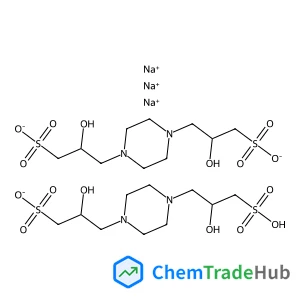
3,3'-(Piperazine-1,4-diyl)bis(2-hydroxypropane-1-sulfonic acid) Sodium Salt
CAS Number:
108321-08-0
Molecular Formula:
C20H41N4Na3O16S4
Recommended Suppliers





Disclaimer
This page provides academic journal information for reference and research purposes only. We are not affiliated with any journal publishers and do not handle publication submissions. For publication-related inquiries, please contact the respective journal publishers directly.
If you notice any inaccuracies in the information displayed, please contact us at support@chemtradehub.com. We will promptly review and address your concerns.