












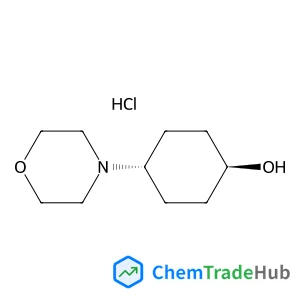
trans-4-(4-Morpholinyl)cyclohexanol hydrochloride (1:1)
CAS Number:
1588441-09-1
Molecular Formula:
C10H20ClNO2
A graphical abstract is available for this content
Zhimin Zhao, Jiawei Ding, Rongmei Zhu, Huan Pang
DOI: 10.1039/C9TA03833G
Robert D. Crapnell, Craig E. Banks
DOI: 10.1039/D1AN00086A
Joseph Baugh, Adetunji Alabi, Ahmed AlHajaj, Linda Zou, Robert A. W. Dryfe
DOI: 10.1039/C8TA09160A
Abraham M. Shultz, Omar K. Farha, Joseph T. Hupp, SonBinh T. Nguyen
DOI: 10.1039/C0SC00339E
Danbi Lee, Eunsuk Kim, Kyung Won Lee, Ka Ram Kim, Hyeong Jin Chun, Hyunjin Yoon, Hyun C. Yoon
DOI: 10.1039/D1AN01543E
Nicole M. Ralbovsky, Randal J. Soukup, Justin P. Lomont, Mackenzie L. Lauro, Amanda Gulasarian, Anumita Saha-Shah, Michael A. Winters, Douglas D. Richardson, Sheng-Ching Wang, Ian Mangion, Joseph P. Smith
DOI: 10.1039/D1AN01797G
Yue Zhao, Juan Bai, Xin-Ru Wu, Pei Chen, Pu-Jun Jin, Hong-Chang Yao, Yu Chen
DOI: 10.1039/C9TA05334D
Lingfei Zhao, Ying Tao, Hongpeng You
DOI: 10.1039/C7CE00097A
Haiwei Li, Wingkei Ho, Shun Cheng Lee
DOI: 10.1039/C9TA03504D
Sandro Spagnolo, Eric S. Muckley, Ilia N. Ivanov, Tibor Hianik
DOI: 10.1039/D1AN01800K
Ethyl 4-chlorothieno[2,3-b]pyridine-5-carboxylate (CAS: 59713-58-5) can be synth...
5-Methyl-1H-indole-3-carbaldehyde (CAS: 52562-50-2) is subject to various regula...
(1,3-Dimethyl-2,4-dioxo-1,2,3,4-tetrahydro-5-pyrimidinyl)boronic acid is a white...
Waste containing Sulfocostunolide A (CAS: 1016983-51-9) should be handled with c...
When handling Murraxocin (CAS: 88478-44-8), ensure proper personal protective eq...
Formvar (CAS: 63148-64-1) is an alkyd resin characterized by a high molecular we...
(S)-4-benzyl-2-((benzyloxy)methyl)morpholine is generally safe when handled with...
Methyl 1-(5-bromo-2-pyrimidinyl)cyclopropanecarboxylate (CAS: 1447607-69-3) is p...
2-Methyl-1-phenyl-1-propanamine hydrochloride (CAS: 24290-47-9) is generally con...
3-(4-Bromophenyl)-2-methylpropanoic acid is synthesized through a multi-step pro...

Physical Chemistry Chemical Physics (PCCP) is an international journal co-owned by 19 physical chemistry and physics societies from around the world. This journal publishes original, cutting-edge research in physical chemistry, chemical physics and biophysical chemistry. To be suitable for publication in PCCP, articles must include significant innovation and/or insight into physical chemistry; this is the most important criterion that reviewers and Editors will judge against when evaluating submissions. The journal has a broad scope and welcomes contributions spanning experiment, theory, computation and data science. Topical coverage includes spectroscopy, dynamics, kinetics, statistical mechanics, thermodynamics, electrochemistry, catalysis, surface science, quantum mechanics, quantum computing and machine learning. Interdisciplinary research areas such as polymers and soft matter, materials, nanoscience, energy, surfaces/interfaces, and biophysical chemistry are welcomed if they demonstrate significant innovation and/or insight into physical chemistry. Joined experimental/theoretical studies are particularly appreciated when complementary and based on up-to-date approaches.
![4-{1-[4-(4,4,5,5-Tetramethyl-1,3,2-dioxaborolan-2-yl)phenyl]cyclopropyl}morpholine structure](https://static.chemtradehub.com/structs/120/1206594-08-2-7afb.webp "4-{1-[4-(4,4,5,5-Tetramethyl-1,3,2-dioxaborolan-2-yl)phenyl]cyclopropyl}morpholine structure")




