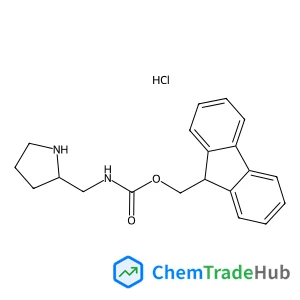
(S)-(9H-Fluoren-9-yl)methyl (pyrrolidin-2-ylmethyl)carbamate hydrochloride
CAS Number:
1217813-15-4
Molecular Formula:
C20H23ClN2O2
Federico Sebastiani, Ana Vila Verde, Matthias Heyden, Gerhard Schwaab, Martina Havenith
We report a terahertz absorption spectroscopy study of MgSO4 aqueous solutions in the concentration range 0.1 mol dm−3 to 2.4 mol dm−3. Accompanying classical MD simulations were carried out that use a polarizable force field parameterized to reproduce the solution thermodynamics. Contrary to prior reports, we find no evidence of contact ion pairs, even close to the solubility limit. Only solvent separated and different types of solvent shared ion pairs are found, being abundant even at the lowest concentration investigated here. The structure of the solution is concentration-dependent: the number of both types of ion pairs grows with increasing salt concentration. The combined theoretical and experimental analysis of the spectra in the frequency region 50–640 cm−1 suggests that the dynamics of water directly between two ions in solvent shared configuration is very strongly perturbed, via a cooperative, supra-additive, effect arising from the two ions. At high concentrations, the results support a scenario, where the perturbations in the water dynamics extend up to the third hydration layer via a cooperative, but additive, effect involving multiple ions. The SO42− and its hydration shell are much more strongly perturbed by the presence of the counterions than the first hydration shell of Mg2+. It is further shown that our simulations and observations are in agreement with thermodynamic properties of aqueous MgSO4 solutions derived by other methods.
Anthony B. Costa, R. Graham Cooks
DOI: 10.1039/C0CP01402H
Tangui Le Bahers, Frédéric Labat, Thierry Pauporté, Ilaria Ciofini
DOI: 10.1039/C004358C
Albert Rimola
DOI: 10.1039/C000009D
Krzysztof Pachucki, Jacek Komasa
DOI: 10.1039/C0CP00209G
Sason Shaik
DOI: 10.1039/C001372M
Miriam Kunze, Yunus Karatas, Hans-Dieter Wiemhöfer, Hellmut Eckert, Monika Schönhoff
DOI: 10.1039/B925840J
Xumei Wang, Shuping Xu, Weiqing Xu
DOI: 10.1039/C0CP00929F
Sarah Couck, Tom Rémy, Gino V. Baron, Jorge Gascon, Freek Kapteijn, Joeri F. M. Denayer
DOI: 10.1039/B927115E
Oscar Donoso-Tauda, Pablo Jaque, Juan C. Santos
DOI: 10.1039/C0CP00928H
Waste containing N-Methoxy-N-methyl-1,3-thiazole-5-carboxamide (CAS: 898825-89-3...
N-(4-Biphenylyl)dibenzo[b,d]furan-4-amine should be stored in a tightly sealed c...
The market for 3-Acetamido-5-amino-2,4,6-triiodobenzoic acid (CAS: 1713-07-1) is...
Benzyl 2-O-acetyl-3,4,6-tri-O-benzyl-beta-D-galactopyranoside (CAS: 61820-03-9) ...
2-Ethylpiperazine dihydrochloride (CAS: 438050-52-3) is regulated under the Glob...
1,1'-[1,3-Phenylenebis(methylene)]bis(3-methyl-1H-pyrrole-2,5-dione) (CAS: 11946...
Several alternatives can be used in the synthesis of 5-Fluoro-2-(1-pyrrolidinyl)...
Proper personal protective equipment (PPE) must be worn when handling this compo...
When handling 6-Bromoimidazo[1,2-a]pyridin-8-amine, it is important to wear appr...
Alternatives to (2S,4R)-4-(4-Nitrobenzyl)pyrrolidine-2-carboxylic acid hydrochlo...

Physical Chemistry Chemical Physics (PCCP) is an international journal co-owned by 19 physical chemistry and physics societies from around the world. This journal publishes original, cutting-edge research in physical chemistry, chemical physics and biophysical chemistry. To be suitable for publication in PCCP, articles must include significant innovation and/or insight into physical chemistry; this is the most important criterion that reviewers and Editors will judge against when evaluating submissions. The journal has a broad scope and welcomes contributions spanning experiment, theory, computation and data science. Topical coverage includes spectroscopy, dynamics, kinetics, statistical mechanics, thermodynamics, electrochemistry, catalysis, surface science, quantum mechanics, quantum computing and machine learning. Interdisciplinary research areas such as polymers and soft matter, materials, nanoscience, energy, surfaces/interfaces, and biophysical chemistry are welcomed if they demonstrate significant innovation and/or insight into physical chemistry. Joined experimental/theoretical studies are particularly appreciated when complementary and based on up-to-date approaches.
![tert-Butyl 6-chloro-4-oxospiro[chroman-2,4'-piperidine]-1'-carboxylate structure](https://static.chemtradehub.com/structs/101/1011482-37-3-88a5.webp "tert-Butyl 6-chloro-4-oxospiro[chroman-2,4'-piperidine]-1'-carboxylate structure")
![2-(7,7-Difluorobicyclo[4.1.0]hept-1-yl)ethanamine structure](https://static.chemtradehub.com/structs/209/2098065-08-6-ff24.webp "2-(7,7-Difluorobicyclo[4.1.0]hept-1-yl)ethanamine structure")