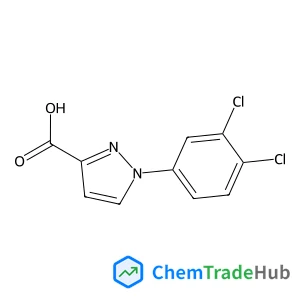
1-(3,4-Dichlorophenyl)-1H-pyrazole-3-carboxylic acid
CAS Number:
1152949-12-6
Molecular Formula:
C10H6Cl2N2O2
Albert Rimola
The adsorption of benzene and benzene-1,4-diol on two all-silica surface models derived from the framework of sanidine mineral with either hydrophobic or hydrophilic properties has been studied by means of periodic calculations based on local Gaussian basis function and the B3LYP-D functional, which includes dispersion contribution as an empirical correction to the pure B3LYP energy. The aromatic molecules have been docked on different adsorption sites of the two surfaces using the electrostatic potential of the separate parts as a guide to ensure the best matching between electrophilic/nucleophilic regions. The inclusion of dispersion in the definition of the functional method dramatically affects both the intermolecular geometries and the adsorption energies, these latter being, in all cases, underestimated without the inclusion of the dispersive contribution. The adsorption of the aromatic molecules on the hydrophobic silica surface is dictated by dispersion and weak CH⋯O(Si)O interactions. The entity of the interaction for benzene on the hydrophilic surface is close to the value of the sublimation energy of the benzene molecular crystal, thus showing that adsorbate self-aggregation and adsorption to the silica surface are competing processes. For hydrophilic surfaces dispersion is still large despite the fact that adsorption energies are almost doubled with respect to the hydrophobic surface due to H-bonding interactions through either SiOH⋯π (benzene case) or SiOH⋯OH (benzene-1,4-diol case). The computed infrared spectra of the adsorbed molecules reveal small perturbations in the CH, CCH and CCC ring modes, which are sensitive to the adsorbate/adsorbent features, so that these bands can be used as fingerprints for the interpretation of experimental spectra. The present work may contribute to a better understanding of the sorption of typical organic contaminants in common earth’s inorganic soils, which is of relevance for environmental concerns.

Journal of the Indian Institute of Science

Polycyclic Aromatic Compounds

Cellulose

Bioorganic & Medicinal Chemistry

Biocatalysis and Biotransformation

Chinese Journal of Chemistry

Topics in Catalysis

Critical Reviews in Solid State and Materials Sciences

Acta Metallurgica Sinica-English Letters

Bioorganic & Medicinal Chemistry Letters
Yusuke Matsuura, Naoko Ouchi, Ayako Nakamura, Haruhisa Kato
DOI: 10.1039/C7CP08332G
Jing Xu, Véronique Perraud, Barbara J. Finlayson-Pitts
DOI: 10.1039/C8CP03634A
Jose J. Plata, Francisca Romero-Sarria, Javier Amaya Suárez, Antonio M. Márquez, Óscar H. Laguna, José A. Odriozola, Javier Fdez Sanz
DOI: 10.1039/C8CP03706J
Victor Gray, Betül Küçüköz, Fredrik Edhborg, Maria Abrahamsson, Kasper Moth-Poulsen, Bo Albinsson
DOI: 10.1039/C8CP00884A
Yun Kyung Shin, A. S. M. Jonayat, Wonho Lee, Clive A. Randall, Adri C. T. van Duin
DOI: 10.1039/C8CP03586E
Yemin Wang, Jie Cheng
DOI: 10.1039/C8CP02974A
Lizhe Liu, Li Wang, Guangsheng Luo, Chunlan Mo, Chenliang Chang
DOI: 10.1039/C8CP02069H
Nirmali Prabha Das, Brigitta Müller, Ágota Tóth, Dezső Horváth, Gábor Schuszter
DOI: 10.1039/C8CP01798K
Marcelo Goulart, Lorenz Kranabetter, Martin Kuhn, Paul Martini, Paul Scheier
DOI: 10.1039/C8CP00486B
Waste containing N-Methoxy-N-methyl-1,3-thiazole-5-carboxamide (CAS: 898825-89-3...
N-(4-Biphenylyl)dibenzo[b,d]furan-4-amine should be stored in a tightly sealed c...
The market for 3-Acetamido-5-amino-2,4,6-triiodobenzoic acid (CAS: 1713-07-1) is...
Benzyl 2-O-acetyl-3,4,6-tri-O-benzyl-beta-D-galactopyranoside (CAS: 61820-03-9) ...
2-Ethylpiperazine dihydrochloride (CAS: 438050-52-3) is regulated under the Glob...
1,1'-[1,3-Phenylenebis(methylene)]bis(3-methyl-1H-pyrrole-2,5-dione) (CAS: 11946...
Several alternatives can be used in the synthesis of 5-Fluoro-2-(1-pyrrolidinyl)...
Proper personal protective equipment (PPE) must be worn when handling this compo...
When handling 6-Bromoimidazo[1,2-a]pyridin-8-amine, it is important to wear appr...
Alternatives to (2S,4R)-4-(4-Nitrobenzyl)pyrrolidine-2-carboxylic acid hydrochlo...

Physical Chemistry Chemical Physics (PCCP) is an international journal co-owned by 19 physical chemistry and physics societies from around the world. This journal publishes original, cutting-edge research in physical chemistry, chemical physics and biophysical chemistry. To be suitable for publication in PCCP, articles must include significant innovation and/or insight into physical chemistry; this is the most important criterion that reviewers and Editors will judge against when evaluating submissions. The journal has a broad scope and welcomes contributions spanning experiment, theory, computation and data science. Topical coverage includes spectroscopy, dynamics, kinetics, statistical mechanics, thermodynamics, electrochemistry, catalysis, surface science, quantum mechanics, quantum computing and machine learning. Interdisciplinary research areas such as polymers and soft matter, materials, nanoscience, energy, surfaces/interfaces, and biophysical chemistry are welcomed if they demonstrate significant innovation and/or insight into physical chemistry. Joined experimental/theoretical studies are particularly appreciated when complementary and based on up-to-date approaches.