



Gas adsorption and light interaction mechanism in phosphorene-based field-effect transistors
Literature Information
Publication Date
2020-02-21
DOI
10.1039/C9CP06547D
Impact Factor
3.676
Authors
Manthila Rajapakse, George Anderson, Congyan Zhang, Rajib Musa, Jackson Walter, Ming Yu, Jacek B. Jasinski
View Original
Abstract
Phosphorene-based field effect transistor (FET) structures were fabricated to study the gas- and photo-detection properties of phosphorene. The interplay between device performance and environmental conditions was probed and analyzed using in situ transport measurements. The device structures were exposed to different chemical and light environments to understand how they perform under different external stimuli. For the gas/molecule detection studies, inert (Ar), as well as, oxidizing (N2O), and reducing (H2 and also N2H4) agents were selected. The FET structure was exposed to these different gases, and the effect of each gas on the device resistance was measured. The study showed varying response towards different molecules. Specifically, no significant resistance change was observed upon exposure to Ar, while H2 and N2H4 were found to decrease the resistance and N2O had the opposite effect resulting in an increase in resistance. This work is the first demonstration for the detection of N2H2 and N2O using a phosphorene-based system. These phosphorene-based FET structures were also found to be sensitive to light exposure. When such structure was irradiated with light, the current modulation was lost. The observed resistance changes can be explained as a result of the modulation of the Schottky barrier at the phosphorene-electrical contact interface due to the adsorbed molecules and charge transfer, and/or photo-induced carrier generation. The results were consistent with the transfer characteristics of Vdsvs. Vg.
Recommended Journals

New Journal of Chemistry

Russian Journal of Applied Chemistry

Russian Journal of Coordination Chemistry

Current Opinion in Solid State & Materials Science

Russian Chemical Bulletin

Russian Journal of General Chemistry

Journal of Natural Medicines

Saudi Pharmaceutical Journal

Chemical Communications

Acta Materialia
Related Literature
Enhancement of near-infrared luminescence of ytterbium in triple-stranded binuclear helicates
Bing Li, Hongfeng Li, Peng Chen, Wenbin Sun, Cheng Wang, Ting Gao, Pengfei Yan
2015-10-21
Paper
DOI: 10.1039/C5CP05888K
Electrochemistry and speciation of Au+ in a deep eutectic solvent: growth and morphology of galvanic immersion coatings
Andrew D. Ballantyne, Gregory C. H. Forrest, Gero Frisch, Jennifer M. Hartley, Karl S. Ryder
2015-10-27
Paper
DOI: 10.1039/C5CP05748E
Realizing diverse electronic and magnetic properties in hybrid zigzag BNC nanoribbons via hydrogenation
Yuanhui Sun, Guangtao Yu, Jingwei Liu, Xiaopeng Shen, Xuri Huang, Wei Chen
2015-11-23
Paper
DOI: 10.1039/C5CP06069A
Application-oriented computational studies on a series of D–π–A structured porphyrin sensitizers with different electron-donor groups
Bao Zhang, Yuanchao Li, Yuxia Liang, Xiaodong Xue
2015-10-26
Paper
DOI: 10.1039/C5CP05625J
The general base in the thymidylate synthase catalyzed proton abstraction
Ananda K. Ghosh, Zahidul Islam, Jonathan Krueger, Thelma Abeysinghe, Amnon Kohen
2015-04-15
Paper
DOI: 10.1039/C5CP01246E
Order and disorder in quaternary atomic laminates from first-principles calculations
Martin Dahlqvist, Johanna Rosen
2015-11-03
Paper
DOI: 10.1039/C5CP06021D
Correction: Quantifying transient interactions between amide groups and the guanidinium cation
V. Balos, M. Bonn, J. Hunger
2015-12-14
Correction
DOI: 10.1039/C5CP90226F
Tetraalkylammonium interactions with dodecyl sulfate micelles: a molecular dynamics study
Guokui Liu, Heng Zhang, Gang Liu, Shiling Yuan, Chengbu Liu
2015-11-19
Paper
DOI: 10.1039/C5CP05639J
S-doped mesoporous nanocomposite of HTiNbO5 nanosheets and TiO2 nanoparticles with enhanced visible light photocatalytic activity
Ruirui Han, Hongmei Ji, Tao Sun, Jin Zhao, Ningna Chen, Jing Chen, Xuefeng Guo, Wenhua Hou, Weiping Ding
2015-11-23
Paper
DOI: 10.1039/C5CP06555K
The effect of iron re-deposition on the corrosion of impurity-containing magnesium
Daniel Höche, Carsten Blawert, Sviatlana V. Lamaka, Nico Scharnagl, Chamini Mendis
2015-11-26
Paper
DOI: 10.1039/C5CP05577F
You might also like
Compound Q&A
Is 6-(3-Fluorophenyl)picolinic acid (CAS: 887982-40-3) safe?
6-(3-Fluorophenyl)picolinic acid is generally considered safe for laboratory use...
887982-40-36-(3-Fluorophenyl)pi...
Compound Q&A
What industries use (3R)-3-Pyrrolidinol (CAS: 2799-21-5)?
(3R)-3-Pyrrolidinol is used in the pharmaceutical industry as a precursor for dr...
2799-21-5(3R)-3-Pyrrolidinol
Compound Q&A
What precautions should be taken when handling (4R,5R)-4,5-Diethoxycarbonyl-2,2-dimethyldioxolane (CAS: 59779-75-8)?
When handling (4R,5R)-4,5-Diethoxycarbonyl-2,2-dimethyldioxolane (CAS: 59779-75-...
59779-75-8(4R,5R)-4,5-Diethoxy...
Compound Q&A
How is 1-(6-Chloroimidazo[1,2-b]pyridazin-3-yl)ethanone (CAS: 90734-71-7) typically synthesized?
1-(6-Chloroimidazo[1,2-b]pyridazin-3-yl)ethanone is often synthesized via a mult...
90734-71-71-(6-Chloroimidazo[1...
Compound Q&A
What is the market or research trend for N-Ethyl-3,4-dimethylbenzylamine (CAS: 39180-83-1)?
The market for N-Ethyl-3,4-dimethylbenzylamine (CAS: 39180-83-1) remains steady,...
39180-83-1N-Ethyl-3,4-dimethyl...
Compound Q&A
What is Tert-butyl 3-(pyrrolidin-1-yl)azetidine-1-carboxylate (CAS: 1019008-21-9)?
Tert-butyl 3-(pyrrolidin-1-yl)azetidine-1-carboxylate is a chemical compound wit...
1019008-21-9Tert-butyl 3-(pyrrol...
Compound Q&A
What regulatory guidelines apply to 1-Bromo-3-chloro-2,4-dimethoxybenzene (CAS: 1228956-93-1)?
1-Bromo-3-chloro-2,4-dimethoxybenzene (CAS: 1228956-93-1) falls under the classi...
1228956-93-11-Bromo-3-chloro-2,4...
Compound Q&A
Is 8-Bromo-2-methyl-3,4-dihydroisoquinolin-1(2H)-one (CAS: 1368622-07-4) safe?
The safety of 8-Bromo-2-methyl-3,4-dihydroisoquinolin-1(2H)-one (CAS: 1368622-07...
1368622-07-48-Bromo-2-methyl-3,4...
Compound Q&A
Is Benzyl [(3S)-2,6-dioxo-3-piperidinyl]carbamate (CAS: 22785-43-9) safe?
Benzyl [(3S)-2,6-dioxo-3-piperidinyl]carbamate is generally safe when handled wi...
22785-43-9Benzyl [(3S)-2,6-dio...
Compound Q&A
How should 1-{[4-(4,4,5,5-Tetramethyl-1,3,2-dioxaborolan-2-yl)phenyl]sulfonyl}pyrrolidine (CAS: 928657-21-0) be stored?
1-{[4-(4,4,5,5-Tetramethyl-1,3,2-dioxaborolan-2-yl)phenyl]sulfonyl}pyrrolidine s...
928657-21-01-{[4-(4,4,5,5-Tetra...
Source Journal
Physical Chemistry Chemical Physics

CiteScore:
5.5
Self-citation Rate:
10.3%
Articles per Year:
3036
Physical Chemistry Chemical Physics (PCCP) is an international journal co-owned by 19 physical chemistry and physics societies from around the world. This journal publishes original, cutting-edge research in physical chemistry, chemical physics and biophysical chemistry. To be suitable for publication in PCCP, articles must include significant innovation and/or insight into physical chemistry; this is the most important criterion that reviewers and Editors will judge against when evaluating submissions. The journal has a broad scope and welcomes contributions spanning experiment, theory, computation and data science. Topical coverage includes spectroscopy, dynamics, kinetics, statistical mechanics, thermodynamics, electrochemistry, catalysis, surface science, quantum mechanics, quantum computing and machine learning. Interdisciplinary research areas such as polymers and soft matter, materials, nanoscience, energy, surfaces/interfaces, and biophysical chemistry are welcomed if they demonstrate significant innovation and/or insight into physical chemistry. Joined experimental/theoretical studies are particularly appreciated when complementary and based on up-to-date approaches.
Recommended Compounds

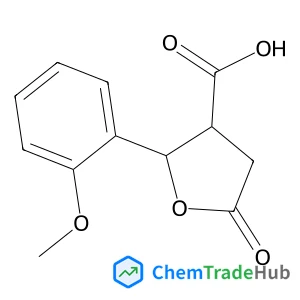
trans-2-(2-Methoxyphenyl)-5-oxotetrahydrofuran-3-carboxylic acid
CAS Number:
99226-02-5
Molecular Formula:
C12H12O5

Recommended Suppliers



Disclaimer
This page provides academic journal information for reference and research purposes only. We are not affiliated with any journal publishers and do not handle publication submissions. For publication-related inquiries, please contact the respective journal publishers directly.
If you notice any inaccuracies in the information displayed, please contact us at support@chemtradehub.com. We will promptly review and address your concerns.