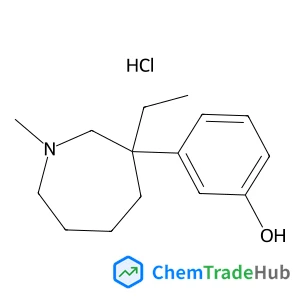
3-(3-Ethyl-1-methyl-3-azepanyl)phenol hydrochloride (1:1)
CAS Number:
59263-76-2
Molecular Formula:
C15H24ClNO
Vincent V. Duong, David Prendergast, Alexander L. Ayzner
Electron transfer is key to the operation of devices based on molecular (organic) semiconductors. Others have shown that electron transfer in the solid state often proceeds on sub-50 fs timescales, the details of which can be difficult to temporally resolve using pump–probe spectroscopy. A popular technique to measure average time scales for such rapid electron-transfer events is the core-hole clock implementation of resonant Auger electron spectroscopy at a single X-ray absorption edge. This is often done on relatively small molecules with core-excited states that are highly localized. We have used resonant Auger spectroscopy to probe sub-50 fs electron dynamics of two relatively large model organic semiconductors: Cu phthalocyanine (CuPc) along with its fluorinated analog, F16CuPc. We have interrogated electron dynamics simultaneously at N and C K-edges, along with calculations of initial and final states participating in the core-excited states. Our measurements show that the electron dynamics differ substantially across the two absorption edges for a given molecule, and that there are significant differences at a given edge between the two derivatives. X-ray spectroscopy calculations suggest that the extension of π-electron density onto peripheral F atoms in F16CuPc is implicated in the large change in ultrafast electron dynamics upon fluorination. We believe our results have important implications for analysis of core-hole clock measurements on relatively large organic semiconductors.
Ignacio Fdez. Galván, Daniel Roca-Sanjuán, Erick L. Bastos, Wilhelm J. Baader, Roland Lindh
DOI: 10.1039/C6CP08154A
DOI: 10.1039/C6CP07827C
K. E. A. Hooper, H. K. H. Lee, M. J. Newman, S. Meroni, J. Baker, T. M. Watson, W. C. Tsoi
DOI: 10.1039/C6CP05123E
Tao Cheng, William A Goddard, III, Qi An, Hai Xiao, Boris Merinov, Sergey Morozov
DOI: 10.1039/C6CP08055C
G. W. Driver, Y. Huang, A. Laaksonen, T. Sparrman, Y.-L. Wang, P.-O. Westlund
DOI: 10.1039/C6CP05801A
Minoru Otani
DOI: 10.1039/C6CP08466D
Alexandra R. McIsaac, David A. Mazziotti
DOI: 10.1039/C6CP07563K
When handling 4-(2-Furylmethyl)thiomorpholine 1,1-dioxide (CAS: 79206-94-3), it ...
When handling 4-Chloro-N-[2-(4-morpholinyl)ethyl]benzamide (CAS: 71320-77-9), it...
Waste containing this compound (CAS: 62921-74-8) should be handled according to ...
Waste containing (S)-Methyl 2-amino-3-cyclohexylpropanoate should be collected i...
This compound can be synthesized using a multi-step process involving the conjug...
There are several alternatives to (2E)-3-(3,4-Dichlorophenyl)acrylic acid in syn...
Ethyl 6-(2-nitrophenyl)imidazo[2,1-b][1,3]thiazole-3-carboxylate (CAS: 925437-84...
Waste containing 2-(1,3-Thiazol-2-yl)ethanamine (CAS: 18453-07-1) should be coll...
Methyl 5-iodo-2-methylbenzoate can be synthesized through the iodination of meth...
5-Chloro[1,2,4]triazolo[1,5-a]pyridine is commonly synthesized via the condensat...

Physical Chemistry Chemical Physics (PCCP) is an international journal co-owned by 19 physical chemistry and physics societies from around the world. This journal publishes original, cutting-edge research in physical chemistry, chemical physics and biophysical chemistry. To be suitable for publication in PCCP, articles must include significant innovation and/or insight into physical chemistry; this is the most important criterion that reviewers and Editors will judge against when evaluating submissions. The journal has a broad scope and welcomes contributions spanning experiment, theory, computation and data science. Topical coverage includes spectroscopy, dynamics, kinetics, statistical mechanics, thermodynamics, electrochemistry, catalysis, surface science, quantum mechanics, quantum computing and machine learning. Interdisciplinary research areas such as polymers and soft matter, materials, nanoscience, energy, surfaces/interfaces, and biophysical chemistry are welcomed if they demonstrate significant innovation and/or insight into physical chemistry. Joined experimental/theoretical studies are particularly appreciated when complementary and based on up-to-date approaches.