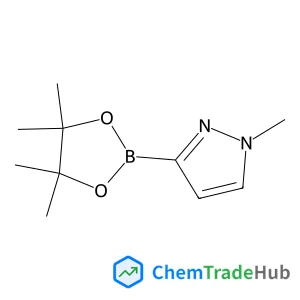
1-Methyl-3-(4,4,5,5-tetramethyl-1,3,2-dioxaborolan-2-yl)-1H-pyrazole
CAS Number:
1020174-04-2
Molecular Formula:
C10H17BN2O2
G. W. Driver, Y. Huang, A. Laaksonen, T. Sparrman, Y.-L. Wang, P.-O. Westlund
Proton/fluoride spin–lattice (T1) nuclear magnetic relaxation dispersion (NMRD) measurements of 1-butyl-3-methyl-1H-imidazolium hexafluorophosphate, [C4mim][PF6], have been carried out using high field spectrometers and a fast-field-cycling instrument at proton Larmor frequencies ranging from 10 kHz to 40 MHz, at different temperatures. The NMRD profiles are interpreted by means of a simple relaxation model based on the inter- and intra-ionic dipole–dipole relaxation mechanism. Using an atomic molecular-ion dynamic simulation at 323 K the relevant spin dipole–dipole (DD) correlation functions are calculated. The results indicate that the NMRD profiles can be rationalized using intra- and inter-ionic spin DD interactions, however, anions are mainly modulated by ionic reorientation because of temporary correlations with cations, where modulation by translational diffusion plays a minor role. Reorientational dynamics of charge-neutral ion couples (i.e. [C4mim]⋯[PF6]) and [C4mim]+ ions are in the nano-second (ns) time range whereas the reorientation of [PF6]− is characterized by a reorientational correlation time in the pico-second (ps) regime. Based on the NMRD profiles we conclude that the main relaxation mechanism for [PF6]− is due to fast internal reorientational motion, a partially averaged F–F intra- and F–H inter-ionic DD coupling as the anion resides in close proximity to its temporary oppositely charged cation partner. The F-T1-NMRD data display a ns dispersion which is interpreted as being due to correlated reorientational modulations resulting from the H-containing charge-neutral ion couple [C4mim]⋯[PF6]. The analysis of ionicity is based on the free anion fraction, f, and it increases with temperature with f → 1 at the highest temperatures investigated. The fraction is obtained from the H–F NMRD profiles as correlated–non-correlated dynamics of the ions. The analysis of T1 relaxation rates of C, H, F and P at high fields cannot generally give the fraction of ions but is consistent with the interpretation based on the NMRD profiles with relaxation contributions due to DD-intra and -inter, CSA-intra (and -inter for C), including spin rotation for P. The investigation has led to a description of the mechanics governing ion transport in the title ionic liquid via identification of transient correlated/non-correlated ion dynamics.
DOI: 10.1039/D1PY90044G
Marcel Fickenscher, Tom Reimers, Holger Frey
DOI: 10.1039/D1PY00302J
Jiaxin Shi, Tianze Zheng, Yao Zhang, Baohua Guo, Jun Xu
DOI: 10.1039/D1PY00157D
Vajk Farkas, Gábor Turczel, János Deme, László Trif, Anvar Mirzaei, Dang Vu Hai, Sándor Kéki, Péter Huszthy, Róbert Tuba
DOI: 10.1039/D1PY00194A
Junle Zhang, Mengya Li, Yanjie He, Xiaomeng Zhang, Zhe Cui, Peng Fu, Minying Liu, Xiaoguang Qiao, Qingxiang Zhao, Xinchang Pang
DOI: 10.1039/D1PY00088H
Matilde Concilio, Nga Nguyen, C. Remzi Becer
DOI: 10.1039/D1PY00534K
Xabier Lopez de Pariza, Nicolas Zivic, Fernando Ruipérez, Timothy E. Long, Haritz Sardon
DOI: 10.1039/D1PY00734C
When handling 4-(2-Furylmethyl)thiomorpholine 1,1-dioxide (CAS: 79206-94-3), it ...
When handling 4-Chloro-N-[2-(4-morpholinyl)ethyl]benzamide (CAS: 71320-77-9), it...
Waste containing this compound (CAS: 62921-74-8) should be handled according to ...
Waste containing (S)-Methyl 2-amino-3-cyclohexylpropanoate should be collected i...
This compound can be synthesized using a multi-step process involving the conjug...
There are several alternatives to (2E)-3-(3,4-Dichlorophenyl)acrylic acid in syn...
Ethyl 6-(2-nitrophenyl)imidazo[2,1-b][1,3]thiazole-3-carboxylate (CAS: 925437-84...
Waste containing 2-(1,3-Thiazol-2-yl)ethanamine (CAS: 18453-07-1) should be coll...
Methyl 5-iodo-2-methylbenzoate can be synthesized through the iodination of meth...
5-Chloro[1,2,4]triazolo[1,5-a]pyridine is commonly synthesized via the condensat...

Physical Chemistry Chemical Physics (PCCP) is an international journal co-owned by 19 physical chemistry and physics societies from around the world. This journal publishes original, cutting-edge research in physical chemistry, chemical physics and biophysical chemistry. To be suitable for publication in PCCP, articles must include significant innovation and/or insight into physical chemistry; this is the most important criterion that reviewers and Editors will judge against when evaluating submissions. The journal has a broad scope and welcomes contributions spanning experiment, theory, computation and data science. Topical coverage includes spectroscopy, dynamics, kinetics, statistical mechanics, thermodynamics, electrochemistry, catalysis, surface science, quantum mechanics, quantum computing and machine learning. Interdisciplinary research areas such as polymers and soft matter, materials, nanoscience, energy, surfaces/interfaces, and biophysical chemistry are welcomed if they demonstrate significant innovation and/or insight into physical chemistry. Joined experimental/theoretical studies are particularly appreciated when complementary and based on up-to-date approaches.