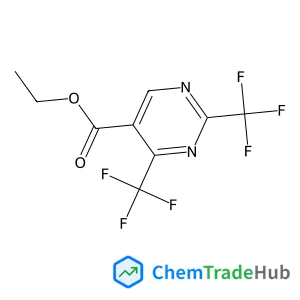
Ethyl 2,4-bis(trifluoromethyl)-5-pyrimidinecarboxylate
CAS Number:
188781-15-9
Molecular Formula:
C9H6F6N2O2
Qianli Wang, Jie Xue, Zhongwu Guo
An efficient synthesis of a derivative of monophosphoryl lipid A suitable for coupling to various structures for the construction of glycoconjugate vaccines and its conjugation with an N-modified form of the tumor-associated antigen GM3 is presented.
Xiaotian Ji, Li Liu
DOI: 10.1039/C7PY00315C
K. Mathieu, J. De Winter, C. Jérôme, A. Debuigne
DOI: 10.1039/C7PY00128B
Nafeesa Mushtaq, Guofei Chen, Lala Rukh Sidra, Yang Liu, Xingzhong Fang
DOI: 10.1039/C6PY01705C
Yanan Zhang, Yifei Zhao, Shaobo Tan, Zhicheng Zhang
DOI: 10.1039/C6PY02119K
Yang Xu, Tianqi Wang, Zidong He, Aiqing Zhong, Wei Yu, Buyin Shi, Kun Huang
DOI: 10.1039/C6PY01706A
Qimin Jiang, Jiating Li, Wenyan Huang, Dongliang Zhang, Jianhai Chen, Hongjun Yang, Xiaoqiang Xue, Bibiao Jiang
DOI: 10.1039/C7PY00844A
Jan K. Szymański
DOI: 10.1039/C6PY01497F
Kilwon Cho
DOI: 10.1039/C7PY00484B
When handling lithium chloride hydrate (1:1:1) (CAS: 16712-20-2), it is importan...
4-(4H-1,2,4-Triazol-4-yl)piperidine is generally considered safe for use in phar...
Waste containing 1,3-Thiazole-2-carboxamide (CAS: 16733-85-0) should be collecte...
5-(Difluoromethyl)-2-fluorobenzonitrile (CAS: 934175-58-3) is subject to regulat...
Methyl 3-acetamido-2-thiophenecarboxylate can be synthesized by the reaction of ...
4-Isoquinolinecarbonitrile is a chemical compound with the CAS number 34846-65-6...
Store Methyl 1H-1,2,3-triazole-4-carboxylate (CAS: 877309-59-6) in a cool, dry p...
6-Bromo[1,3]thiazolo[5,4-b]pyridin-2-amine (CAS: 1160791-13-8) is subject to the...
(2S,3S)-2-Ammonio-3-(3,4-dihydroxyphenyl)-3-hydroxypropanoate (CAS: 23651-95-8) ...
7-Bromo-3-methyl-3,4-dihydroquinazolin-4-one is a solid with a crystalline form....

ChemComm publishes urgent research which is of outstanding significance and interest to experts in the field, while also appealing to the journal’s broad chemistry readership. Our communication format is ideally suited to short, urgent studies that are of such importance that they require accelerated publication. Our scope covers all topics in chemistry, and research at the interface of chemistry and other disciplines (such as materials science, nanoscience, physics, engineering and biology) where there is a significant novelty in the chemistry aspects. Major topic areas covered include: Analytical Chemistry Catalysis Chemical Biology and medicinal chemistry Computational Chemistry and Machine Learning Energy and sustainable chemistry Environmental Chemistry Green Chemistry Inorganic Chemistry Materials Chemistry Nanoscience Organic Chemistry Physical Chemistry Polymer Chemistry Supramolecular Chemistry
![8-Bromo-6-fluoro[1,2,4]triazolo[1,5-a]pyridin-2-amine structure](https://static.chemtradehub.com/structs/125/1257705-51-3-9f4a.webp "8-Bromo-6-fluoro[1,2,4]triazolo[1,5-a]pyridin-2-amine structure")