












A DFT study on Zr-SBA-15 catalyzed conversion of ethanol to 1,3-butadiene
Literature Information
Publication Date
2018-04-09
DOI
10.1039/C7CP08620B
Impact Factor
3.676
Authors
View Original
Abstract
Density functional theory (DFT) calculations have been used to elucidate the influence of the surface properties of Zr-SBA-15 on the conversion of ethanol to 1,3-butadiene at the molecular level. To identify the critical reactive intermediates of ethanol catalysis to catalytically form 1,3-butadiene on the Zr-SBA-15 surface, the model of Zr-SBA-15 was first built. The overall enthalpy energy surface was explored for the highly-debated reaction mechanisms, including Toussaint's aldol condensation mechanism and Fripiat's Prins mechanism. It was found that ethanol dehydration to form ethylene possessed a lower energy barrier than dehydrogenation to yield acetaldehyde, which means they are competing reactive pathways. C–C bond coupling to form acetaldol (3-hydroxybutanal) proceeds with a 2.15 eV forward reaction barrier. Direct reaction of ethylene and acetaldehyde proceeds with a free energy barrier of 2.90 eV suggesting that Prins condensation hardly occurs. The results here provide a first glimpse into the overall mechanism of 1,3-butadiene formation on Zr-SBA-15 reactive sites in light of the variety of proposed mechanistic pathways mostly based on conventional homogenous organic chemistry reactions.
Related Literature
Thermal equilibration between excited states or solvent effects: unveiling the origins of anomalous emissions in heteroleptic Ru(ii) complexes
Denis Jacquemin, Daniel Escudero
2018-04-04
Communication
DOI: 10.1039/C8CP01101J
The gelation influence on diffusion and conductivity enhancement effect in renewable ionic gels based on a LMWG
M. Bielejewski, A. Rachocki, J. Kaszyńska, J. Tritt-Goc
2018-01-24
Paper
DOI: 10.1039/C7CP07740H
Thermoelectric properties of Ag-doped CuS nanocomposites synthesized by a facile polyol method
Tarachand, S. Hussain, N. P. Lalla, Y.-K. Kuo, A. Lakhani, V. G. Sathe, U. Deshpande, G. S. Okram
2018-01-25
Paper
DOI: 10.1039/C7CP07986A
2-Chloromalonaldehyde, a model system of resonance-assisted hydrogen bonding: vibrational investigation
Michèle Chevalier, Justinas Ceponkus, Germán A. Rojas-Lorenzo, Claudine Crépin
2018-04-16
Paper
DOI: 10.1039/C7CP06481K
Facile preparation of a nano-imprinted polymer on magnetite nanoparticles for the rapid separation of lead ions from aqueous solution
Delong Kong, Ning Qiao, Nian Wang, Zhuo Wang, Qi Wang, Zhiyong Zhou, Zhongqi Ren
2018-04-19
Paper
DOI: 10.1039/C8CP01163J
Size-dependent magnetic and inductive heating properties of Fe3O4 nanoparticles: scaling laws across the superparamagnetic size
Jeotikanta Mohapatra, Fanhao Zeng, Kevin Elkins, Meiying Xing, Madhav Ghimire, Sunghyun Yoon, Sanjay R. Mishra, J. Ping Liu
2018-04-06
Paper
DOI: 10.1039/C7CP08631H
Mediating both valence and conduction bands of TiO2 by anionic dopants for visible- and infrared-light photocatalysis
Tingwei Chen, Guokui Liu, Fan Jin, Min Wei, Jin Feng, Yuchen Ma
2018-04-04
Paper
DOI: 10.1039/C8CP00895G
Real time monitoring of the minute dynamic variation at the crude oil–water interface
Ziling Ding, Yan Xiong
2018-01-26
Paper
DOI: 10.1039/C7CP07491C
You might also like
Compound Q&A
What are the main uses of 1-(3-Aminophenyl)-3-[(3R)-1-(3,3-dimethyl-2-oxobutyl)-2-oxo-5-(2-pyridinyl)-2,3-dihydro-1H-1,4-benzodiazepin-3-yl]urea (CAS: 155412-88-7)?
This compound is mainly used as an intermediate in the synthesis of antipsychoti...
155412-88-71-(3-Aminophenyl)-3-...
Compound Q&A
How should waste containing 1-(D-Ribofuranosyl)-1,4-dihydro-3-pyridinecarboxamide (CAS: 19132-12-8) be handled?
Waste containing 1-(D-Ribofuranosyl)-1,4-dihydro-3-pyridinecarboxamide (CAS: 191...
19132-12-81-(D-Ribofuranosyl)-...
Compound Q&A
What regulatory guidelines apply to 2-Methyl-2-propanyl 3-bromo-3-(hydroxymethyl)-1-azetidinecarboxylate (CAS: 2007919-81-3)?
2-Methyl-2-propanyl 3-bromo-3-(hydroxymethyl)-1-azetidinecarboxylate (CAS: 20079...
2007919-81-32-Methyl-2-propanyl ...
Compound Q&A
What is N-(4-Chloro-2-pyridinyl)acetamide (CAS: 245056-66-0)?
N-(4-Chloro-2-pyridinyl)acetamide (CAS: 245056-66-0) is a chemical compound with...
245056-66-0N-(4-Chloro-2-pyridi...
Compound Q&A
What is 5-Chloro-2-hydroxybenzoic acid (CAS: 321-14-2)?
5-Chloro-2-hydroxybenzoic acid, also known as 5-chlorosalicylic acid, is an arom...
321-14-25-Chloro-2-hydroxybe...
Compound Q&A
What precautions should be taken when handling 1,1-Dichloro-1-fluoroethane (CAS: 1717-00-6)?
When handling 1,1-Dichloro-1-fluoroethane (CAS: 1717-00-6), it is important to u...
1717-00-61,1-Dichloro-1-fluor...
Compound Q&A
What are the physical and chemical properties of Fmoc-(2S,3R)-3-phenylpyrrolidine-2-carboxylic acid (CAS: 281655-32-1)?
Fmoc-(2S,3R)-3-phenylpyrrolidine-2-carboxylic acid is a white crystalline solid ...
281655-32-1Fmoc-(2S,3R)-3-pheny...
Compound Q&A
What are the main uses of 4-Amino-5-bromo-2-pyridinecarboxylic acid (CAS: 1363381-01-4)?
4-Amino-5-bromo-2-pyridinecarboxylic acid is primarily used as a precursor in th...
1363381-01-44-Amino-5-bromo-2-py...
Compound Q&A
What precautions should be taken when handling (S)-tert-butyl 2-((2-(4-bromophenyl)-2-oxoethyl)carbamoyl)pyrrolidine-1-carboxylate (CAS: 1007881-98-2)?
Handling this compound should be done with personal protective equipment (PPE) i...
1007881-98-2(S)-tert-butyl 2-((2...
Compound Q&A
What precautions should be taken when handling 8-bromo-2,2-dimethyl-3,4-dihydro-2H-1,4-benzoxazin-3-one (CAS: 688363-73-7)?
When handling 8-bromo-2,2-dimethyl-3,4-dihydro-2H-1,4-benzoxazin-3-one, use prop...
688363-73-78-bromo-2,2-dimethyl...
Source Journal
Physical Chemistry Chemical Physics

CiteScore:
5.5
Self-citation Rate:
10.3%
Articles per Year:
3036
Physical Chemistry Chemical Physics (PCCP) is an international journal co-owned by 19 physical chemistry and physics societies from around the world. This journal publishes original, cutting-edge research in physical chemistry, chemical physics and biophysical chemistry. To be suitable for publication in PCCP, articles must include significant innovation and/or insight into physical chemistry; this is the most important criterion that reviewers and Editors will judge against when evaluating submissions. The journal has a broad scope and welcomes contributions spanning experiment, theory, computation and data science. Topical coverage includes spectroscopy, dynamics, kinetics, statistical mechanics, thermodynamics, electrochemistry, catalysis, surface science, quantum mechanics, quantum computing and machine learning. Interdisciplinary research areas such as polymers and soft matter, materials, nanoscience, energy, surfaces/interfaces, and biophysical chemistry are welcomed if they demonstrate significant innovation and/or insight into physical chemistry. Joined experimental/theoretical studies are particularly appreciated when complementary and based on up-to-date approaches.
Recommended Compounds
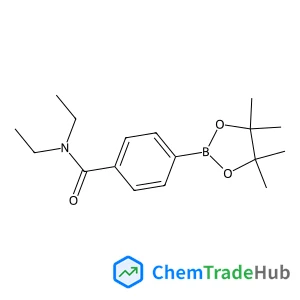
N,N-Diethyl-4-(4,4,5,5-tetramethyl-1,3,2-dioxaborolan-2-yl)benzamide
CAS Number:
325142-99-2
Molecular Formula:
C17H26BNO3
Recommended Suppliers






Disclaimer
This page provides academic journal information for reference and research purposes only. We are not affiliated with any journal publishers and do not handle publication submissions. For publication-related inquiries, please contact the respective journal publishers directly.
If you notice any inaccuracies in the information displayed, please contact us at support@chemtradehub.com. We will promptly review and address your concerns.