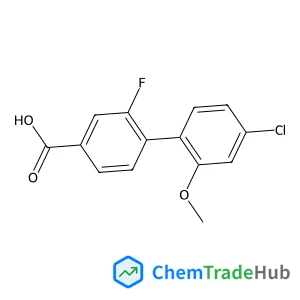
4-(4-Chloro-2-methoxyphenyl)-3-fluorobenzoic acid
CAS Number:
1261970-23-3
Molecular Formula:
C14H10ClFO3
James A. Green, Roberto Improta
We compute at the anharmonic level the vibrational spectra of the Watson–Crick dimer formed by guanosine (G) and cytidine (C) in chloroform, together with those of G, C and the most populated GG dimer. The spectra for deuterated and partially deuterated GC are also computed. We use DFT calculations, with B3LYP and CAM-B3LYP as reference functionals. Solvent effects from chloroform are included via the Polarizable Continuum Model (PCM), and by performing tests on models including up two chloroform molecules. Both B3LYP and CAM-B3LYP calculations reproduce the shape of the experimental spectra well in the fingerprint region (1500–1700 cm−1) and in the N–H stretching region (2800–3600 cm−1), with B3LYP providing better quantitative agreement with experiments. According to our calculations, the N–H amido streching mode of G falls at ∼2900 cm−1, while the N–H amino of G and C falls at ∼3100 cm−1 when hydrogen-bonded, or ∼3500 cm−1 when free. Overtone and combination bands strongly contribute to the absorption band at ∼3300 cm−1. Inclusion of bulk solvent effects significantly increases the accuracy of the computed spectra, while solute–solvent interactions have a smaller, though still noticeable, effect. Some key aspects of the anharmonic treatment of strongly vibrationally coupled supermolecular systems and the related methodological issues are also discussed.
Kyriaki Koupepidou, Andrey A. Bezrukov, Dominic C. Castell, Debobroto Sensharma, Soumya Mukherjee, Michael J. Zaworotko
DOI: 10.1039/D3CC04109C
Mengnan Yang, Yao Zhang, Shiyan Ji, Huafeng Li, Xinyi Ma, Yuzhen Jin, Pengtao Ma, Jingping Wang, Jingyang Niu
DOI: 10.1039/D3CC04517J
Anna A. Wilson, Lucy Hart, Thomas Shalvey, Michael Sachs, Weidong Xu, Benjamin Moss, Eva Mazzolini, Asim Mumtaz
DOI: 10.1039/D3CC04616H
Shengsheng Yu, Rong-Xin Zhu, Kai-Kai Niu, Ning Han, Hui Liu, Ling-Bao Xing
DOI: 10.1039/D3SC05820D
Jeffrey S. S. K. Formen, Diandra S. Hassan, Christian Wolf
DOI: 10.1039/D3SC05706B
Huilin Zhan, Bin Chen, Biao Zhu, Xiang Li, Zhengyu Han, Jianwei Sun, Hai Huang
DOI: 10.1039/D3CC04475K
Sreelakshmi Radhakrishnan, Samir Nandi
DOI: 10.1039/D3CC04039A
Yuxuan Liang, Meijia Qiu, Peng Sun, Wenjie Mai
DOI: 10.1039/D3SC05334B
(5-Sulfamoyl-3-pyridinyl)boronic acid is primarily used in chemical synthesis, p...
Benzyl 2-methyl-2-(methylsulfonyl)-4-pentenoate is typically synthesized via est...
When handling 8-Fluoroquinolin-6-ol (CAS: 209353-22-0), it is important to use p...
1,3-Dibromo-5-(2-methyl-2-propanyl)benzene (CAS: 129316-09-2) is a crystalline c...
Ethyl 7-chloro-4-oxo-1-(1,3-thiazol-2-yl)-1,4-dihydro-1,8-naphthyridine-3-carbox...
When handling Delta-7-Avenasterol (CAS: 23290-26-8), it is important to wear app...
Proper handling involves the use of personal protective equipment such as gloves...
When handling 2-Methyl-2-proanyl 4-[(2-aminophenyl)amino]-1-piperidinecarboxylat...
N-Methyl-4-chlorobenzylamine hydrochloride (CAS: 65542-24-7) is a organic compou...
[2-(Dodecyloxy)ethoxy]acetic acid (CAS: 27306-90-7) is generally considered safe...

Physical Chemistry Chemical Physics (PCCP) is an international journal co-owned by 19 physical chemistry and physics societies from around the world. This journal publishes original, cutting-edge research in physical chemistry, chemical physics and biophysical chemistry. To be suitable for publication in PCCP, articles must include significant innovation and/or insight into physical chemistry; this is the most important criterion that reviewers and Editors will judge against when evaluating submissions. The journal has a broad scope and welcomes contributions spanning experiment, theory, computation and data science. Topical coverage includes spectroscopy, dynamics, kinetics, statistical mechanics, thermodynamics, electrochemistry, catalysis, surface science, quantum mechanics, quantum computing and machine learning. Interdisciplinary research areas such as polymers and soft matter, materials, nanoscience, energy, surfaces/interfaces, and biophysical chemistry are welcomed if they demonstrate significant innovation and/or insight into physical chemistry. Joined experimental/theoretical studies are particularly appreciated when complementary and based on up-to-date approaches.
![2-Azaspiro[4.5]decane-3,8-dione structure](https://static.chemtradehub.com/structs/914/914780-96-4-e94b.webp "2-Azaspiro[4.5]decane-3,8-dione structure")