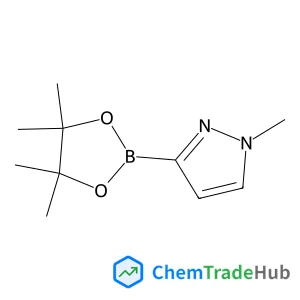
1-Methyl-3-(4,4,5,5-tetramethyl-1,3,2-dioxaborolan-2-yl)-1H-pyrazole
CAS Number:
1020174-04-2
Molecular Formula:
C10H17BN2O2
Dipanjan Mukherjee, Priya Singh, Tatini Rakshit, Theja P. Puthiya-Purayil, Praveen Kumar Vemula, Jhimli Sengupta, Ranjan Das, Samir Kumar Pal
Cationic liposomes, a type of non-viral vectors, often play the important biological function of delivering nucleic acids during cell transfection. Variations in the molecular architecture of di-alkyl dihydroxy ethyl ammonium chloride-based cationic lipids involving hydrophobic tails have been found to influence their biological function in terms of cell transfection efficiency. For example, liposomes based on a cationic lipid (Lip1814) with asymmetry in the hydrophobic chains were found to display higher transfection efficacy in cultured mammalian cell lines than those comprising of symmetric Lip1818 or asymmetric Lip1810. The effect of variations in the molecular architecture of the cationic lipids on the biological activity of liposomes has been explored here via the photophysical studies of 8-anilino-1-naphthalenesulphonate (ANS) and Nile Red (NR) in three cationic liposomes, namely Lip1810, Lip1814 and Lip1818. Time-resolved fluorescence of ANS revealed reduced hydration at the lipid–water interface and enhanced relaxation dynamics of surface water (lipid headgroup bound water molecules) in Lip1810- and Lip1814-based liposomes in the presence of cholesterol. As the probe ANS failed to be incorporated into the lipid–water interface of Lip1818 due to the significantly high rigidity of these liposomes, no information concerning the extent of hydration of the lipid–water interface or the interfacial water dynamics could be obtained. Time-resolved polarization-gated anisotropy measurements of NR in the presence of cholesterol revealed the rigidity of the cationic liposomes to be increasing in the order of Lip1810 < Lip1814 < Lip1818. In the presence of cholesterol, moderately higher rigidity, reduced membrane hydration and enhanced relaxation dynamics of the interfacial water molecules gave rise to the superior cell transfection efficacy of Lip1814-based cationic liposomes than those of the highly flexible Lip1810 or the highly rigid Lip1818.
Ignacio Fdez. Galván, Daniel Roca-Sanjuán, Erick L. Bastos, Wilhelm J. Baader, Roland Lindh
DOI: 10.1039/C6CP08154A
Hua-Bin Sun, Ying-Xian Zhou, Lu-Lu Zhang, Xue-Lin Yang, Xing-Zhong Cao, Hanu Arave, Hui Fang, Gan Liang
DOI: 10.1039/C6CP07760A
Minoru Otani
DOI: 10.1039/C6CP08466D
Junghyun Choi, Pitchaimuthu Sudhagar, Joo Hyun Kim, Jiseok Kwon, Jeonghyun Kim, Chiaki Terashima, Akira Fujishima, Taeseup Song, Ungyu Paik
DOI: 10.1039/C6CP08199A
Teng Fang, Shuqi Zheng, Tian Zhou, Lei Yan, Peng Zhang
DOI: 10.1039/C6CP07897D
Xiaojun Wu, Jinlong Yang
DOI: 10.1039/C6CP07402B
Elijah G. Schnitzler, Nathan A. Seifert, Supriya Ghosh, Javix Thomas, Yunjie Xu, Wolfgang Jäger
DOI: 10.1039/C6CP08741H
Weizhao Cai, Rong Zhang, Shanti Deemyad
DOI: 10.1039/C6CP08171A
Ryansu Sai, Kazuhide Ueno, Kenta Fujii, Yohei Nakano, Naho Shigaki, Hiromori Tsutsumi
DOI: 10.1039/C6CP08386B
When handling 4-(2-Furylmethyl)thiomorpholine 1,1-dioxide (CAS: 79206-94-3), it ...
When handling 4-Chloro-N-[2-(4-morpholinyl)ethyl]benzamide (CAS: 71320-77-9), it...
Waste containing this compound (CAS: 62921-74-8) should be handled according to ...
Waste containing (S)-Methyl 2-amino-3-cyclohexylpropanoate should be collected i...
This compound can be synthesized using a multi-step process involving the conjug...
There are several alternatives to (2E)-3-(3,4-Dichlorophenyl)acrylic acid in syn...
Ethyl 6-(2-nitrophenyl)imidazo[2,1-b][1,3]thiazole-3-carboxylate (CAS: 925437-84...
Waste containing 2-(1,3-Thiazol-2-yl)ethanamine (CAS: 18453-07-1) should be coll...
Methyl 5-iodo-2-methylbenzoate can be synthesized through the iodination of meth...
5-Chloro[1,2,4]triazolo[1,5-a]pyridine is commonly synthesized via the condensat...

Physical Chemistry Chemical Physics (PCCP) is an international journal co-owned by 19 physical chemistry and physics societies from around the world. This journal publishes original, cutting-edge research in physical chemistry, chemical physics and biophysical chemistry. To be suitable for publication in PCCP, articles must include significant innovation and/or insight into physical chemistry; this is the most important criterion that reviewers and Editors will judge against when evaluating submissions. The journal has a broad scope and welcomes contributions spanning experiment, theory, computation and data science. Topical coverage includes spectroscopy, dynamics, kinetics, statistical mechanics, thermodynamics, electrochemistry, catalysis, surface science, quantum mechanics, quantum computing and machine learning. Interdisciplinary research areas such as polymers and soft matter, materials, nanoscience, energy, surfaces/interfaces, and biophysical chemistry are welcomed if they demonstrate significant innovation and/or insight into physical chemistry. Joined experimental/theoretical studies are particularly appreciated when complementary and based on up-to-date approaches.
![N-[(Benzyloxy)carbonyl]serine structure](https://static.chemtradehub.com/structs/276/2768-56-1-77f7.webp "N-[(Benzyloxy)carbonyl]serine structure")
![1-Naphthalenesulfonic acid, 2-[(2-hydroxy-1-naphthalenyl)azo]-, bariumsalt (2:1) structure](https://static.chemtradehub.com/structs/110/1103-38-4-0b33.webp "1-Naphthalenesulfonic acid, 2-[(2-hydroxy-1-naphthalenyl)azo]-, bariumsalt (2:1) structure")