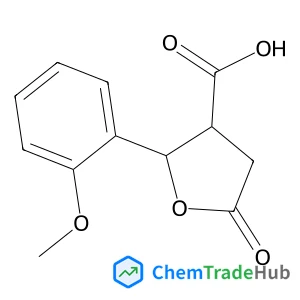
trans-2-(2-Methoxyphenyl)-5-oxotetrahydrofuran-3-carboxylic acid
CAS Number:
99226-02-5
Molecular Formula:
C12H12O5
Martin A. Schroer, Verena Markmann, Johannes Möller
Colloidal nanocrystals (NC) are known to self-organize into superlattices that promise many applications ranging from medicine to optoelectronics. Recently, the formation of high-quality PEGylated gold NC was reported at high hydrostatic pressure and high salt concentrations. Here, we study the formation kinetics of these superlattices after pressure jumps beyond their crystallisation pressure by means of small-angle X-ray scattering with few ms experimental resolution. The timescale of NC formation was found to be reduced the larger the width of the pressure jump. This is connected to an increase of crystal quality, i.e., the faster the NC superlattice forms, the better the crystal quality. In contrast to the formation kinetics, the melting of the NC superlattice is approximately one order of magnitude slower and shows linear kinetics.

Chemistry Education Research and Practice

Russian Journal of General Chemistry

Journal of Natural Medicines

Journal of Saudi Chemical Society

Saudi Pharmaceutical Journal

Current Opinion in Solid State & Materials Science

Russian Chemical Bulletin

Russian Journal of Organic Chemistry

Russian Journal of Bioorganic Chemistry

Nature Medicine
S. Ali, V. S. Myasnichenko, E. C. Neyts
DOI: 10.1039/C5CP06153A
Annalisa Dalzini, Fernando Formaggio, Claudio Toniolo, Marina Gobbo, Anna Lisa Maniero
DOI: 10.1039/C5CP04136H
Min-Sik Park, Jeonghun Kim, Ki Jae Kim, Jong-Won Lee, Jung Ho Kim
DOI: 10.1039/C5CP05936D
F. Pedraza, S. A. Mahadik, B. Bouchaud
DOI: 10.1039/C5CP04723D
Robert S. Weatherup
DOI: 10.1039/C5CP04058B
Marc Nadal-Ferret, Ricard Gelabert, Miquel Moreno
DOI: 10.1039/C5CP01067E
Tianran Chen, Benjamin J. Foley, Madhusudan Tyagi, John R. D. Copley, Joshua J. Choi, Seung-Hun Lee
DOI: 10.1039/C5CP05348J
Ananda K. Ghosh, Zahidul Islam, Jonathan Krueger, Thelma Abeysinghe, Amnon Kohen
DOI: 10.1039/C5CP01246E
6-(3-Fluorophenyl)picolinic acid is generally considered safe for laboratory use...
(3R)-3-Pyrrolidinol is used in the pharmaceutical industry as a precursor for dr...
When handling (4R,5R)-4,5-Diethoxycarbonyl-2,2-dimethyldioxolane (CAS: 59779-75-...
1-(6-Chloroimidazo[1,2-b]pyridazin-3-yl)ethanone is often synthesized via a mult...
The market for N-Ethyl-3,4-dimethylbenzylamine (CAS: 39180-83-1) remains steady,...
Tert-butyl 3-(pyrrolidin-1-yl)azetidine-1-carboxylate is a chemical compound wit...
1-Bromo-3-chloro-2,4-dimethoxybenzene (CAS: 1228956-93-1) falls under the classi...
The safety of 8-Bromo-2-methyl-3,4-dihydroisoquinolin-1(2H)-one (CAS: 1368622-07...
Benzyl [(3S)-2,6-dioxo-3-piperidinyl]carbamate is generally safe when handled wi...
1-{[4-(4,4,5,5-Tetramethyl-1,3,2-dioxaborolan-2-yl)phenyl]sulfonyl}pyrrolidine s...

Physical Chemistry Chemical Physics (PCCP) is an international journal co-owned by 19 physical chemistry and physics societies from around the world. This journal publishes original, cutting-edge research in physical chemistry, chemical physics and biophysical chemistry. To be suitable for publication in PCCP, articles must include significant innovation and/or insight into physical chemistry; this is the most important criterion that reviewers and Editors will judge against when evaluating submissions. The journal has a broad scope and welcomes contributions spanning experiment, theory, computation and data science. Topical coverage includes spectroscopy, dynamics, kinetics, statistical mechanics, thermodynamics, electrochemistry, catalysis, surface science, quantum mechanics, quantum computing and machine learning. Interdisciplinary research areas such as polymers and soft matter, materials, nanoscience, energy, surfaces/interfaces, and biophysical chemistry are welcomed if they demonstrate significant innovation and/or insight into physical chemistry. Joined experimental/theoretical studies are particularly appreciated when complementary and based on up-to-date approaches.