


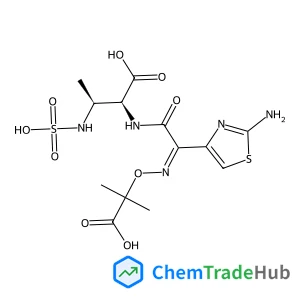
Aztreonam USP Related Compound A (Open-ring Aztreonam)
CAS Number:
87500-74-1
Molecular Formula:
C13H19N5O9S2
Kiki Adi Kurnia, Ana M. Fernandes, João A. P. Coutinho
Recently, combinations of two (or more) ionic liquids, known as ionic liquid mixtures, have become popular and have a broad range of applications. However, the fundamental knowledge on the molecular interactions that exist in ionic liquid mixtures is far from being understood. In this work, the experimental measurement of the water activity coefficient and computational modelling using Conductor-like Screening Model for Real Solvent (COSMO-RS) were carried out to get an insight into the molecular interactions that are present in ionic liquid mixtures in aqueous solution. The results show that the combination of two ionic liquids of different basicity in aqueous solution allows fine tuning of the water activities, covering a wide range of values that could replace several pure fluids. This is an important feature resulting from the unexpected ion speciation of the ionic liquid mixtures in aqueous solution.

Chemical Communications

Russian Journal of General Chemistry

Russian Journal of Bioorganic Chemistry

Saudi Pharmaceutical Journal

Journal of Peptide Science

Current Opinion in Solid State & Materials Science

Russian Journal of Applied Chemistry

Russian Chemical Bulletin

Journal of Natural Medicines

Journal of Saudi Chemical Society
David Zanuy, Jordi Poater, Miquel Solà, Ian W. Hamley
DOI: 10.1039/C5CP04269K
O. Deparis, S. R. Mouchet, B.-L. Su
DOI: 10.1039/C5CP04983K
Chenyu Zou, Sumathy Raman
DOI: 10.1039/C5CP06108C
Linqi Shi, Jiabao Cui, Fei Zhao, Dejun Wang, Tengfeng Xie, Yanhong Lin
DOI: 10.1039/C5CP05935F
Jun Ma, Xizi Cao, Xiaopeng Xing, Xuefeng Wang, Joel H. Parks
DOI: 10.1039/C5CP06116D
Silvia Carlotto, Mauro Sambi, Andrea Vittadini
DOI: 10.1039/C5CP06844D
Pengfei Huo, Thomas F. Miller III
DOI: 10.1039/C5CP02517F
Anne Knorr, Koichi Fumino, Anne-Marie Bonsa
DOI: 10.1039/C5CP03412D
Annalisa Dalzini, Fernando Formaggio, Claudio Toniolo, Marina Gobbo, Anna Lisa Maniero
DOI: 10.1039/C5CP04136H
6-(3-Fluorophenyl)picolinic acid is generally considered safe for laboratory use...
(3R)-3-Pyrrolidinol is used in the pharmaceutical industry as a precursor for dr...
When handling (4R,5R)-4,5-Diethoxycarbonyl-2,2-dimethyldioxolane (CAS: 59779-75-...
1-(6-Chloroimidazo[1,2-b]pyridazin-3-yl)ethanone is often synthesized via a mult...
The market for N-Ethyl-3,4-dimethylbenzylamine (CAS: 39180-83-1) remains steady,...
Tert-butyl 3-(pyrrolidin-1-yl)azetidine-1-carboxylate is a chemical compound wit...
1-Bromo-3-chloro-2,4-dimethoxybenzene (CAS: 1228956-93-1) falls under the classi...
The safety of 8-Bromo-2-methyl-3,4-dihydroisoquinolin-1(2H)-one (CAS: 1368622-07...
Benzyl [(3S)-2,6-dioxo-3-piperidinyl]carbamate is generally safe when handled wi...
1-{[4-(4,4,5,5-Tetramethyl-1,3,2-dioxaborolan-2-yl)phenyl]sulfonyl}pyrrolidine s...

Physical Chemistry Chemical Physics (PCCP) is an international journal co-owned by 19 physical chemistry and physics societies from around the world. This journal publishes original, cutting-edge research in physical chemistry, chemical physics and biophysical chemistry. To be suitable for publication in PCCP, articles must include significant innovation and/or insight into physical chemistry; this is the most important criterion that reviewers and Editors will judge against when evaluating submissions. The journal has a broad scope and welcomes contributions spanning experiment, theory, computation and data science. Topical coverage includes spectroscopy, dynamics, kinetics, statistical mechanics, thermodynamics, electrochemistry, catalysis, surface science, quantum mechanics, quantum computing and machine learning. Interdisciplinary research areas such as polymers and soft matter, materials, nanoscience, energy, surfaces/interfaces, and biophysical chemistry are welcomed if they demonstrate significant innovation and/or insight into physical chemistry. Joined experimental/theoretical studies are particularly appreciated when complementary and based on up-to-date approaches.
![4-[(2,4-Dihydroxyphenyl)diazenyl]-5-hydroxy-2,7-naphthalenedisulfonic acid structure](https://static.chemtradehub.com/structs/362/3627-01-8-79ac.webp "4-[(2,4-Dihydroxyphenyl)diazenyl]-5-hydroxy-2,7-naphthalenedisulfonic acid structure")



