



Nitrogen-doped graphene/graphitic carbon nitride with enhanced charge separation and two-electron-transferring reaction activity for boosting photocatalytic hydrogen peroxide production
Literature Information
Publication Date
2021-02-03
DOI
10.1039/D0SE01828G
Impact Factor
6.367
Authors
Muye Liu, Yue Wen, Luhua Lu, Ying Chen, Xiaocong Tian, Hongyun Jin, Jinghai Liu, Kai Dai
View Original
Abstract
Strong photo-generated charge recombination within graphitic carbon nitride and the lack of suitable co-catalysts with selective high catalytic reaction activity have hindered the effective photocatalytic hydrogen peroxide production. In this work, a series of 2D co-catalyst nitrogen-doped graphenes with the different bond states of doped nitrogen were synthesized under modified synthetic conditions, resulting in different surface catalytic hydrogen peroxide generation activities. Electrochemical analysis proves that pyrrolic nitrogen doped in graphene plays an important role in improving two-electron-transferring reactions on the surface of nitrogen-doped graphene for hydrogen peroxide generation, which depresses further reduction of hydrogen peroxide into hydroxyl radicals. Benefiting from the synergistic role of improved charge separation and enhanced surface-selective reaction activity of the co-catalyst nitrogen-doped graphene, 2D/2D graphitic carbon nitride/nitrogen-doped graphene heterostructure composites produce 56.22 μmol hydrogen peroxide under visible light irradiation in 4 h, which is 2.77 times higher than the 20.28 μmol of pure graphitic carbon nitride.
Recommended Journals

Drug Discovery Today

Journal of Peptide Science

Current Opinion in Solid State & Materials Science

Chemistry Education Research and Practice

Russian Journal of Applied Chemistry

Current Opinion in Colloid & Interface Science

Chemical Communications

Saudi Pharmaceutical Journal

Russian Journal of General Chemistry

Russian Journal of Bioorganic Chemistry
Related Literature
Sugar sensing based on induced pH changes
Youngmi Kim, Scott A. Hilderbrand, Ralph Weissleder, Ching-Hsuan Tung
2007-03-09
Communication
DOI: 10.1039/B700741H
Ionic strength mediated hydrophobic force switching of CF3-terminated ethylene glycol self-assembled monolayers (SAMs) on gold
Nelly Bonnet, David O'Hagan, Georg Hähner
2007-10-03
Communication
DOI: 10.1039/B712968H
Transition metal dinitrogen complexes supported by a versatile monoanionic [N2P2] ligand
Wayne A. Chomitz, John Arnold
2007-09-05
Communication
DOI: 10.1039/B709763H
Facile transformation of hydrophilic cellulose into superhydrophobic cellulose
Shenghai Li, Haibo Xie, Suobo Zhang, Xianhong Wang
2007-09-21
Communication
DOI: 10.1039/B712056G
Zeolite-like nitride–chlorides with a predicted topology
Andrew J. D. Barnes, Timothy J. Prior, M. Grazia Francesconi
2007-10-19
Communication
DOI: 10.1039/B712110E
A new zinc–zinc-bonded compound with a dianionic α-diimine ligand: synthesis and structure of [Na(THF)2]2·[LZn–ZnL] (L = [(2,6-iPr2C6H3)N(Me)C]22−)
Yaoming Xie, Henry F. Schaefer, Yongmin Liang
2007-04-20
Communication
DOI: 10.1039/B703200E
Catalytic enantioselective diboration, disilation and silaboration: new opportunities for asymmetric synthesis
Heather E. Burks, James P. Morken
2007-08-22
Feature Article
DOI: 10.1039/B707779C
Construction of di-scFv through a trivalent alkyne–azide 1,3-dipolar cycloaddition
Arutselvan Natarajan, Wenjun Du, Cheng-Yi Xiong, Gerald L. DeNardo, Sally J. DeNardo, Jacquelyn Gervay-Hague
2006-11-28
Communication
DOI: 10.1039/B611636A
Metal-mediated transport of electrons across molecular films
V. Ganesh, Maria Pilar Calatayud Sanz, Juan C. Mareque-Rivas
2006-11-24
Communication
DOI: 10.1039/B612676F
You might also like
Compound Q&A
What regulatory guidelines apply to 4-Amino-3-bromophenol (CAS: 74440-80-5)?
4-Amino-3-bromophenol (CAS: 74440-80-5) falls under the classification of a haza...
74440-80-54-Amino-3-bromopheno...
Compound Q&A
How should (17beta)-3-Oxoestr-4-en-17-yl acetate (CAS: 1425-10-1) be stored?
(17beta)-3-Oxoestr-4-en-17-yl acetate should be stored in a cool, dry place away...
1425-10-1(17beta)-3-Oxoestr-4...
Compound Q&A
What are the physical and chemical properties of 2-[(2,2-Diethoxyethyl)disulfanyl]-1,1-diethoxyethane (CAS: 76505-71-0)?
2-[(2,2-Diethoxyethyl)disulfanyl]-1,1-diethoxyethane (CAS: 76505-71-0) is a colo...
76505-71-02-[(2,2-Diethoxyethy...
Compound Q&A
What is the market or research trend for 1-(β-D-ribofuranosyl)-1H-imidazo[4,5-c]pyridin-4-amine?
The market and research for 1-(β-D-ribofuranosyl)-1H-imidazo[4,5-c]pyridin-4-ami...
6736-58-91-(beta-D-Ribofurano...
Compound Q&A
How should waste containing Conjugated Estrogen (CAS: 12126-59-9) be handled?
Waste containing Conjugated Estrogen (CAS: 12126-59-9) should be collected and d...
12126-59-9Conjugated Estrogen
Compound Q&A
What is the market or research trend for Bis(2,2,2-trifluoroethyl) (methoxycarbonylmethyl)phosphonate?
The market for Bis(2,2,2-trifluoroethyl) (methoxycarbonylmethyl)phosphonate (CAS...
88738-78-7Bis(2,2,2-trifluoroe...
Compound Q&A
Are there alternatives to 3,4'-Di-O-methylellagic acid (CAS: 57499-59-9) in synthesis?
There are several alternatives to 3,4'-Di-O-methylellagic acid (CAS: 57499-59-9)...
57499-59-93,4'-Di-O-methylella...
Compound Q&A
What regulatory guidelines apply to 2-Chloro-N,N-dimethylpyridin-4-amine (CAS: 59047-70-0)?
2-Chloro-N,N-dimethylpyridin-4-amine (CAS: 59047-70-0) is regulated under the Gl...
59047-70-02-Chloro-N,N-dimethy...
Compound Q&A
What is cerium(3+);oxygen(2-);vanadium(5+) (CAS: 13597-19-8)?
Cerium(3+);oxygen(2-);vanadium(5+) (CAS: 13597-19-8) is a complex inorganic comp...
13597-19-8cerium(3+);oxygen(2-...
Compound Q&A
Is 7-Chloro-1-iodoisoquinoline (CAS: 1203579-27-4) safe?
7-Chloro-1-iodoisoquinoline (CAS: 1203579-27-4) is generally considered safe whe...
1203579-27-47-Chloro-1-iodoisoqu...
Source Journal
Recommended Compounds
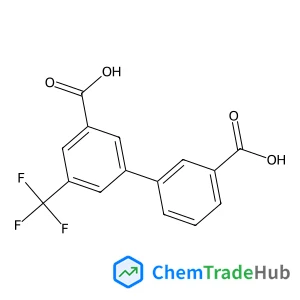
3-(3-Carboxyphenyl)-5-(trifluoromethyl)benzoic acid
CAS Number:
1261930-96-4
Molecular Formula:
C15H9F3O4
Recommended Suppliers






Disclaimer
This page provides academic journal information for reference and research purposes only. We are not affiliated with any journal publishers and do not handle publication submissions. For publication-related inquiries, please contact the respective journal publishers directly.
If you notice any inaccuracies in the information displayed, please contact us at support@chemtradehub.com. We will promptly review and address your concerns.