



Sustainable production of γ-valerolactone and δ-valerolactone through the coupling of hydrogenation and dehydrogenation
Literature Information
Publication Date
2021-01-05
DOI
10.1039/D0SE01776K
Impact Factor
6.367
Authors
Guoqiang Ding, Xianqing Li
View Original
Abstract
γ-Valerolactone (GVL) and δ-valerolactone (DVL) are valuable chemicals that can be obtained by catalytic processes from nonedible lignocellulose biomass. However, highly efficient synthesis of GVL and DVL through an environmentally friendly and cost-effective method is still a challenge. In this work, synchronized production of GVL and DVL with high yields (>98%) was realized over cheap Cu catalysts through catalytic coupling of 1,5-pentanediol (1,5-PDO) dehydrogenation and ethyl levulinate (EL) hydrogenation. Improved substrate conversion and selectivity to desired products can be observed in the combined reactions without the use of any solvent and consumption of hydrogen. In the coupled reactions, except using the hydrogen released from dehydrogenation, the large energy released from EL hydrogenation can be utilized effectively for endothermic 1,5-PDO dehydrogenation. In addition, easy temperature control in the combined reactions can be achieved due to moderate heat release, which can avoid the formation of apparent hotspots or coldspots in the practical process.
Recommended Journals

Current Opinion in Colloid & Interface Science

Organic Process Research & Development

Russian Journal of Applied Chemistry

Current Opinion in Solid State & Materials Science

Russian Journal of Bioorganic Chemistry

Acta Materialia

Nature Medicine

Russian Journal of Organic Chemistry

Crystallography Reports

Russian Journal of Coordination Chemistry
Related Literature
New insights into the enantioselectivity in the hydrogenation of prochiral ketones
Samuel A. French, Devis Di Tommaso, Antonio Zanotti-Gerosa, Fred Hancock
2007-03-12
Communication
DOI: 10.1039/B616210J
A theoretical analysis of a classic example of supramolecular catalysis
Peter Carlqvist
2006-11-21
Communication
DOI: 10.1039/B613434C
Ligand-free Pd/C-catalyzed Suzuki–Miyaura coupling reaction for the synthesis of heterobiaryl derivatives
Yoshiaki Kitamura, Satoko Sako, Takahiro Udzu, Azusa Tsutsui, Tomohiro Maegawa, Yasunari Monguchi, Hironao Sajiki
2007-10-02
Communication
DOI: 10.1039/B712207A
Template-directed supramolecular self-assembly of coordination dumbbells at surfaces
Nian Lin, Alexander Langner, Steven L. Tait, Chandrasekar Rajadurai, Mario Ruben
2007-09-20
Communication
DOI: 10.1039/B712082F
Karman vortex street assisted patterning in the growth of silicon nanowires
Mingwang Shao, Hui Hu, Min Li, Huizhao Ban, Mengya Wang, Juan Jiang
2006-11-13
Communication
DOI: 10.1039/B613473D
The first direct C–H arylation of purinenucleosides
Igor Čerňa, Radek Pohl, Michal Hocek
2007-10-25
Communication
DOI: 10.1039/B714253F
Template controlled self-assembly of bidentate phosphine complexes with hemilabile coordination behaviour
Samir Chikkali, Dietrich Gudat, Mark Niemeyer
2006-12-12
Communication
DOI: 10.1039/B616102B
Synthesis of AgBiS2 microspheres by a templating method and their catalytic polymerization of alkylsilanes
Jiaqiang Wang, Xikung Yang, Wenbing Hu, Bin Li, Jiangmei Yan, Jinjin Hu
2007-09-19
Communication
DOI: 10.1039/B710832J
You might also like
Compound Q&A
What regulatory guidelines apply to 4-Amino-3-bromophenol (CAS: 74440-80-5)?
4-Amino-3-bromophenol (CAS: 74440-80-5) falls under the classification of a haza...
74440-80-54-Amino-3-bromopheno...
Compound Q&A
How should (17beta)-3-Oxoestr-4-en-17-yl acetate (CAS: 1425-10-1) be stored?
(17beta)-3-Oxoestr-4-en-17-yl acetate should be stored in a cool, dry place away...
1425-10-1(17beta)-3-Oxoestr-4...
Compound Q&A
What are the physical and chemical properties of 2-[(2,2-Diethoxyethyl)disulfanyl]-1,1-diethoxyethane (CAS: 76505-71-0)?
2-[(2,2-Diethoxyethyl)disulfanyl]-1,1-diethoxyethane (CAS: 76505-71-0) is a colo...
76505-71-02-[(2,2-Diethoxyethy...
Compound Q&A
What is the market or research trend for 1-(β-D-ribofuranosyl)-1H-imidazo[4,5-c]pyridin-4-amine?
The market and research for 1-(β-D-ribofuranosyl)-1H-imidazo[4,5-c]pyridin-4-ami...
6736-58-91-(beta-D-Ribofurano...
Compound Q&A
How should waste containing Conjugated Estrogen (CAS: 12126-59-9) be handled?
Waste containing Conjugated Estrogen (CAS: 12126-59-9) should be collected and d...
12126-59-9Conjugated Estrogen
Compound Q&A
What is the market or research trend for Bis(2,2,2-trifluoroethyl) (methoxycarbonylmethyl)phosphonate?
The market for Bis(2,2,2-trifluoroethyl) (methoxycarbonylmethyl)phosphonate (CAS...
88738-78-7Bis(2,2,2-trifluoroe...
Compound Q&A
Are there alternatives to 3,4'-Di-O-methylellagic acid (CAS: 57499-59-9) in synthesis?
There are several alternatives to 3,4'-Di-O-methylellagic acid (CAS: 57499-59-9)...
57499-59-93,4'-Di-O-methylella...
Compound Q&A
What regulatory guidelines apply to 2-Chloro-N,N-dimethylpyridin-4-amine (CAS: 59047-70-0)?
2-Chloro-N,N-dimethylpyridin-4-amine (CAS: 59047-70-0) is regulated under the Gl...
59047-70-02-Chloro-N,N-dimethy...
Compound Q&A
What is cerium(3+);oxygen(2-);vanadium(5+) (CAS: 13597-19-8)?
Cerium(3+);oxygen(2-);vanadium(5+) (CAS: 13597-19-8) is a complex inorganic comp...
13597-19-8cerium(3+);oxygen(2-...
Compound Q&A
Is 7-Chloro-1-iodoisoquinoline (CAS: 1203579-27-4) safe?
7-Chloro-1-iodoisoquinoline (CAS: 1203579-27-4) is generally considered safe whe...
1203579-27-47-Chloro-1-iodoisoqu...
Source Journal
Recommended Compounds
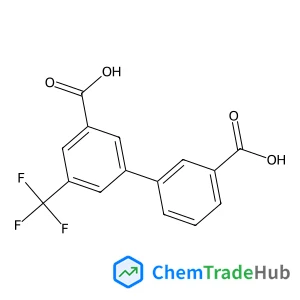
3-(3-Carboxyphenyl)-5-(trifluoromethyl)benzoic acid
CAS Number:
1261930-96-4
Molecular Formula:
C15H9F3O4
![N-[(1R,2R)-2-Amino-1,2-diphenylethyl]-1,1,1-trifluoromethanesulfonamide structure](https://static.chemtradehub.com/structs/852/852212-89-6-5ef9.webp "N-[(1R,2R)-2-Amino-1,2-diphenylethyl]-1,1,1-trifluoromethanesulfonamide structure")
N-[(1R,2R)-2-Amino-1,2-diphenylethyl]-1,1,1-trifluoromethanesulfonamide
CAS Number:
852212-89-6
Molecular Formula:
C15H15F3N2O2S
Recommended Suppliers





Disclaimer
This page provides academic journal information for reference and research purposes only. We are not affiliated with any journal publishers and do not handle publication submissions. For publication-related inquiries, please contact the respective journal publishers directly.
If you notice any inaccuracies in the information displayed, please contact us at support@chemtradehub.com. We will promptly review and address your concerns.