



Improving the electrocatalytic performance of sustainable Co/carbon materials for the oxygen evolution reaction by ultrasound and microwave assisted synthesis
Literature Information
Publication Date
2020-12-11
DOI
10.1039/D0SE01505A
Impact Factor
6.367
Authors
Alessio Zuliani, Manuel Cano, Federica Calsolaro, Alain R. Puente Santiago, Juan J. Giner-Casares, Enrique Rodríguez-Castellón, Gloria Berlier, Giancarlo Cravotto, Katia Martina
View Original
Abstract
The design of sustainable procedures for the preparation of cobalt/carbon-based materials as an anode for hydrogen fuel production through electrocatalytic water splitting has attracted much interest in the last few years. Herein, a novel environmentally friendly approach for the development of stable and active catalysts for the oxygen evolution reaction (OER) is reported. In detail, the methodology aimed at developing a sequence of composites having a low cobalt loading (<4%wt) using polyphenols extracted from green tea as metal stabilizers and activated carbon derived from pinecones as a metal-support as well as a co-active material. The approach exploited ultrasound (US), microwave (MW) and combined US/MW-assisted techniques with the purpose of enhancing the final electrocatalytic activity of these new composites, replacing conventional high-temperature approaches. The results indicated that the so-produced electrocatalytic materials followed the order of activity US > MW/US > MW > conventional heating, with the best sample requiring an overpotential of 365 mV to deliver a current density of 10 mA cm−2 and a Tafel slope of 58 mV dec−1.
Recommended Journals

Journal of Natural Medicines

Russian Chemical Bulletin

Organic Process Research & Development

Current Opinion in Solid State & Materials Science

New Journal of Chemistry

Drug Discovery Today

Russian Journal of Organic Chemistry

Current Opinion in Colloid & Interface Science

Journal of Peptide Science

Crystallography Reports
Related Literature
Carbonylation of heterocycles by homogeneous catalysts
Tamara L. Church, Yutan D. Y. L. Getzler, Christopher M. Byrne, Geoffrey W. Coates
2007-01-19
Feature Article
DOI: 10.1039/B613476A
Recent advances in polymer protected gold nanoparticles: synthesis, properties and applications
Jun Shan, Heikki Tenhu
2007-07-09
Feature Article
DOI: 10.1039/B707740H
Nucleophilic aromatic substitution using Et3SiH/cat. t-Bu-P4 as a system for nucleophile activation
Masahiro Ueno, Misato Yonemoto, Masahiro Hashimoto, Andrew E. H. Wheatley, Hiroshi Naka, Yoshinori Kondo
2007-02-28
Communication
DOI: 10.1039/B700140A
Facile transformation of hydrophilic cellulose into superhydrophobic cellulose
Shenghai Li, Haibo Xie, Suobo Zhang, Xianhong Wang
2007-09-21
Communication
DOI: 10.1039/B712056G
Self-assembly of amphiphilic imidazolium-based hexa-peri-hexabenzo-coronenes into fibreous aggregates
Bassem El Hamaoui, Linjie Zhi, Wojciech Pisula, Ute Kolb, Jishan Wu, Klaus Müllen
2007-03-12
Communication
DOI: 10.1039/B618821D
Hydrogen-bond quenching of photodecarbonylation in the solid state and recovery of reactivity by co-crystallization‡
Jing Zhang, Milan Gembicky, Marc Messerschmidt, Philip Coppens
2007-03-09
Communication
DOI: 10.1039/B700073A
New ligand platforms for developing the chemistry of the TiN–NR2 functional group and the insertion of alkynes into the N–N bond of a TiN–NPh2 ligand
Jonathan D. Selby, Catherine D. Manley, Marta Feliz, Andrew D. Schwarz, Eric Clot, Philip Mountford
2007-09-21
Communication
DOI: 10.1039/B711941K
An unprecedented (6,8)-connected self-penetrating network based on two distinct zinc clusters
Ya-Qian Lan, Xin-Long Wang, Shun-Li Li, Zhong-Min Su, Kui-Zhan Shao, En-Bo Wang
2007-09-19
Communication
DOI: 10.1039/B709835A
Retracted article: Biogenetic hypothesis and first steps towards a biomimetic synthesis of haouamines
Edmond Gravel, Erwan Poupon, Reynald Hocquemiller
2006-12-19
Communication
DOI: 10.1039/B613737G
New strong organic acceptors by cycloaddition of TCNE and TCNQ to donor-substituted cyanoalkynes
Philippe Reutenauer, Milan Kivala, Peter D. Jarowski, Corinne Boudon, Jean-Paul Gisselbrecht, Maurice Gross, François Diederich
2007-10-31
Communication
DOI: 10.1039/B714731G
You might also like
Compound Q&A
What regulatory guidelines apply to 4-Amino-3-bromophenol (CAS: 74440-80-5)?
4-Amino-3-bromophenol (CAS: 74440-80-5) falls under the classification of a haza...
74440-80-54-Amino-3-bromopheno...
Compound Q&A
How should (17beta)-3-Oxoestr-4-en-17-yl acetate (CAS: 1425-10-1) be stored?
(17beta)-3-Oxoestr-4-en-17-yl acetate should be stored in a cool, dry place away...
1425-10-1(17beta)-3-Oxoestr-4...
Compound Q&A
What are the physical and chemical properties of 2-[(2,2-Diethoxyethyl)disulfanyl]-1,1-diethoxyethane (CAS: 76505-71-0)?
2-[(2,2-Diethoxyethyl)disulfanyl]-1,1-diethoxyethane (CAS: 76505-71-0) is a colo...
76505-71-02-[(2,2-Diethoxyethy...
Compound Q&A
What is the market or research trend for 1-(β-D-ribofuranosyl)-1H-imidazo[4,5-c]pyridin-4-amine?
The market and research for 1-(β-D-ribofuranosyl)-1H-imidazo[4,5-c]pyridin-4-ami...
6736-58-91-(beta-D-Ribofurano...
Compound Q&A
How should waste containing Conjugated Estrogen (CAS: 12126-59-9) be handled?
Waste containing Conjugated Estrogen (CAS: 12126-59-9) should be collected and d...
12126-59-9Conjugated Estrogen
Compound Q&A
What is the market or research trend for Bis(2,2,2-trifluoroethyl) (methoxycarbonylmethyl)phosphonate?
The market for Bis(2,2,2-trifluoroethyl) (methoxycarbonylmethyl)phosphonate (CAS...
88738-78-7Bis(2,2,2-trifluoroe...
Compound Q&A
Are there alternatives to 3,4'-Di-O-methylellagic acid (CAS: 57499-59-9) in synthesis?
There are several alternatives to 3,4'-Di-O-methylellagic acid (CAS: 57499-59-9)...
57499-59-93,4'-Di-O-methylella...
Compound Q&A
What regulatory guidelines apply to 2-Chloro-N,N-dimethylpyridin-4-amine (CAS: 59047-70-0)?
2-Chloro-N,N-dimethylpyridin-4-amine (CAS: 59047-70-0) is regulated under the Gl...
59047-70-02-Chloro-N,N-dimethy...
Compound Q&A
What is cerium(3+);oxygen(2-);vanadium(5+) (CAS: 13597-19-8)?
Cerium(3+);oxygen(2-);vanadium(5+) (CAS: 13597-19-8) is a complex inorganic comp...
13597-19-8cerium(3+);oxygen(2-...
Compound Q&A
Is 7-Chloro-1-iodoisoquinoline (CAS: 1203579-27-4) safe?
7-Chloro-1-iodoisoquinoline (CAS: 1203579-27-4) is generally considered safe whe...
1203579-27-47-Chloro-1-iodoisoqu...
Source Journal
Recommended Compounds
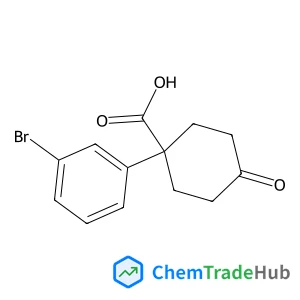
1-(3-Bromophenyl)-4-oxocyclohexanecarboxylic acid
CAS Number:
1385694-53-0
Molecular Formula:
C13H13BrO3
Recommended Suppliers






Disclaimer
This page provides academic journal information for reference and research purposes only. We are not affiliated with any journal publishers and do not handle publication submissions. For publication-related inquiries, please contact the respective journal publishers directly.
If you notice any inaccuracies in the information displayed, please contact us at support@chemtradehub.com. We will promptly review and address your concerns.