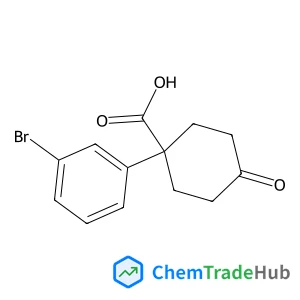
1-(3-Bromophenyl)-4-oxocyclohexanecarboxylic acid
CAS Number:
1385694-53-0
Molecular Formula:
C13H13BrO3
Ramón Arcas, Eduardo Peris, Elena Mas-Marzá, Francisco Fabregat-Santiago
Photoelectrochemical approaches are finding use in the transformation of organic molecules beyond water oxidation and CO2 reduction. Among the different reactions that can be performed, the selective oxidation of alcohols to aldehydes is a transformation of great interest, as aldehydes are the starting materials for the preparation of more complex organic molecules with high added value. In order to develop efficient photoelectrochemical methodologies for this reaction, it is crucial to reveal all the different parameters that are involved in such light-driven processes. Herein we analyse in detail the effect of the light wavelength and atmosphere on the photoelectrochemical oxidation of benzyl alcohol to benzaldehyde using BiVO4 electrodes. Our studies demonstrate that an important contribution to the oxidation of alcohol is due to UV light-induced production of singlet oxygen, which is also responsible for the formation of hydrogen peroxide in the reaction media. These findings are key for identifying and evaluating the underlying mechanism involved in this type of photoelectrochemically induced oxidation, in order to avoid misinterpretations of the efficiencies.
David Díaz Díaz, Tomás Torres, Rudolf Zentel, Riju Davis, Martin Brehmer
DOI: 10.1039/B703685J
Ian Robinson, Cameron Alexander, Le T. Lu, Le D. Tung
DOI: 10.1039/B713528A
J. Jacob Morris, Bruce C. Noll, Kenneth W. Henderson
DOI: 10.1039/B711668C
Edmond Gravel, Erwan Poupon, Reynald Hocquemiller
DOI: 10.1039/B613737G
Ganna Lyashenko, Gerald Saischek, Aritra Pal, Regine Herbst-Irmer, Nadia C. Mösch-Zanetti
DOI: 10.1039/B617199K
Jun Shan, Heikki Tenhu
DOI: 10.1039/B707740H
Sarah L. Foster, Sandeep Handa, Michael Krafft, David Rowling
DOI: 10.1039/B712542A
A. C. Mclaughlin, L. Begg, A. J. McCue, J. P. Attfield
DOI: 10.1039/B617872C
Alexey A. Goryunkov, Ilya N. Ioffe, Pavel A. Khavrel, Stanislav M. Avdoshenko, Vitaly Yu. Markov, Z. Mazej, Lev N. Sidorov, Sergey I. Troyanov
DOI: 10.1039/B615457C
4-Amino-3-bromophenol (CAS: 74440-80-5) falls under the classification of a haza...
(17beta)-3-Oxoestr-4-en-17-yl acetate should be stored in a cool, dry place away...
2-[(2,2-Diethoxyethyl)disulfanyl]-1,1-diethoxyethane (CAS: 76505-71-0) is a colo...
The market and research for 1-(β-D-ribofuranosyl)-1H-imidazo[4,5-c]pyridin-4-ami...
Waste containing Conjugated Estrogen (CAS: 12126-59-9) should be collected and d...
The market for Bis(2,2,2-trifluoroethyl) (methoxycarbonylmethyl)phosphonate (CAS...
There are several alternatives to 3,4'-Di-O-methylellagic acid (CAS: 57499-59-9)...
2-Chloro-N,N-dimethylpyridin-4-amine (CAS: 59047-70-0) is regulated under the Gl...
Cerium(3+);oxygen(2-);vanadium(5+) (CAS: 13597-19-8) is a complex inorganic comp...
7-Chloro-1-iodoisoquinoline (CAS: 1203579-27-4) is generally considered safe whe...
![2-Methyl-2-propanyl 4-[3-(aminomethyl)phenyl]-1-piperazinecarboxylate structure](https://static.chemtradehub.com/structs/889/889948-55-4-5c12.webp "2-Methyl-2-propanyl 4-[3-(aminomethyl)phenyl]-1-piperazinecarboxylate structure")