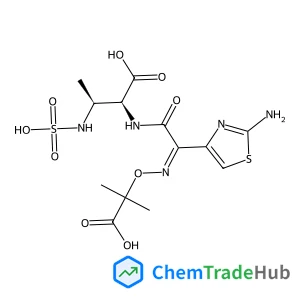
Aztreonam USP Related Compound A (Open-ring Aztreonam)
CAS Number:
87500-74-1
Molecular Formula:
C13H19N5O9S2
Experimental hydration thermodynamic functions of methane and methanol over a large temperature range and at 1 atm (coming from previous studies of others) are analysed by means of a theoretical approach grounded in statistical mechanics. It is shown that the hydration Gibbs energy change can be reproduced quite well for both solutes by adding the large positive reversible work of cavity creation to the solute–water van der Waals and H-bond energetic attractions. The large negative hydration entropy change of both methane and methanol comes from the decrease in translational entropy of water molecules due to the solvent-excluded volume effect caused by cavity creation in water. The reorganization of water–water H-bonds upon solute insertion is characterized by almost complete enthalpy–entropy compensation and so cannot affect the hydration Gibbs energy change. In addition, such reorganization is endothermic above 4 °C, suggesting that no significant increase in water structure occurs upon methane or methanol insertion.

Acta Materialia

Nature Medicine

Journal of Peptide Science

Russian Chemical Bulletin

Russian Journal of General Chemistry

Organic Process Research & Development

Russian Journal of Applied Chemistry

Current Opinion in Solid State & Materials Science

Journal of Saudi Chemical Society

Chemistry Education Research and Practice
Guojing Wang, Jiecui Liao, Chienhua Chen, Shasha Lv, Chuanqing Shi
DOI: 10.1039/C5CP05036G
F. M. Schunk, D. Rand, C. Rose-Petruck
DOI: 10.1039/C5CP04508H
Daniel Höche, Carsten Blawert, Sviatlana V. Lamaka, Nico Scharnagl, Chamini Mendis
DOI: 10.1039/C5CP05577F
Yukihiro Nakabayashi, Yoshio Nosaka
DOI: 10.1039/C5CP04531B
Ruirui Han, Hongmei Ji, Tao Sun, Jin Zhao, Ningna Chen, Jing Chen, Xuefeng Guo, Wenhua Hou, Weiping Ding
DOI: 10.1039/C5CP06555K
Biswajit Biswas, Prashant Chandra Singh
DOI: 10.1039/C5CP04744G
Mohammad Alaghemandi
DOI: 10.1039/C5CP05125H
Debabrata Maiti, Arindam Saha, Parukuttyamma Sujatha Devi
DOI: 10.1039/C5CP05840F
Sara Del Galdo, Paolo Marracino, Marco D'Abramo, Andrea Amadei
DOI: 10.1039/C5CP05891K
6-(3-Fluorophenyl)picolinic acid is generally considered safe for laboratory use...
(3R)-3-Pyrrolidinol is used in the pharmaceutical industry as a precursor for dr...
When handling (4R,5R)-4,5-Diethoxycarbonyl-2,2-dimethyldioxolane (CAS: 59779-75-...
1-(6-Chloroimidazo[1,2-b]pyridazin-3-yl)ethanone is often synthesized via a mult...
The market for N-Ethyl-3,4-dimethylbenzylamine (CAS: 39180-83-1) remains steady,...
Tert-butyl 3-(pyrrolidin-1-yl)azetidine-1-carboxylate is a chemical compound wit...
1-Bromo-3-chloro-2,4-dimethoxybenzene (CAS: 1228956-93-1) falls under the classi...
The safety of 8-Bromo-2-methyl-3,4-dihydroisoquinolin-1(2H)-one (CAS: 1368622-07...
Benzyl [(3S)-2,6-dioxo-3-piperidinyl]carbamate is generally safe when handled wi...
1-{[4-(4,4,5,5-Tetramethyl-1,3,2-dioxaborolan-2-yl)phenyl]sulfonyl}pyrrolidine s...

Physical Chemistry Chemical Physics (PCCP) is an international journal co-owned by 19 physical chemistry and physics societies from around the world. This journal publishes original, cutting-edge research in physical chemistry, chemical physics and biophysical chemistry. To be suitable for publication in PCCP, articles must include significant innovation and/or insight into physical chemistry; this is the most important criterion that reviewers and Editors will judge against when evaluating submissions. The journal has a broad scope and welcomes contributions spanning experiment, theory, computation and data science. Topical coverage includes spectroscopy, dynamics, kinetics, statistical mechanics, thermodynamics, electrochemistry, catalysis, surface science, quantum mechanics, quantum computing and machine learning. Interdisciplinary research areas such as polymers and soft matter, materials, nanoscience, energy, surfaces/interfaces, and biophysical chemistry are welcomed if they demonstrate significant innovation and/or insight into physical chemistry. Joined experimental/theoretical studies are particularly appreciated when complementary and based on up-to-date approaches.