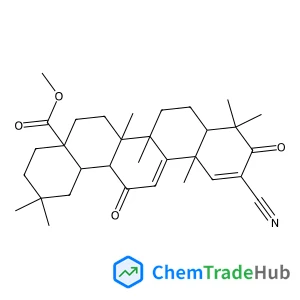
Methyl 2-cyano-3,12-dioxooleana-1,9(11)-dien-28-oate
CAS Number:
218600-53-4
Molecular Formula:
C32H43NO4
Adam D. Wexler, Elmar C. Fuchs, Jakob Woisetschläger, Giuseppe Vitiello
In this work we expand on findings previously reported [Wexler et al., Phys. Chem. Chem. Phys., 2016, 18, 16281] on the experimental observation of a phase transition in a hydrogen bonded liquid manifesting in long range dipole–dipole interactions. The studied system, liquid water stressed by an electric field, exhibits collective oscillations brought about through spontaneous breakdown of symmetry. Raman spectroscopy identifies the primary excitation of the emergent phase as transverse optically active phonon-like sidebands that appear on the hydrogen bonded asymmetric stretch mode. The phase transition is observed throughout the entire volume of liquid. The system also exhibits a self-similarity relation between the scattered Raman intensity and the electric field strength which further supports the conclusion that collective behavior persists against thermal disruption. The experimental findings are discussed in terms of a quantum field theory for macroscopic quantum systems.
Guohai Deng, Xuelin Dong, Qifan Liu, Dingqing Li, Hongmin Li, Qiao Sun, Xiaoqing Zeng
DOI: 10.1039/C6CP08125H
Zhanli Cao, Zhendong Li, Fan Wang, Wenjian Liu
DOI: 10.1039/C6CP07588F
Pablo Gamallo, Sinan Akpinar, Paolo Defazio, Carlo Petrongolo
DOI: 10.1039/C6CP07756K
Alexandra R. McIsaac, David A. Mazziotti
DOI: 10.1039/C6CP07563K
Elham Ashori, Francesc Illas
DOI: 10.1039/C6CP07898B
Vladimir I. Novoderezhkin, Elisabet Romero, Javier Prior, Rienk van Grondelle
DOI: 10.1039/C6CP07308E
Thomas J. McDonough, Lushuai Zhang, Susmit Singha Roy, Nicholas M. Kearns, Michael S. Arnold, Martin T. Zanni
DOI: 10.1039/C6CP06454J
Mandeep K. Chahal, Muniappan Sankar, Ray J. Butcher
DOI: 10.1039/C6CP08396J
DOI: 10.1039/C6CP07597E
Z. J. Li, H. Y. Yu, G. Y. Song, J. Zhao, H. Zhang, M. Zhang, A. L. Meng, Q. D. Li
DOI: 10.1039/C6CP07457J
When handling 4-(2-Furylmethyl)thiomorpholine 1,1-dioxide (CAS: 79206-94-3), it ...
When handling 4-Chloro-N-[2-(4-morpholinyl)ethyl]benzamide (CAS: 71320-77-9), it...
Waste containing this compound (CAS: 62921-74-8) should be handled according to ...
Waste containing (S)-Methyl 2-amino-3-cyclohexylpropanoate should be collected i...
This compound can be synthesized using a multi-step process involving the conjug...
There are several alternatives to (2E)-3-(3,4-Dichlorophenyl)acrylic acid in syn...
Ethyl 6-(2-nitrophenyl)imidazo[2,1-b][1,3]thiazole-3-carboxylate (CAS: 925437-84...
Waste containing 2-(1,3-Thiazol-2-yl)ethanamine (CAS: 18453-07-1) should be coll...
Methyl 5-iodo-2-methylbenzoate can be synthesized through the iodination of meth...
5-Chloro[1,2,4]triazolo[1,5-a]pyridine is commonly synthesized via the condensat...

Physical Chemistry Chemical Physics (PCCP) is an international journal co-owned by 19 physical chemistry and physics societies from around the world. This journal publishes original, cutting-edge research in physical chemistry, chemical physics and biophysical chemistry. To be suitable for publication in PCCP, articles must include significant innovation and/or insight into physical chemistry; this is the most important criterion that reviewers and Editors will judge against when evaluating submissions. The journal has a broad scope and welcomes contributions spanning experiment, theory, computation and data science. Topical coverage includes spectroscopy, dynamics, kinetics, statistical mechanics, thermodynamics, electrochemistry, catalysis, surface science, quantum mechanics, quantum computing and machine learning. Interdisciplinary research areas such as polymers and soft matter, materials, nanoscience, energy, surfaces/interfaces, and biophysical chemistry are welcomed if they demonstrate significant innovation and/or insight into physical chemistry. Joined experimental/theoretical studies are particularly appreciated when complementary and based on up-to-date approaches.