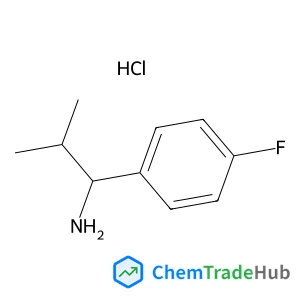
(1R)-1-(4-Fluorophenyl)-2-methyl-1-propanamine hydrochloride (1:1)
CAS Number:
1213329-40-8
Molecular Formula:
C10H15ClFN
Yoshihiro Aiura, Kenichi Ozawa, Yasuhisa Tezuka, Makoto Minohara, Kyoko Bando
Local distortion in the conduction pathway has a significant influence on the conducting properties of oxides. The electronic states induced in the band gap of SrTiO3 by La doping were investigated using photoemission spectroscopy (PES) and soft X-ray emission spectroscopy (SXES); moreover, the local distortion in the conduction pathway was examined using extended X-ray absorption fine structure (EXAFS). An itinerant state and a localized state were observed as a metallic state and an in-gap state, respectively, in the PES spectra and as inelastic peaks in the SXES spectra. This implied that the itinerant state and the in-gap state coexisted within the bulk. From EXAFS results, it was observed that La doped into SrTiO3 substituted Sr and locally distorted the conduction pathway. The results showed that some electrons doped by La-on-Sr substitution are trapped/localized by the local distortion in the conduction pathway, whereas the remaining doped electrons itinerate in the pristine conduction pathway with no distortion.

Proceedings of the National Academy of Sciences of the United States of America

Journal of Medicinal Chemistry

Israel Journal of Chemistry

European Journal of Wood and Wood Products

Science

Kinetics and Catalysis

Journal of Physics and Chemistry of Solids

Pure and Applied Chemistry

Science Progress

Journal of Organometallic Chemistry
Mohd Taher, Kshatresh Dutta Dubey, Shyamalava Mazumdar
DOI: 10.1039/D3SC02857G
Liming Sun, Yaya Yuan, Xiaoxiao He, Wenwen Zhan, Dong Li, Yanli Zhao, Xiao-Jun Wang, Xiguang Han
DOI: 10.1039/D3SC04328B
Benjamin Rioux, Louis M. M. Mouterde, Jimmy Alarcan, Matthias J. A. Vink, Jack M. Woolley, Aurélien A. M. Peru, Matthieu M. Mention, Fanny Brunissen, Giel Berden, Jos Oomens, Albert Braeuning, Florent Allais
DOI: 10.1039/D3SC04836E
Corentin Rossi, Giel Muller, Sandesh Gondarry, Paul M. Mayer, Ugo Jacovella
DOI: 10.1039/D3SC03015F
Liangyiqun Xie, Yujing Jiang, Wenlei Zhu, Shichao Ding, Yang Zhou, Jun-Jie Zhu
DOI: 10.1039/D3SC04353C
Tomoyuki Hamachi, Koki Nishimura, Keita Sakamoto, Yusuke Kawashima, Hironori Kouno, Shunsuke Sato
DOI: 10.1039/D3SC04123A
Aleksandr Denisenko, Pavel Garbuz, Yelyzaveta Makovetska, Dmytro Lesyk, Rodion Korzh, Iryna V. Sadkova, Pavel K. Mykhailiuk
DOI: 10.1039/D3SC05121H
Douglas Turnbull, Marc-André Légaré
DOI: 10.1039/D3SC05071H
Jonathan E. Tsang, David A. Nathanson
DOI: 10.1039/D3SC04424F
3-(2-Bromoimidazo[2,1-b]thiazol-6-yl)propanoic acid hydrochloride is typically s...
2-Isopropyl-1,3-dioxane-5-carboxylic acid is typically synthesized by the carbox...
Alisporivir (CAS: 254435-95-5) is an antiviral medication used in the treatment ...
[1,2,4]triazolo[3,4-a]phthalazine (CAS: 234-80-0) is a crystalline compound with...
Regulatory guidelines for (2S)-5-Hydroxy-2-(4-hydroxyphenyl)-4-oxo-3,4-dihydro-2...
2,2-Difluorocyclohexanamine hydrochloride is generally safe when handled under p...
3-Nitro-2-phenylthiophene is primarily used in the synthesis of other organic co...
1-(Trifluoroacetyl)-4-piperidinecarbonitrile (CAS: 77940-79-5) is a colorless to...
Research and market trends for 1,3,6,8-Tetranitro-9H-carbazole (CAS: 4543-33-3) ...
Waste containing Dibenzo[b,d]thiophen-1-ylboronic acid (CAS: 1245943-60-5) shoul...

Physical Chemistry Chemical Physics (PCCP) is an international journal co-owned by 19 physical chemistry and physics societies from around the world. This journal publishes original, cutting-edge research in physical chemistry, chemical physics and biophysical chemistry. To be suitable for publication in PCCP, articles must include significant innovation and/or insight into physical chemistry; this is the most important criterion that reviewers and Editors will judge against when evaluating submissions. The journal has a broad scope and welcomes contributions spanning experiment, theory, computation and data science. Topical coverage includes spectroscopy, dynamics, kinetics, statistical mechanics, thermodynamics, electrochemistry, catalysis, surface science, quantum mechanics, quantum computing and machine learning. Interdisciplinary research areas such as polymers and soft matter, materials, nanoscience, energy, surfaces/interfaces, and biophysical chemistry are welcomed if they demonstrate significant innovation and/or insight into physical chemistry. Joined experimental/theoretical studies are particularly appreciated when complementary and based on up-to-date approaches.