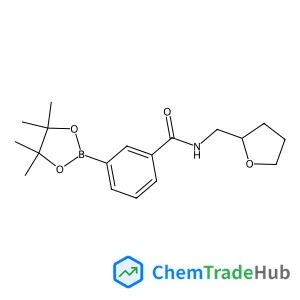
N-(Tetrahydro-2-furanylmethyl)-3-(4,4,5,5-tetramethyl-1,3,2-dioxaborolan-2-yl)benzamide
CAS Number:
1073355-06-2
Molecular Formula:
C18H26BNO4
Qingqing Wang, Xianggang Kong, Huilei Han, Ge Sang, Guanghui Zhang, Yougen Yi, Tao Gao
We have performed state-of-the-art ab initio calculations based on density functional theory to study the effect of Ti on helium dissolution and migration in a dilute Ti-doped ZrCo system. The formation energy of He-related defects predicts that it is preferable to occupy the VZr (Zr vacancy) at first. As for the Heint (interstitial site He), the results corroborate that Hetet (tetrahedral site He) is more stable than Heoct (octahedral site He) by 0.25 eV. The Heoct in the vicinity of Ti atoms becomes unstable, being relaxed into a nearby tetrahedral site, unlike in the pure ZrCo. We also reveal that ZrCo is susceptible to dopant Ti in terms of helium diffusion. The energy barrier for a Hetet to diffuse into a neighboring tetrahedral site is found to be about three times as large as the migration barrier between two adjacent octahedral interstitial sites (0.35 vs. 0.12 eV). In addition, the He atom can migrate from one octahedral site to another without going through a tetrahedral one in pure ZrCo. Furthermore, Hetet needs to overcome higher energy barriers of 0.27 eV and 0.58 eV in Ti-doped ZrCo than in the pure one (0.22 eV and 0.35 eV) along the 1nn (the first nearest neighbor) → 1nn → 2nn (the second nearest neighbor) pathway with the He atom escaping away from the Ti region. In addition, the dissociative energy barrier of the HeZr (Zr position substituted by the He atom) or HeCo (Co position substituted by the He atom) is somewhat higher in the presence of Ti than the pure one. All these conclusions elucidate that Ti acts as a trapping center for He impurities and blocks interstitial He mobility in ZrCo alloys.
Qiuhong Cheng, Aiyou Hao, Pengyao Xing
DOI: 10.1039/D3SC05212E
Joaquim Caner, Akira Matsumoto
DOI: 10.1039/D3SC05305A
Yusheng Chen, Anastasia Kuvayskaya, Maren Pink, Amar H. Flood
DOI: 10.1039/D3SC03685E
Ilia B. Moroz, Yishay Feldman, Raanan Carmieli, Xinyu Liu, Michal Leskes
DOI: 10.1039/D3SC03456A
DOI: 10.1039/D3SC04126C
Ebbin Joseph, Ian Smith, Jon A. Tunge
DOI: 10.1039/D3SC05583C
Charlie Ruffman, Krista G. Steenbergen, Anna L. Garden, Nicola Gaston
DOI: 10.1039/D3SC04416E
Kalyan Jyoti Kalita, Saikat Mondal, C. Malla Reddy, Ratheesh K. Vijayaraghavan
DOI: 10.1039/D3SC03267A
Maria Chiara Storer, Katarzyna J. Zator, Derek P. Reynolds, Christopher A. Hunter
DOI: 10.1039/D3SC05690B
3-(2-Bromoimidazo[2,1-b]thiazol-6-yl)propanoic acid hydrochloride is typically s...
2-Isopropyl-1,3-dioxane-5-carboxylic acid is typically synthesized by the carbox...
Alisporivir (CAS: 254435-95-5) is an antiviral medication used in the treatment ...
[1,2,4]triazolo[3,4-a]phthalazine (CAS: 234-80-0) is a crystalline compound with...
Regulatory guidelines for (2S)-5-Hydroxy-2-(4-hydroxyphenyl)-4-oxo-3,4-dihydro-2...
2,2-Difluorocyclohexanamine hydrochloride is generally safe when handled under p...
3-Nitro-2-phenylthiophene is primarily used in the synthesis of other organic co...
1-(Trifluoroacetyl)-4-piperidinecarbonitrile (CAS: 77940-79-5) is a colorless to...
Research and market trends for 1,3,6,8-Tetranitro-9H-carbazole (CAS: 4543-33-3) ...
Waste containing Dibenzo[b,d]thiophen-1-ylboronic acid (CAS: 1245943-60-5) shoul...

Physical Chemistry Chemical Physics (PCCP) is an international journal co-owned by 19 physical chemistry and physics societies from around the world. This journal publishes original, cutting-edge research in physical chemistry, chemical physics and biophysical chemistry. To be suitable for publication in PCCP, articles must include significant innovation and/or insight into physical chemistry; this is the most important criterion that reviewers and Editors will judge against when evaluating submissions. The journal has a broad scope and welcomes contributions spanning experiment, theory, computation and data science. Topical coverage includes spectroscopy, dynamics, kinetics, statistical mechanics, thermodynamics, electrochemistry, catalysis, surface science, quantum mechanics, quantum computing and machine learning. Interdisciplinary research areas such as polymers and soft matter, materials, nanoscience, energy, surfaces/interfaces, and biophysical chemistry are welcomed if they demonstrate significant innovation and/or insight into physical chemistry. Joined experimental/theoretical studies are particularly appreciated when complementary and based on up-to-date approaches.
![[3-Fluoro-5-(2,2,2-trifluoroethoxy)phenyl]boronic acid structure](https://static.chemtradehub.com/structs/850/850589-55-8-a8ed.webp "[3-Fluoro-5-(2,2,2-trifluoroethoxy)phenyl]boronic acid structure")