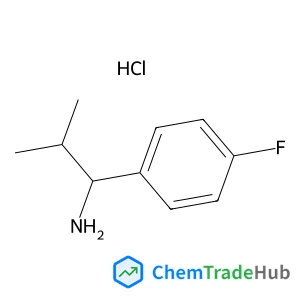
(1R)-1-(4-Fluorophenyl)-2-methyl-1-propanamine hydrochloride (1:1)
CAS Number:
1213329-40-8
Molecular Formula:
C10H15ClFN
Benoît Champagne, Sameh Ayadi, Vincent Liégeois
A computational study of the magnetically-induced current (MIC) density has been carried out for a variety of ortho fused polycyclic aromatic molecules at the density functional theory level with the gauge including magnetically induced current (GIMIC) method. With this method, the aromatic character of each ring in a homologous series of carbohelicenes with an increasing number of fused benzene rings is assessed and compared with other aromaticity criteria such as the Nucleus Independent Chemical Shift [NICS(0), NICSzz(0)] and Bond Length Alternation (BLA) parameters. All criteria indicate that the two outer rings are the most aromatic ones [i.e. higher induced current, more negative NICS(0) and NICSzz(0) values, and smaller BLA values]. For the large helicenes (n > 10), the current drops along the following four rings and then rises again. Additionally, we have proven that this behavior is not due to a difference of the local magnetic field coming from a difference of orientation of the ring with respect to the external magnetic field (oriented along the helical axis). Upon fusing additional benzene rings to form hexa-peri-hexabenzo[7]helicene, some rings (B, D, and F) are a lot less aromatic (even non-aromatic) than the others. The NICS(0) and NICSzz(0) values exaggerate this behavior because they are all positive values, which is a signature of antiaromaticity. Then, when substituting one, three, or four benzene rings with pyrrole ones to form mono-aza-[7]-helicene, tri-aza-[7]-helicene, and tetra-aza-[7]-helicene, remarkable changes in the electronic structures of the helicenes are observed. Indeed, the induced currents are always smaller in the pyrrole rings than in the benzene ones. This has been further investigated using the streamline and the color map representations, which indicate that the diatropic current density passing through the plane cutting the C–N bonds in the pyrrole rings is stronger but is more localized than the current density passing through the plane cutting the C–C bonds in the benzene rings. This gives a positive but smaller total induced current for the pyrrole rings than for the benzene ones. For these systems, the NICS(0) and even more the NICSzz(0) values are not fully reliable to probe the local aromaticity, contrary to the induced current. Indeed, the NICSzz(0) values for the tri-aza-[7]-helicene molecule range from −14.23 to 1.14 ppm, which cannot lead to the same conclusion as the induced current values (10.03 to 12.87 nA T−1).

Helvetica Chimica Acta

Science

Journal of Organometallic Chemistry

Organic Preparations and Procedures International

Journal of Catalysis

Science Progress

Proceedings of the National Academy of Sciences of the United States of America

Russian Chemical Reviews

Journal of Medicinal Chemistry

Molecular Pharmacology
Liangyiqun Xie, Yujing Jiang, Wenlei Zhu, Shichao Ding, Yang Zhou, Jun-Jie Zhu
DOI: 10.1039/D3SC04353C
Rajib Dey, Sudip Mukherjee, Riya Mukherjee
DOI: 10.1039/D3SC05124B
Jayoh A. Hernandez, Paul S. Micus, Sean Alec Lois Sunga, Luca Mazzei, Stefano Ciurli, Gabriele Meloni
DOI: 10.1039/D3SC05135H
Lucas T. Göttemann, Stefan Wiesler, Richmond Sarpong
DOI: 10.1039/D3SC05414D
Chun-Li Hu
DOI: 10.1039/D3SC05770D
Pedro Zuazua-Villar, Oliwia Koczy, Andrew J. Counsell, Stephen J. Walsh, Naomi S. Robertson, David R. Spring, Jessica A. Downs, Marko Hyvönen
DOI: 10.1039/D3SC03331G
Peng Yin, Mingmin Ge, Shiyi Xie, Li Zhang, Shi Kuang, Zhou Nie
DOI: 10.1039/D3SC04957D
Fang Yuan, Cuiling Zhang, Xianzhu Luo, Shasha Cheng, Yingxin Zhu, Yuezhong Xian
DOI: 10.1039/D3SC02022C
Ting Chen, Chuyao Wen, Chen Wu, Lang Qiu, Zhenguo Wu, Jiayang Li, Yanfang Zhu, Haoyu Li, Qingquan Kong, Yang Song, Fang Wan, Mingzhe Chen, Ismael Saadoune, Benhe Zhong, Shixue Dou, Yao Xiao
DOI: 10.1039/D3SC05461F
Qiuhong Cheng, Aiyou Hao, Pengyao Xing
DOI: 10.1039/D3SC05212E
3-(2-Bromoimidazo[2,1-b]thiazol-6-yl)propanoic acid hydrochloride is typically s...
2-Isopropyl-1,3-dioxane-5-carboxylic acid is typically synthesized by the carbox...
Alisporivir (CAS: 254435-95-5) is an antiviral medication used in the treatment ...
[1,2,4]triazolo[3,4-a]phthalazine (CAS: 234-80-0) is a crystalline compound with...
Regulatory guidelines for (2S)-5-Hydroxy-2-(4-hydroxyphenyl)-4-oxo-3,4-dihydro-2...
2,2-Difluorocyclohexanamine hydrochloride is generally safe when handled under p...
3-Nitro-2-phenylthiophene is primarily used in the synthesis of other organic co...
1-(Trifluoroacetyl)-4-piperidinecarbonitrile (CAS: 77940-79-5) is a colorless to...
Research and market trends for 1,3,6,8-Tetranitro-9H-carbazole (CAS: 4543-33-3) ...
Waste containing Dibenzo[b,d]thiophen-1-ylboronic acid (CAS: 1245943-60-5) shoul...

Physical Chemistry Chemical Physics (PCCP) is an international journal co-owned by 19 physical chemistry and physics societies from around the world. This journal publishes original, cutting-edge research in physical chemistry, chemical physics and biophysical chemistry. To be suitable for publication in PCCP, articles must include significant innovation and/or insight into physical chemistry; this is the most important criterion that reviewers and Editors will judge against when evaluating submissions. The journal has a broad scope and welcomes contributions spanning experiment, theory, computation and data science. Topical coverage includes spectroscopy, dynamics, kinetics, statistical mechanics, thermodynamics, electrochemistry, catalysis, surface science, quantum mechanics, quantum computing and machine learning. Interdisciplinary research areas such as polymers and soft matter, materials, nanoscience, energy, surfaces/interfaces, and biophysical chemistry are welcomed if they demonstrate significant innovation and/or insight into physical chemistry. Joined experimental/theoretical studies are particularly appreciated when complementary and based on up-to-date approaches.