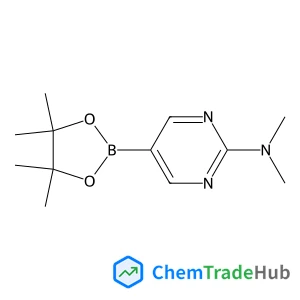
N,N-Dimethyl-5-(4,4,5,5-tetramethyl-1,3,2-dioxaborolan-2-yl)-2-pyrimidinamine
CAS Number:
1032759-30-0
Molecular Formula:
C12H20BN3O2
Sergei Manzhos, Amrita Pal, Yingqian Chen, Giacomo Giorgi
We study the effect of organic cation-centered states in mixed organic–inorganic halide perovskites on the bandstructure and optical properties. Clusters of methylammonium lead iodide (MAPbI3) and bromide (MAPbBr3) and of MAPbI3 (MAPbBr3) in which an organic cation was substituted with formamidinium (FA) and guanidinium (GA) are studied with density functional theory and time-dependent density functional theory. This model permitted comparing bandstructure and optical properties with different organic cations computed with GGA and hybrid functionals. We find that while with MA and GA, cation-centered states are deep in the conduction band, with FA, organic cation-centered states are introduced within as little as 0.5 eV of the conduction band maximum, which are expected to influence electronic and optical properties of perovskites in solar cells and other optoelectronic devices. There is qualitative agreement between a GGA and a hybrid functional; however, the use of a hybrid functional leads to a slightly higher offset of the cation-centered states from the conduction band edge, a different order of electronic states, and much better localization of cation-centered states. Analysis of optical absorption spectra suggests that occupation by photoexcitation of FA-centered states and formation of transient formamidinium species is possible in both I and Br-based perovskites.
Suguru Higashida, Aiko Harada, Rikako Kawakatsu, Noriko Fujiwara, Michio Matsumura
DOI: 10.1039/B604332A
Darryl J. Morrison, Susanne D. Riegel, Warren E. Piers, Masood Parvez, Robert McDonald
DOI: 10.1039/B605716K
Hyun-Ji Song, Che Jo Lim, Sunggi Lee, Sunggak Kim
DOI: 10.1039/B606295D
Susan E. Gibson, Jacob T. Rendell
DOI: 10.1039/B712298E
Jack A. Brown, Stephanie Irvine, Alan R. Kennedy, William J. Kerr, Shalini Andersson, Göran N. Nilsson
DOI: 10.1039/B715938B
Michael R. Reithofer, Mathea S. Galanski, Vladimir B. Arion, Bernhard K. Keppler
DOI: 10.1039/B715680D
Qi Zeng, Ping Cai, Zhen Li, Jingui Qin, Ben Zhong Tang
DOI: 10.1039/B717764J
YooJeong Kwon, Jaephil Cho
DOI: 10.1039/B716694J
Matthew A. Henderson, J. Scott McIndoe
DOI: 10.1039/B606938J
Ruibing Wang, Lina Yuan, Donal H. Macartney
DOI: 10.1039/B605919H
When considering alternatives to 1-(4-Chlorophenyl)-N-hydroxymethanimine (CAS: 3...
This compound should be stored in a cool, dry place away from direct sunlight. I...
3-(4-Bromophenyl)-5-(2-fluorophenyl)-1,2,4-oxadiazole is synthesized through a m...
5-Chloro-2-(4-chlorophenyl)-4-methyl-6-[3-(1-piperidinyl)propoxy]pyrimidine (CAS...
2-Chloro-4-(difluoromethoxy)pyridine is used in the pharmaceutical industry for ...
3-Chloro-6-methylpyridazine (CAS: 1121-79-5) is classified under the Globally Ha...
Several alternatives can be used in the synthesis of Methyl 4,5-dimethyl-2-nitro...
Alternatives to (2E,2'E)-3,3'-(1,4-Phenylene)bisacrylaldehyde include other acry...
3-Amino-5-chloropyridin-2-ol hydrochloride is an organic compound with the CAS n...
When handling 6,7-Difluoro-2,3-dihydro-4H-chromen-4-one, it is essential to wear...

Physical Chemistry Chemical Physics (PCCP) is an international journal co-owned by 19 physical chemistry and physics societies from around the world. This journal publishes original, cutting-edge research in physical chemistry, chemical physics and biophysical chemistry. To be suitable for publication in PCCP, articles must include significant innovation and/or insight into physical chemistry; this is the most important criterion that reviewers and Editors will judge against when evaluating submissions. The journal has a broad scope and welcomes contributions spanning experiment, theory, computation and data science. Topical coverage includes spectroscopy, dynamics, kinetics, statistical mechanics, thermodynamics, electrochemistry, catalysis, surface science, quantum mechanics, quantum computing and machine learning. Interdisciplinary research areas such as polymers and soft matter, materials, nanoscience, energy, surfaces/interfaces, and biophysical chemistry are welcomed if they demonstrate significant innovation and/or insight into physical chemistry. Joined experimental/theoretical studies are particularly appreciated when complementary and based on up-to-date approaches.