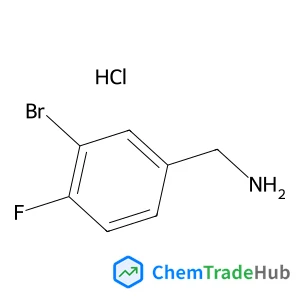
1-(3-Bromo-4-fluorophenyl)methanamine hydrochloride (1:1)
CAS Number:
202865-68-7
Molecular Formula:
C7H8BrClFN
Hyun-Ji Song, Che Jo Lim, Sunggi Lee, Sunggak Kim
The radical alkylation of ketones is achieved by their conversion into corresponding N-silyloxy enamines, followed by a radical reaction with alkyl halides bearing electron-withdrawing groups.
Hao-Wei Shih, Kuo-Ting Chen, Shao-Kang Chen, Chia-Ying Huang, Ting-Jen R Cheng, Che Ma, Chi-Huey Wong, Wei-Chieh Cheng
DOI: 10.1039/C000622J
Jan Spielmann, Michael Bolte, Sjoerd Harder
DOI: 10.1039/B914979A
Fosca Conti, Enrico Negro, Vito Di Noto
DOI: 10.1039/B913870F
Yi Zhou, Xue-Yan You, Yuan Fang, Ju-Ying Li, Ke Liu, Cheng Yao
DOI: 10.1039/C0OB00452A
Renato Bonomi, Paolo Scrimin, Fabrizio Mancin
DOI: 10.1039/B926916A
Vitor Francisco Ferreira, Sabrina Baptista Ferreira, Fernando de Carvalho da Silva
DOI: 10.1039/C0OB00277A
Min Jung Jou, Xiaoqiang Chen, Ha Na Kim, Hae-Jo Kim, Sang-gi Lee
DOI: 10.1039/B917832E
Gustavo Fernández, Fátima García, Fátima Aparicio, Emilio Matesanz, Luis Sánchez
DOI: 10.1039/B916418A
Min Li, Sergio L. De Rooy, David K. Bwambok, Bilal El-Zahab, John F. DiTusa, Isiah M. Warner
DOI: 10.1039/B917683G
M. Micaela Gonzalez, Magali Pellon-Maison, Matias A. Ales-Gandolfo, Maria R. Gonzalez-Baró, Rosa Erra-Balsells, Franco M. Cabrerizo
DOI: 10.1039/C002235G
(1R,3S)-1,3-Cyclopentanediol finds applications in various industries. In the ph...
When handling N'-[4-(Dimethylamino)phenyl]-N,N-dimethyl-1,4-benzenediamine, it i...
There are several alternatives to 5-(2,4-Difluorophenyl)-2-methoxypyrimidine in ...
1-(3-Methoxyphenoxy)propan-2-ol (CAS: 382141-68-6) must comply with the Globally...
Tetrodotoxin Citrate is extremely dangerous and should be handled with extreme c...
2-Methyl-2-propanyl [(1R,3S)-3-hydroxycyclopentyl]carbamate (CAS: 225641-84-9) i...
Waste containing 4-(2-Hydroxyhexafluoroisopropyl)Benzoic Acid (CAS: 16261-80-6) ...
2-Methyl-2-proanyl {(2S)-1-[(benzyloxy)amino]-3-hydroxy-3-methyl-1-oxo-2-butanyl...
Benzeneethanamine, α-ethyl-, hydrochloride (1:1) is an organic compound with the...
In the synthesis of compounds similar to 3-{(E)-[4-(Dimethylamino)phenyl]diazeny...

ChemComm publishes urgent research which is of outstanding significance and interest to experts in the field, while also appealing to the journal’s broad chemistry readership. Our communication format is ideally suited to short, urgent studies that are of such importance that they require accelerated publication. Our scope covers all topics in chemistry, and research at the interface of chemistry and other disciplines (such as materials science, nanoscience, physics, engineering and biology) where there is a significant novelty in the chemistry aspects. Major topic areas covered include: Analytical Chemistry Catalysis Chemical Biology and medicinal chemistry Computational Chemistry and Machine Learning Energy and sustainable chemistry Environmental Chemistry Green Chemistry Inorganic Chemistry Materials Chemistry Nanoscience Organic Chemistry Physical Chemistry Polymer Chemistry Supramolecular Chemistry