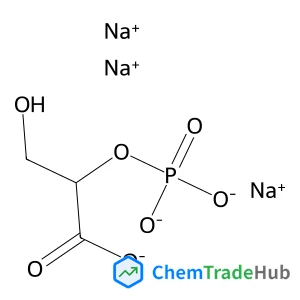
Sodium (1R)-1-carboxy-2-hydroxyethyl phosphate hydrate (2:1:1)
CAS Number:
70195-25-4
Molecular Formula:
C3H7Na2O8P
Yan Guo, Qingqing Song, Tongyu Xu, Jiani Ma, David Lee Phillips
Time-resolved spectroscopy studies coupled with the results from density functional theory (DFT) computations were utilized to unravel the photodeprotection reaction mechanism(s) of AQ protected p-methoxybenzoic acid (1) and its influence on the solvent was examined. It has been found that in aprotic organic solvents such as acetonitrile only the triplet state species was seen, whereas a hydrogen atom transfer (HAT) reaction takes place in isopropanol (IPA) to yield the aromatic ketyl radical species for 1. Compound 1 undergoes HAT and a proton transfer process sequentially to accomplish the release of the leaving group in protic organic solvent MeOH and MeOH–H2O solutions and photodeprotection is more favourable in the latter solution due to the stronger proton mediation ability of the water molecules and this system also facilitates the potential application of 1 in biological systems. Although the released acid from photodeprotection reaction can also be seen in another aqueous solvent system of THF–H2O, the by-product of the AQ chromophore undergoes side recombination reaction, which means this the solvent is not preferred for the photodeprotection process. This mechanistic work will help in the future design and development of AQ-PPGs for particular applications.
Daniel Probst, William H. Green, Georg K. H. Madsen
DOI: 10.1039/D3SC02048G
Ana Alcalde-Ordóñez, Natalia Barreiro-Piñeiro, Bríonna McGorman, Jacobo Gómez-González, David Bouzada, Francisco Rivadulla, M. Eugenio Vázquez, Andrew Kellett, José Martínez-Costas, Miguel Vázquez López
DOI: 10.1039/D3SC03303A
Sandra Díaz, Julian Bergueiro, Riccardo Capelli, Javier Montenegro
DOI: 10.1039/D3SC03930G
Liangyiqun Xie, Yujing Jiang, Wenlei Zhu, Shichao Ding, Yang Zhou, Jun-Jie Zhu
DOI: 10.1039/D3SC04353C
Douglas Turnbull, Marc-André Légaré
DOI: 10.1039/D3SC05071H
Bryan E. Metze, Riley A. Roberts, Aleksandra Nilova, David R. Stuart
DOI: 10.1039/D3SC05429B
Joaquim Caner, Akira Matsumoto
DOI: 10.1039/D3SC05305A
Toshiyuki Sugiyama, Francisco Medina, Wouter van Beek, Jun-ya Hasegawa
DOI: 10.1039/D3SC04466A
Marcin Oszajca, Dariusz Matoga
DOI: 10.1039/D3SC04401G
Yusheng Chen, Anastasia Kuvayskaya, Maren Pink, Amar H. Flood
DOI: 10.1039/D3SC03685E
3-(2-Bromoimidazo[2,1-b]thiazol-6-yl)propanoic acid hydrochloride is typically s...
2-Isopropyl-1,3-dioxane-5-carboxylic acid is typically synthesized by the carbox...
Alisporivir (CAS: 254435-95-5) is an antiviral medication used in the treatment ...
[1,2,4]triazolo[3,4-a]phthalazine (CAS: 234-80-0) is a crystalline compound with...
Regulatory guidelines for (2S)-5-Hydroxy-2-(4-hydroxyphenyl)-4-oxo-3,4-dihydro-2...
2,2-Difluorocyclohexanamine hydrochloride is generally safe when handled under p...
3-Nitro-2-phenylthiophene is primarily used in the synthesis of other organic co...
1-(Trifluoroacetyl)-4-piperidinecarbonitrile (CAS: 77940-79-5) is a colorless to...
Research and market trends for 1,3,6,8-Tetranitro-9H-carbazole (CAS: 4543-33-3) ...
Waste containing Dibenzo[b,d]thiophen-1-ylboronic acid (CAS: 1245943-60-5) shoul...

Physical Chemistry Chemical Physics (PCCP) is an international journal co-owned by 19 physical chemistry and physics societies from around the world. This journal publishes original, cutting-edge research in physical chemistry, chemical physics and biophysical chemistry. To be suitable for publication in PCCP, articles must include significant innovation and/or insight into physical chemistry; this is the most important criterion that reviewers and Editors will judge against when evaluating submissions. The journal has a broad scope and welcomes contributions spanning experiment, theory, computation and data science. Topical coverage includes spectroscopy, dynamics, kinetics, statistical mechanics, thermodynamics, electrochemistry, catalysis, surface science, quantum mechanics, quantum computing and machine learning. Interdisciplinary research areas such as polymers and soft matter, materials, nanoscience, energy, surfaces/interfaces, and biophysical chemistry are welcomed if they demonstrate significant innovation and/or insight into physical chemistry. Joined experimental/theoretical studies are particularly appreciated when complementary and based on up-to-date approaches.