












Interfacially driven transport theory: a way to unify Marangoni and osmotic flows
Literature Information
Publication Date
2019-04-29
DOI
10.1039/C9CP00999J
Impact Factor
3.676
Authors
Patrice Bacchin, Kirill Glavatskiy, Vincent Gerbaud
View Original
Abstract
We show that the solvent behaviour in both diffusio-osmosis and Marangoni flow can be derived from a simple model of colloid–interface interactions. We demonstrate that the direction of the flow is regulated by a single value of the attractive parameter covering the purely repulsive and attractive–repulsive interaction cases. The proposed universality between diffusio-osmosis and Marangoni flow is extended further to include diffusio-phoresis. In particular, an object immersed to a colloidal solution moves towards the low concentration of the colloidal particles in the case of colloid–interface repulsion and towards the high concentration of the colloidal particles in the case of colloid–interface attraction. The approach combines the methods of fluid dynamics, molecular physics and transport phenomena and provides a tractable explanation of how the colloid–interface interactions affect the momentum balance and the transport phenomena (interfacially driven transport).
Related Literature
A scalable solar-based adsorption thermal battery for day and night heating in a low-carbon scenario
Kian Jon Ernest Chua
2023-12-12
Paper
DOI: 10.1039/D3EE03519K
Using natural language processing (NLP)-inspired molecular embedding approach to predict Hansen solubility parameters
Jiayun Pang, Alexander W. R. Pine, Abdulai Sulemana
2023-11-29
Paper
DOI: 10.1039/D3DD00119A
An interpretable machine learning framework for modelling macromolecular interaction mechanisms with nuclear magnetic resonance
Samantha Stuart, Jeffrey Watchorn
2023-07-21
Paper
DOI: 10.1039/D3DD00009E
Towards the 4 V-class n-type organic lithium-ion positive electrode materials: the case of conjugated triflimides and cyanamides
Xiaolong Guo, Petru Apostol, Xuan Zhou, Jiande Wang, Xiaodong Lin, Darsi Rambabu, Mengyuan Du, Süleyman Er, Alexandru Vlad
2023-11-20
Paper
DOI: 10.1039/D3EE02897F
Gibbs–Duhem-informed neural networks for binary activity coefficient prediction
Jan G. Rittig, Kobi C. Felton, Alexei A. Lapkin
2023-10-04
Paper
DOI: 10.1039/D3DD00103B
Rational design from materials to devices enables an efficiency of 10.5% based on thermoelectric (Bi, Sb)2Te3 and Mg3(Bi, Sb)2 for power generation
Yuxin Sun, Yuke Zhu, Hao Wu, Nuo Qu, Liangjun Xie, Jianbo Zhu, Zihang Liu, Qian Zhang, Wei Cai, Fengkai Guo, Jiehe Sui
2023-12-07
Paper
DOI: 10.1039/D3EE03411A
Domain-specific chatbots for science using embeddings
Kevin G. Yager
2023-10-10
Paper
DOI: 10.1039/D3DD00112A
Rare three-valence-band convergence leading to ultrahigh thermoelectric performance in all-scale hierarchical cubic SnTe
Fan Li, Xin Liu, Shu-Rong Li, Xiao-Fan Zhang, Ni Ma, Xin-Jing Li, Xin-Yun Lin, Haijun Wu
2023-11-09
Paper
DOI: 10.1039/D3EE02482B
You might also like
Compound Q&A
What are the main uses of 1H-Indazole-6-carbonitrile (CAS: 141290-59-7)?
1H-Indazole-6-carbonitrile finds applications in pharmaceuticals, where it serve...
141290-59-71H-Indazole-6-carbon...
Compound Q&A
How should waste containing Dioctyl (2E)-2-butenedioate (CAS: 2997-85-5) be handled?
Waste containing Dioctyl (2E)-2-butenedioate (CAS: 2997-85-5) should be collecte...
2997-85-5Dioctyl (2E)-2-buten...
Compound Q&A
What industries use Sodium [(1,2-benzoxazol-3-ylmethyl)sulfonyl]azanide (CAS: 68291-98-5)?
Sodium [(1,2-benzoxazol-3-ylmethyl)sulfonyl]azanide is primarily used in pharmac...
68291-98-5Sodium [(1,2-benzoxa...
Compound Q&A
Are there alternatives to Dimethyl 4-(4,4,5,5-tetramethyl-1,3,2-dioxaborolan-2-yl)-2,6-pyridinedicarboxylate (CAS: 741709-66-0) in synthesis?
Dimethyl 4-(4,4,5,5-tetramethyl-1,3,2-dioxaborolan-2-yl)-2,6-pyridinedicarboxyla...
741709-66-0Dimethyl 4-(4,4,5,5-...
Compound Q&A
How should waste containing 2-Fluoro-6-hydrazinopyridine (CAS: 80714-39-2) be handled?
Waste containing 2-Fluoro-6-hydrazinopyridine (CAS: 80714-39-2) should be manage...
80714-39-22-Fluoro-6-hydrazino...
Compound Q&A
What is 6-Formyl-2-pyridinecarboxylic acid (CAS: 499214-11-8)?
6-Formyl-2-pyridinecarboxylic acid is an organic compound with the molecular for...
499214-11-86-Formyl-2-pyridinec...
Compound Q&A
What is the market or research trend for 3-(3,4-dimethoxyphenyl)-2,5-dimethyl-N-(2-morpholin-4-ylethyl)pyrazolo[1,5-a]pyrimidin-7-amine (CAS: 900874-91-1)?
Research trends for this compound indicate a focus on its potential applications...
900874-91-13-(3,4-dimethoxyphen...
Compound Q&A
How is 9H-Tribenzo[b,d,f]azepine (CAS: 29875-73-8) typically synthesized?
9H-Tribenzo[b,d,f]azepine is typically synthesized via a multi-step process invo...
29875-73-89H-Tribenzo[b,d,f]az...
Compound Q&A
How is 1-Cyclopropyl-7-ethoxy-6-fluoro-8-methoxy-4-oxo-1,4-dihydro-3-quinolinecarboxylic acid (CAS: 1797982-51-4) typically synthesized?
1-Cyclopropyl-7-ethoxy-6-fluoro-8-methoxy-4-oxo-1,4-dihydro-3-quinolinecarboxyli...
1797982-51-41-Cyclopropyl-7-etho...
Compound Q&A
How should waste containing Methyl 3-oxo-1,2,3,4-tetrahydro-6-quinoxalinecarboxylate (CAS: 671820-52-3) be handled?
Waste containing Methyl 3-oxo-1,2,3,4-tetrahydro-6-quinoxalinecarboxylate (CAS: ...
671820-52-3Methyl 3-oxo-1,2,3,4...
Source Journal
Physical Chemistry Chemical Physics

CiteScore:
5.5
Self-citation Rate:
10.3%
Articles per Year:
3036
Physical Chemistry Chemical Physics (PCCP) is an international journal co-owned by 19 physical chemistry and physics societies from around the world. This journal publishes original, cutting-edge research in physical chemistry, chemical physics and biophysical chemistry. To be suitable for publication in PCCP, articles must include significant innovation and/or insight into physical chemistry; this is the most important criterion that reviewers and Editors will judge against when evaluating submissions. The journal has a broad scope and welcomes contributions spanning experiment, theory, computation and data science. Topical coverage includes spectroscopy, dynamics, kinetics, statistical mechanics, thermodynamics, electrochemistry, catalysis, surface science, quantum mechanics, quantum computing and machine learning. Interdisciplinary research areas such as polymers and soft matter, materials, nanoscience, energy, surfaces/interfaces, and biophysical chemistry are welcomed if they demonstrate significant innovation and/or insight into physical chemistry. Joined experimental/theoretical studies are particularly appreciated when complementary and based on up-to-date approaches.
Recommended Compounds
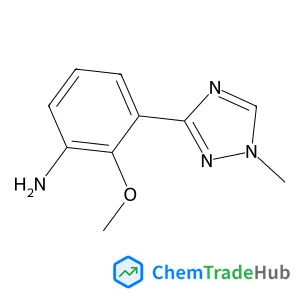
2-Methoxy-3-(1-methyl-1H-1,2,4-triazol-3-yl)aniline
CAS Number:
1609394-10-6
Molecular Formula:
C10H12N4O
Recommended Suppliers




Disclaimer
This page provides academic journal information for reference and research purposes only. We are not affiliated with any journal publishers and do not handle publication submissions. For publication-related inquiries, please contact the respective journal publishers directly.
If you notice any inaccuracies in the information displayed, please contact us at support@chemtradehub.com. We will promptly review and address your concerns.