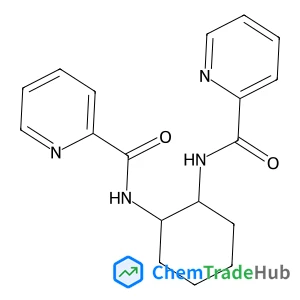
N,N'-(1R,2R)-1,2-Cyclohexanediyldi(2-pyridinecarboxamide)
CAS Number:
218290-24-5
Molecular Formula:
C18H20N4O2
Mario Bracker, Fabian Dinkelbach, Oliver Weingart, Martin Kleinschmidt
10-Methylisoalloxazine (MIA) and its mono-fluorinated derivatives (6-9F-MIA) were investigated by means of quantum chemistry, looking into the influence of fluorination on fluorescence, absorption and inter-system crossing (ISC). A maximized fluorescence quantum yield (ΦFl) of this chromophore is desirable for application as a potential fluorescence marker in biodiagnostics/photobiological studies. An enhanced triplet quantum yield ΦT on the other hand may open a perspective for photodynamic therapies (PDT) in cancer treatment. Determination of equilibrium geometries was carried out employing (time-dependent) Kohn–Sham density functional theory and electronic properties were obtained using a combined density functional theory and multi-reference configuration interaction (DFT/MRCI) method. In the gas phase, El-Sayed-favored 1(ππ*) 3(nπ*)-ISC enables population transfer to the triplet domain on a timescale of 109 s−1, i.e. significantly faster than fluorescence (kFl ≈ 107 s−1). Two different models were applied to investigate the influence of aqueous medium on absorption and relaxation: the implicit solvation model A is the well-established conductor-like screening model (COSMO) and hybrid model B combines quantum mechanical micro-hydration and conductor-like screening. A polar, protic environment leads to a significant blue-shift of the nπ* potentials, slowing down the ISC process to 107–108 s−1, now enabled by vibronic spin–orbit coupling. Simple principles are derived that demonstrate the effect of fluorination at different positions on the spectroscopic properties. These principles can be utilized with respect to multiply fluorinated derivatives and even further substitution to enlarge effects on the population decay and quantum yields.
Jiajun Zhou, Austin Mroz, Kim E. Jelfs
DOI: 10.1039/D3DD00154G
U. S. Vaitesswar, Tan Huang, Jose Recatala-Gomez, Shuo-Wang Yang
DOI: 10.1039/D3DD00131H
Jin-Tao Ren, Lei Chen, Hao-Yu Wang, Wen-Wen Tian
DOI: 10.1039/D3EE02467A
Phillip Donnelly, Helge S. Stein
DOI: 10.1039/D3DD00166K
Albert Sabadell-Rendón, Kamila Kaźmierczak, Florian Euzenat, Daniel Curulla-Ferré, Núria López
DOI: 10.1039/D3DD00163F
Fang Li, Zhaohui Fang, Zhihua Xu, Quanjun Xiang
DOI: 10.1039/D3EE03282E
Zongjin Yi, Rui He, Jingwei Zhu, Wenbo Jiao, Yi Luo, Yuliang Xu, Yunfan Wang, Zixin Zeng, Kun Wei, Jinbao Zhang, Sai-Wing Tsang, Cong Chen, Dewei Zhao
DOI: 10.1039/D3EE02839A
Liang Zhao, Zheng Lv, Yue Shi, Shuanglong Zhou, Yan Liu, Jiani Han, Qi Zhang, Jianping Lai
DOI: 10.1039/D3EE03761D
Elena Zamaraeva, Christopher M. Collins, Dmytro Antypov, George R. Darling
DOI: 10.1039/D3DD00063J
Dapeng Luo, Jinping Zou, Zhaohui Wei, Xiaoyun Ye, Qianting Wang, Li-An Ma
DOI: 10.1039/D3CE00900A
1H-Indazole-6-carbonitrile finds applications in pharmaceuticals, where it serve...
Waste containing Dioctyl (2E)-2-butenedioate (CAS: 2997-85-5) should be collecte...
Sodium [(1,2-benzoxazol-3-ylmethyl)sulfonyl]azanide is primarily used in pharmac...
Dimethyl 4-(4,4,5,5-tetramethyl-1,3,2-dioxaborolan-2-yl)-2,6-pyridinedicarboxyla...
Waste containing 2-Fluoro-6-hydrazinopyridine (CAS: 80714-39-2) should be manage...
6-Formyl-2-pyridinecarboxylic acid is an organic compound with the molecular for...
Research trends for this compound indicate a focus on its potential applications...
9H-Tribenzo[b,d,f]azepine is typically synthesized via a multi-step process invo...
1-Cyclopropyl-7-ethoxy-6-fluoro-8-methoxy-4-oxo-1,4-dihydro-3-quinolinecarboxyli...
Waste containing Methyl 3-oxo-1,2,3,4-tetrahydro-6-quinoxalinecarboxylate (CAS: ...

Physical Chemistry Chemical Physics (PCCP) is an international journal co-owned by 19 physical chemistry and physics societies from around the world. This journal publishes original, cutting-edge research in physical chemistry, chemical physics and biophysical chemistry. To be suitable for publication in PCCP, articles must include significant innovation and/or insight into physical chemistry; this is the most important criterion that reviewers and Editors will judge against when evaluating submissions. The journal has a broad scope and welcomes contributions spanning experiment, theory, computation and data science. Topical coverage includes spectroscopy, dynamics, kinetics, statistical mechanics, thermodynamics, electrochemistry, catalysis, surface science, quantum mechanics, quantum computing and machine learning. Interdisciplinary research areas such as polymers and soft matter, materials, nanoscience, energy, surfaces/interfaces, and biophysical chemistry are welcomed if they demonstrate significant innovation and/or insight into physical chemistry. Joined experimental/theoretical studies are particularly appreciated when complementary and based on up-to-date approaches.