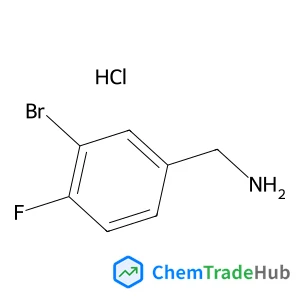
1-(3-Bromo-4-fluorophenyl)methanamine hydrochloride (1:1)
CAS Number:
202865-68-7
Molecular Formula:
C7H8BrClFN
Jordi Gómez-Segura, Ismael Díez-Pérez, Naoto Ishikawa, Motohiro Nakano, Jaume Veciana, Daniel Ruiz-Molina
The presence of alkoxyl chains on the single-molecule magnet [(Pc′)2TbIII] and its planar character favour its 2-D self-assembly on HOPG with the molecular plane parallel to the graphite surface, enabling us to control and/or predict the orientation of the preferential magnetization axis on the surface.
Mathias Schnippering, Alain Zahn, Shi-Xia Liu, Christian Leumann, Silvio Decurtins, David J. Fermín
DOI: 10.1039/B907847A
Victor Duffort, René Thouvenot, Carlos Afonso, Guillaume Izzet, Anna Proust
DOI: 10.1039/B913475A
Mihye Kim, Ji Youn Lee, Sunny S. Shah, Giyoong Tae, Alexander Revzin
DOI: 10.1039/B909169F
Long Lin, Qianjin Chen, Bo Xu
DOI: 10.1039/D0QO00979B
Haibo Mei, Jiang Liu, Romana Pajkert, Li Wang, Gerd-Volker Röschenthaler, Jianlin Han
DOI: 10.1039/D0QO01394C
Chao Che, Wenzhao Li, Shengyue Lin, Jiwei Chen, Jie Zheng, Jiun-chen Wu, Qunxiong Zheng, Guoqing Zhang, Biwang Jiang
DOI: 10.1039/B911999J
Ghayoor A. Chotana, Britt A. Vanchura, II, Man Kin Tse, Richard J. Staples, Robert E. Maleczka, Jr, Milton R. Smith, III
DOI: 10.1039/B914736E
Xing Yi Ling, Jurriaan Huskens
DOI: 10.1039/B909918B
When considering alternatives to 1-(4-Chlorophenyl)-N-hydroxymethanimine (CAS: 3...
This compound should be stored in a cool, dry place away from direct sunlight. I...
3-(4-Bromophenyl)-5-(2-fluorophenyl)-1,2,4-oxadiazole is synthesized through a m...
5-Chloro-2-(4-chlorophenyl)-4-methyl-6-[3-(1-piperidinyl)propoxy]pyrimidine (CAS...
2-Chloro-4-(difluoromethoxy)pyridine is used in the pharmaceutical industry for ...
3-Chloro-6-methylpyridazine (CAS: 1121-79-5) is classified under the Globally Ha...
Several alternatives can be used in the synthesis of Methyl 4,5-dimethyl-2-nitro...
Alternatives to (2E,2'E)-3,3'-(1,4-Phenylene)bisacrylaldehyde include other acry...
3-Amino-5-chloropyridin-2-ol hydrochloride is an organic compound with the CAS n...
When handling 6,7-Difluoro-2,3-dihydro-4H-chromen-4-one, it is essential to wear...

ChemComm publishes urgent research which is of outstanding significance and interest to experts in the field, while also appealing to the journal’s broad chemistry readership. Our communication format is ideally suited to short, urgent studies that are of such importance that they require accelerated publication. Our scope covers all topics in chemistry, and research at the interface of chemistry and other disciplines (such as materials science, nanoscience, physics, engineering and biology) where there is a significant novelty in the chemistry aspects. Major topic areas covered include: Analytical Chemistry Catalysis Chemical Biology and medicinal chemistry Computational Chemistry and Machine Learning Energy and sustainable chemistry Environmental Chemistry Green Chemistry Inorganic Chemistry Materials Chemistry Nanoscience Organic Chemistry Physical Chemistry Polymer Chemistry Supramolecular Chemistry