













Thermoelectric properties of the tetrahedrite–tennantite solid solutions Cu12Sb4−xAsxS13 and Cu10Co2Sb4−yAsyS13 (0 ≤ x, y ≤ 4)
Literature Information
Publication Date
2019-01-31
DOI
10.1039/C9CP00213H
Impact Factor
3.676
Authors
Christophe Candolfi, Anne Dauscher, Janusz Tobola, Jiří Hejtmánek, Bertrand Lenoir
View Original
Abstract
Tetrahedrites, a class of copper- and sulfur-rich minerals, exhibit inherently very low lattice thermal conductivity and adjustable electronic properties that make them interesting candidates for thermoelectric applications. Here, we investigate the influence of isovalent As substitution on the Sb site on the structural and transport properties (5–700 K) of the two solid solutions Cu12Sb4−xAsxS13 and Cu10Co2Sb4−yAsyS13 (0 ≤ x, y ≤ 4). Electronic band structure calculations predict that As has only a weak influence on the valence bands and hence, on the p-type metallic character of Cu12Sb4S13. In agreement with these predictions, all the samples of the series Cu12Sb4−xAsxS13 exhibit p-type metallic behavior with relatively low electrical resistivity and moderate thermopower values that only slightly evolve with the As content. In contrast, the substitution of Co for Cu in As-rich samples seems less favorable as suggested by a decrease in the Co concentration with increasing the As content. This trend leads to a concomitant increase in the electrical resistivity and thermopower leaving the ZT values practically unchanged with respect to purely Cu-based samples. As a result, peak ZT values ranging between 0.60 and 0.75 are achieved at 700 K for both series. The lack of significant variations in the ZT values confirms the robustness of the thermoelectric performances of tetrahedrites with respect to variations in the Sb-to-As ratio.
Related Literature
Carboxymethylcellulose/layered double hydroxide dispersions for topical ocular delivery of non-steroidal anti-inflammatory drugs
Giuliana Mosconi, María Lina Formica, Santiago D. Palma, Ricardo Rojas
2023-11-24
Paper
DOI: 10.1039/D3NJ04434C
Near-infrared dye IRDye800CW-NHS coupled to Trastuzumab for near-infrared II fluorescence imaging in tumor xenograft models of HER-2-positive breast cancer
Junhui Xiao, Qiufeng Ma, Silan Bai, Xinrong Guo, Lishi Wang
2023-10-31
Paper
DOI: 10.1039/D3TB01486J
Boosting the photodegradation of rhodamine B with the CuWO4/g-C3N4 heterojunction by introducing biomass derived N-CQDs as an electron mediator: mechanism and DFT calculations
Purashri Basyach, Siddhartha K. Purkayastha, Ankur K. Guha, Lakshi Saikia
2023-11-10
Paper
DOI: 10.1039/D3NJ05016E
Manganese(ii) complexes of hexaazatrinaphthylene and hexaazatrianthracene: synthesis, structure and properties
Maxim V. Mikhailenko, Vladislav V. Ivanov, Maxim A. Faraonov, Aleksey V. Kuzmin, Salavat S. Khasanov, Akihiro Otsuka, Hideki Yamochi, Hiroshi Kitagawa, Dmitri V. Konarev
2023-11-14
Paper
DOI: 10.1039/D3NJ04615J
Fine-tuning of the charge-separated state energy in compact orthogonal naphthalene–phenoxazine dyads and its effect on the thermally-activated delayed fluorescence
Jieyu Tang, Xi Liu, Xue Zhang, Jianzhang Zhao, Yan Wan
2023-11-13
Paper
DOI: 10.1039/D3NJ04201D
Direct osteogenesis and immunomodulation dual function via sustained release of naringin from the polymer scaffold
Wei Xiong, Lingmei Yuan, Jinyang Huang, Bin Pan, Ling Guo, Guowen Qian
2023-10-18
Paper
DOI: 10.1039/D3TB01555F
Transition-metal-free synthesis and photophysical studies of highly functionalized (E)-stilbenes
Ritu Mamgain, Gana R. J., Abhrajeet Malik, Fateh V. Singh
2023-11-21
Paper
DOI: 10.1039/D3NJ03458E
The synthesis and topochemical polymerization of o-carborane-based diacetylene macrocycles
Meigui Fu, Shuai Yuan, Qi Qu, Yaofeng Yuan, Caixia Lin
2023-10-12
Paper
DOI: 10.1039/D3NJ03491G
You might also like
Compound Q&A
What precautions should be taken when handling 4-(2-Furylmethyl)thiomorpholine 1,1-dioxide (CAS: 79206-94-3)?
When handling 4-(2-Furylmethyl)thiomorpholine 1,1-dioxide (CAS: 79206-94-3), it ...
79206-94-34-(2-Furylmethyl)thi...
Compound Q&A
What precautions should be taken when handling 4-Chloro-N-[2-(4-morpholinyl)ethyl]benzamide (CAS: 71320-77-9)?
When handling 4-Chloro-N-[2-(4-morpholinyl)ethyl]benzamide (CAS: 71320-77-9), it...
71320-77-94-Chloro-N-[2-(4-mor...
Compound Q&A
How should waste containing 2-[2-(2-Methoxyethoxy)ethoxy]ethyl 4-methylbenzenesulfonate (CAS: 62921-74-8) be handled?
Waste containing this compound (CAS: 62921-74-8) should be handled according to ...
62921-74-82-[2-(2-Methoxyethox...
Compound Q&A
How should waste containing (S)-Methyl 2-amino-3-cyclohexylpropanoate be handled?
Waste containing (S)-Methyl 2-amino-3-cyclohexylpropanoate should be collected i...
40056-18-6(S)-Methyl 2-amino-3...
Compound Q&A
How is 5-({4-[(2S,4R)-4-Hydroxy-2-methyltetrahydro-2H-pyran-4-yl]-2-thienyl}sulfanyl)-1-methyl-1,3-dihydro-2H-indol-2-one (CAS: 166882-70-8) typically synthesized?
This compound can be synthesized using a multi-step process involving the conjug...
166882-70-85-({4-[(2S,4R)-4-Hyd...
Compound Q&A
Are there alternatives to (2E)-3-(3,4-Dichlorophenyl)acrylic acid (CAS: 7312-27-8) in synthesis?
There are several alternatives to (2E)-3-(3,4-Dichlorophenyl)acrylic acid in syn...
7312-27-8(2E)-3-(3,4-Dichloro...
Compound Q&A
How should Ethyl 6-(2-nitrophenyl)imidazo[2,1-b][1,3]thiazole-3-carboxylate (CAS: 925437-84-9) be stored?
Ethyl 6-(2-nitrophenyl)imidazo[2,1-b][1,3]thiazole-3-carboxylate (CAS: 925437-84...
925437-84-9Ethyl 6-(2-nitrophen...
Compound Q&A
How should waste containing 2-(1,3-Thiazol-2-yl)ethanamine (CAS: 18453-07-1) be handled?
Waste containing 2-(1,3-Thiazol-2-yl)ethanamine (CAS: 18453-07-1) should be coll...
18453-07-12-(1,3-Thiazol-2-yl)...
Compound Q&A
How is Methyl 5-iodo-2-methylbenzoate (CAS: 103440-54-6) typically synthesized?
Methyl 5-iodo-2-methylbenzoate can be synthesized through the iodination of meth...
103440-54-6Methyl 5-iodo-2-meth...
Compound Q&A
How is 5-Chloro[1,2,4]triazolo[1,5-a]pyridine (CAS: 1427399-34-5) typically synthesized?
5-Chloro[1,2,4]triazolo[1,5-a]pyridine is commonly synthesized via the condensat...
1427399-34-55-Chloro[1,2,4]triaz...
Source Journal
Physical Chemistry Chemical Physics

CiteScore:
5.5
Self-citation Rate:
10.3%
Articles per Year:
3036
Physical Chemistry Chemical Physics (PCCP) is an international journal co-owned by 19 physical chemistry and physics societies from around the world. This journal publishes original, cutting-edge research in physical chemistry, chemical physics and biophysical chemistry. To be suitable for publication in PCCP, articles must include significant innovation and/or insight into physical chemistry; this is the most important criterion that reviewers and Editors will judge against when evaluating submissions. The journal has a broad scope and welcomes contributions spanning experiment, theory, computation and data science. Topical coverage includes spectroscopy, dynamics, kinetics, statistical mechanics, thermodynamics, electrochemistry, catalysis, surface science, quantum mechanics, quantum computing and machine learning. Interdisciplinary research areas such as polymers and soft matter, materials, nanoscience, energy, surfaces/interfaces, and biophysical chemistry are welcomed if they demonstrate significant innovation and/or insight into physical chemistry. Joined experimental/theoretical studies are particularly appreciated when complementary and based on up-to-date approaches.
Recommended Compounds



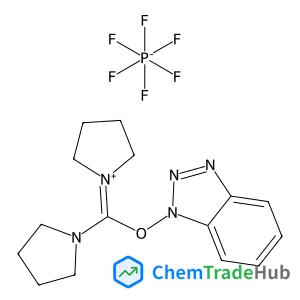
(1H-Benzotriazol-1-yloxy)(di-1-pyrrolidinyl)methylium hexafluorophosphate
CAS Number:
105379-24-6
Molecular Formula:
C15H21F6N5OP
Recommended Suppliers







Disclaimer
This page provides academic journal information for reference and research purposes only. We are not affiliated with any journal publishers and do not handle publication submissions. For publication-related inquiries, please contact the respective journal publishers directly.
If you notice any inaccuracies in the information displayed, please contact us at support@chemtradehub.com. We will promptly review and address your concerns.