












Manganese(ii) complexes of hexaazatrinaphthylene and hexaazatrianthracene: synthesis, structure and properties
Literature Information
Publication Date
2023-11-14
DOI
10.1039/D3NJ04615J
Impact Factor
3.591
Authors
Maxim V. Mikhailenko, Vladislav V. Ivanov, Maxim A. Faraonov, Aleksey V. Kuzmin, Salavat S. Khasanov, Akihiro Otsuka, Hideki Yamochi, Hiroshi Kitagawa, Dmitri V. Konarev
View Original
Abstract
Complexes of high-spin (S = 5/2) manganese(II) with hexaazatrinaphthylene (HATNA) and hexaazatrianthracene (HATA) dianions and radical trianions have been obtained in a crystalline form. Neutral HATNA is coordinated with only one MnII(dedtc)2 fragment (dedtc: diethyldithiocarbamate) in [{MnII(dedtc)2}(HATNA)]0 (1) with long MnII–N(HATNA) bonds of 2.390(5) Å. The HATNA dianions are coordinated with three MnII(dedtc)2 or MnII(acac)2 units in {(K+)(crypt)}2[{MnII(dedtc)2}]3{(HATNA)}2−·2C6H4Cl2 (2) and {(K+)(crypt)}2[{MnII(acac)2}3{(HATNA)}]2−·2C6H4Cl2·C6H14 (3) (crypt is cryptand[2.2.2]) with shorter MnII–N(HATNA) bonds of 2.252(3) and 2.287(4) Å length, respectively. The MnII–N(HATA or HATNA) bonds are shortened to 2.160(4) and 2.110(4) Å in dianionic (CV+)2[(MnIICl2)]3{(HATA)}2−·4C6H4Cl2 (4) and trianionic {(K+)(crypt)}3 {(MnIII2)3(HATNA)}3−·5C6H4Cl2 (5) complexes, respectively (CV+ is a crystal violet cation). It is shown that the MnII–N bonds in 1–5 are longer in comparison with the FeII–N and especially CoII–N bonds. Weak antiferromagnetic MnII–MnII coupling with J values of −1.98 and −2.70 cm−1 is observed for diamagnetic ligands in 2 and 4. The paramagnetic HATNA˙3− ligand (S = 1/2) leads to the additional antiferromagnetic MnII–HATNA˙3− coupling with a J value of −6.6 cm−1 in 5, which coexists with weaker MnII–MnII coupling with a J value of −0.6 cm−1. As a result, the χMT value in 5 only weakly depends on temperature. Thus, the MnII–HATNA˙3− and MnII–MnII couplings are noticeably smaller than those in previously studied CoII and FeII assemblies. Zero-field splitting parameter D is rather high for manganese(II) ions in 2, 4 and 5 being −3.1 to −4.6 cm−1. Weaker exchange coupling allows the observation of both EPR signals from MnII and the paramagnetic ligand. An isotropic EPR signal from MnII with a g-factor of 2.03–2.04 is observed in 2 in the whole studied temperature range. An isotropic EPR signal is also observed in 4 with g = 2.0346 at 295 K. This signal shifts to a lower g-factor at 100 K, whereas low-field components appear only at 4.5 K. The contribution from HATNA˙3− in 5 probably decreases the g-factor to 2.0017 at 295 K. Zero-field splitting of the EPR signal for MnII is manifested at 4.2 K.
Related Literature
Dynamics of N2 sticking on W(100): the decisive role of van der Waals interactions
H. Fabio Busnengo
2018-07-04
Communication
DOI: 10.1039/C8CP03515F
Strain-driven carrier-type switching of surface two-dimensional electron and hole gases in a KTaO3 thin film‡
2018-08-30
Paper
DOI: 10.1039/C8CP03650K
An insight into the effects of transition metals on the thermal expansion of complex perovskite compounds: an experimental and density functional theory investigation
Xiao Wang, Ye Han, Xiaojie Song, Weihui Liu, Yinxi Jin, Wentao Liu, Hongzhi Cui
2018-06-05
Paper
DOI: 10.1039/C8CP02451K
The magnetic fingerprint of dithiazolyl-based molecule magnets
Jordi Ribas-Arino, Juan J. Novoa, Ria Broer, Mercè Deumal
2018-07-12
Paper
DOI: 10.1039/C8CP03173H
Excitonic phenomena in perovskite quantum-dot supercrystals
Ilia A. Vovk, Nikita V. Tepliakov, Anvar S. Baimuratov, Mikhail Yu. Leonov, Alexander V. Baranov, Anatoly V. Fedorov, Ivan D. Rukhlenko
2018-09-17
Paper
DOI: 10.1039/C8CP04724C
Aggregation and fragmentation in liquids with dispersed nanoparticles
2018-06-26
Paper
DOI: 10.1039/C8CP01594E
Insight into the enhanced photocatalytic activity of SrTiO3 in the presence of a (Ni, V/Nb/Ta/Sb) pair
Swapan K. Ghosh
2018-07-06
Paper
DOI: 10.1039/C8CP00844B
Sub-molecular spectroscopy and temporary molecular charging of Ni-phthalocyanine on graphene with STM
Mali Zhao, Faisal Almarzouqi, Eric Duverger, Philippe Sonnet, Gérald Dujardin, Andrew J. Mayne
2018-07-05
Paper
DOI: 10.1039/C8CP02113A
You might also like
Compound Q&A
What precautions should be taken when handling 4-(2-Furylmethyl)thiomorpholine 1,1-dioxide (CAS: 79206-94-3)?
When handling 4-(2-Furylmethyl)thiomorpholine 1,1-dioxide (CAS: 79206-94-3), it ...
79206-94-34-(2-Furylmethyl)thi...
Compound Q&A
What precautions should be taken when handling 4-Chloro-N-[2-(4-morpholinyl)ethyl]benzamide (CAS: 71320-77-9)?
When handling 4-Chloro-N-[2-(4-morpholinyl)ethyl]benzamide (CAS: 71320-77-9), it...
71320-77-94-Chloro-N-[2-(4-mor...
Compound Q&A
How should waste containing 2-[2-(2-Methoxyethoxy)ethoxy]ethyl 4-methylbenzenesulfonate (CAS: 62921-74-8) be handled?
Waste containing this compound (CAS: 62921-74-8) should be handled according to ...
62921-74-82-[2-(2-Methoxyethox...
Compound Q&A
How should waste containing (S)-Methyl 2-amino-3-cyclohexylpropanoate be handled?
Waste containing (S)-Methyl 2-amino-3-cyclohexylpropanoate should be collected i...
40056-18-6(S)-Methyl 2-amino-3...
Compound Q&A
How is 5-({4-[(2S,4R)-4-Hydroxy-2-methyltetrahydro-2H-pyran-4-yl]-2-thienyl}sulfanyl)-1-methyl-1,3-dihydro-2H-indol-2-one (CAS: 166882-70-8) typically synthesized?
This compound can be synthesized using a multi-step process involving the conjug...
166882-70-85-({4-[(2S,4R)-4-Hyd...
Compound Q&A
Are there alternatives to (2E)-3-(3,4-Dichlorophenyl)acrylic acid (CAS: 7312-27-8) in synthesis?
There are several alternatives to (2E)-3-(3,4-Dichlorophenyl)acrylic acid in syn...
7312-27-8(2E)-3-(3,4-Dichloro...
Compound Q&A
How should Ethyl 6-(2-nitrophenyl)imidazo[2,1-b][1,3]thiazole-3-carboxylate (CAS: 925437-84-9) be stored?
Ethyl 6-(2-nitrophenyl)imidazo[2,1-b][1,3]thiazole-3-carboxylate (CAS: 925437-84...
925437-84-9Ethyl 6-(2-nitrophen...
Compound Q&A
How should waste containing 2-(1,3-Thiazol-2-yl)ethanamine (CAS: 18453-07-1) be handled?
Waste containing 2-(1,3-Thiazol-2-yl)ethanamine (CAS: 18453-07-1) should be coll...
18453-07-12-(1,3-Thiazol-2-yl)...
Compound Q&A
How is Methyl 5-iodo-2-methylbenzoate (CAS: 103440-54-6) typically synthesized?
Methyl 5-iodo-2-methylbenzoate can be synthesized through the iodination of meth...
103440-54-6Methyl 5-iodo-2-meth...
Compound Q&A
How is 5-Chloro[1,2,4]triazolo[1,5-a]pyridine (CAS: 1427399-34-5) typically synthesized?
5-Chloro[1,2,4]triazolo[1,5-a]pyridine is commonly synthesized via the condensat...
1427399-34-55-Chloro[1,2,4]triaz...
Source Journal
New Journal of Chemistry

CiteScore:
5.3
Self-citation Rate:
3.7%
Articles per Year:
2153
NJC (New Journal of Chemistry) is a broad-based primary journal encompassing all branches of chemistry and its sub-disciplines. It contains full research articles, communications, perspectives and focus articles. This well-established journal, owned by the Centre National de la Recherche Scientifique (CNRS) of France, has been co-published with the Royal Society of Chemistry since January 1998. NJC is the forum for the publication of high-quality, original and significant work that opens new directions in chemistry or other scientific disciplines. In addition to having a significant chemical component, work published in NJC must demonstrate that it will have an impact on areas of research other than that of the reported work.
Recommended Compounds
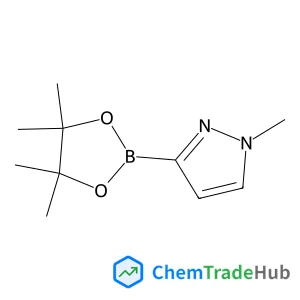
1-Methyl-3-(4,4,5,5-tetramethyl-1,3,2-dioxaborolan-2-yl)-1H-pyrazole
CAS Number:
1020174-04-2
Molecular Formula:
C10H17BN2O2
Recommended Suppliers






Disclaimer
This page provides academic journal information for reference and research purposes only. We are not affiliated with any journal publishers and do not handle publication submissions. For publication-related inquiries, please contact the respective journal publishers directly.
If you notice any inaccuracies in the information displayed, please contact us at support@chemtradehub.com. We will promptly review and address your concerns.