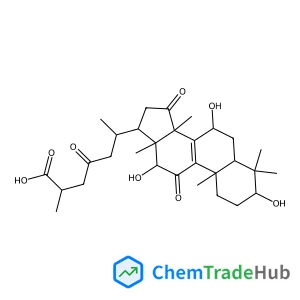
(3beta,7beta,12beta)-3,7,12-Trihydroxy-11,15,23-trioxolanost-8-en-26-oic acid
CAS Number:
98665-22-6
Molecular Formula:
C30H44O8
Giuliana Mosconi, María Lina Formica, Santiago D. Palma, Ricardo Rojas
Drug delivery to ocular tissues is mainly hindered by anatomical and physiological barriers that diminish their bioavailability. In this work, layered double hydroxides (LDHs) intercalated with non-steroidal anti-inflammatory drugs (NSAIDs; ibuprofen, ketoprofen, and ketorolac) were incorporated into carboxymethylcellulose (CMC) dispersions with the aim of adjusting their rheological properties, producing sustained release, and inducing mucoadhesive properties. Pure NSAID-intercalated LDHs (LDH-NSAID) with high drug loading were obtained. The obtained particles showed high aggregation and positive surface charges, which allowed interaction with the negatively charged groups of CMC. Isotonic 1% CMC and 1% LDH-NSAID (w/w) dispersions behaved as viscous, shear-thinning fluids, although a stronger interaction with ketoprofen led to more gel-like behavior. Also, CMC/LDH-NSAID dispersions exhibited a more sustained drug release than that achieved with analogous formulations containing pure drugs, and the modeling of the profile indicated that the release rate was mainly determined by the anion exchange of the intercalated NSAID. Finally, the formulations showed strong mucoadhesion capacity, as they produce significant changes in the zeta potential of mucin dispersions. Further optimization of the particle size and surface properties of the particles is required to modulate the release profile and to enhance the rheological properties of these CMC/LDH-based formulations.
Xiaoyong Liao, You Li, Hongying Cao, Yishu Zhao, Daniel P. Cassidy
DOI: 10.1039/C9AN01540J
Bingbing Gao, Xin Li, Yaqiong Yang, Jianlin Chu, Bingfang He
DOI: 10.1039/C9AN01275C
Xiaohu Liu, Peng Chen, Nhung Thi Tran, Jinling Zhang, Wei Sheng Chia, Bo Liedberg
DOI: 10.1039/C5AN02508G
Zoë J. Ayres, Mark E. Newton, Julie V. Macpherson
DOI: 10.1039/C6AN00340K
Wen Chen, Mei Yang, Na Luo, Fenglin Wang, Ru-Qin Yu, Jian-Hui Jiang
DOI: 10.1039/C9AN01778J
Qi Kang, Dazhong Shen, Yunqing Wang
DOI: 10.1039/C9AN01694E
Elizabeth N. Ndunda, Boris Mizaikoff
DOI: 10.1039/C6AN00293E
Han Zhao, Ying Yan, Mingjian Chen, Tingting Hu, Kefeng Wu, Haisheng Liu, Changbei Ma
DOI: 10.1039/C9AN01659G
Holly J. Butler, Martin R. McAinsh
DOI: 10.1039/C6AN00392C
When handling 4-(2-Furylmethyl)thiomorpholine 1,1-dioxide (CAS: 79206-94-3), it ...
When handling 4-Chloro-N-[2-(4-morpholinyl)ethyl]benzamide (CAS: 71320-77-9), it...
Waste containing this compound (CAS: 62921-74-8) should be handled according to ...
Waste containing (S)-Methyl 2-amino-3-cyclohexylpropanoate should be collected i...
This compound can be synthesized using a multi-step process involving the conjug...
There are several alternatives to (2E)-3-(3,4-Dichlorophenyl)acrylic acid in syn...
Ethyl 6-(2-nitrophenyl)imidazo[2,1-b][1,3]thiazole-3-carboxylate (CAS: 925437-84...
Waste containing 2-(1,3-Thiazol-2-yl)ethanamine (CAS: 18453-07-1) should be coll...
Methyl 5-iodo-2-methylbenzoate can be synthesized through the iodination of meth...
5-Chloro[1,2,4]triazolo[1,5-a]pyridine is commonly synthesized via the condensat...

NJC (New Journal of Chemistry) is a broad-based primary journal encompassing all branches of chemistry and its sub-disciplines. It contains full research articles, communications, perspectives and focus articles. This well-established journal, owned by the Centre National de la Recherche Scientifique (CNRS) of France, has been co-published with the Royal Society of Chemistry since January 1998. NJC is the forum for the publication of high-quality, original and significant work that opens new directions in chemistry or other scientific disciplines. In addition to having a significant chemical component, work published in NJC must demonstrate that it will have an impact on areas of research other than that of the reported work.