













On the preparation and NMR spectroscopic characterization of potassium aluminium tetrahydride KAlH4
Literature Information
Publication Date
2019-05-17
DOI
10.1039/C9CP01059A
Impact Factor
3.676
Authors
Bodo Zibrowius, Michael Felderhoff
View Original
Abstract
Potassium aluminium tetrahydride KAlH4 of high phase purity (space group Pnma (62)) was synthesized via a mechanochemical route. The thus obtained material was studied by 27Al and 39K MAS NMR spectroscopy. For both nuclei precise data for the isotropic chemical shift and the quadrupole coupling at T = 295 K were derived (27Al: δiso = (107.6 ± 0.2) ppm, CQ = (1.29 ± 0.02) MHz and η = 0.64 ± 0.02; 39K: δiso = (6.1 ± 0.2) ppm, CQ = (0.562 ± 0.005) MHz and η = 0.74 ± 0.02). The straightforward NMR spectroscopic approach applied here should also work for other complex aluminium hydrides and for many other materials containing half-integer nuclei experiencing small to medium-sized quadrupole couplings.
Related Literature
3D Printing of a self-healing, high strength, and reprocessable thermoset
Tianyu Yuan, Lisha Zhang, Tony Li, Ruowen Tu
2020-09-01
Paper
DOI: 10.1039/D0PY00819B
Semifluorinated, kinked polyarylenes via direct arylation polycondensation
Fabian Kempe, Felix Riehle, Hartmut Komber, Rukiya Matsidik, Michael Walter, Michael Sommer
2020-10-07
Paper
DOI: 10.1039/D0PY00973C
Cubic POSS engineering of photosensitizer-doped semiconducting polymer nanoparticles for enhanced fluorescence imaging and amplified photodynamic therapy
Biqing Bao, Xue Zhai, Tianqi Liu, Peng Su, Luyao Zhou, Yu Xu, Bingbing Gu, Lianhui Wang
2020-10-08
Paper
DOI: 10.1039/D0PY01199A
Multimesophase transitions of main-chain liquid crystalline copolymers with strictly alternating fluorocarbon chains
Enjie He, Kai Tu, Jiannan Cheng, Huanjun Lu, Lifen Zhang, Zhenping Cheng, Xiulin Zhu
2021-01-05
Paper
DOI: 10.1039/D0PY01644F
Facile topological transformation of ABA triblock copolymers into multisite, single-chain-folding and branched multiblock copolymers via sequential click coupling and anthracene chemistry
Yanzhe He, Zhigang Wang, Peng Liu, Xiangdong Zhou, Youliang Zhao
2021-01-13
Paper
DOI: 10.1039/D0PY01649G
A supramolecular polymer with ultra-stretchable, notch-insensitive, rapid self-healing and adhesive properties
Lun Zhang, Dong Wang, Liqiang Xu, Aimin Zhang
2020-12-14
Paper
DOI: 10.1039/D0PY01536A
Command-destruct thermosets via photoinduced thiol-catalyzed β-scission of acyclic benzylidene acetals
William D. Walker, Michael J. Sandoz, Samuel Roland, Tony M. Buster, John K. Newman, Derek L. Patton
2020-09-14
Communication
DOI: 10.1039/D0PY01006E
Coupling of RAFT polymerization and chemoselective post-modifications of elastin-like polypeptides for the synthesis of gene delivery hybrid vectors
Lourdes Mónica Bravo-Anaya, Julien Rosselgong, Ye Xiao, Amélie Vax, Emmanuel Ibarboure, Anna Ruban, Coralie Lebleu, Gilles Joucla, Bertrand Garbay, Elisabeth Garanger, Sébastien Lecommandoux
2020-11-21
Paper
DOI: 10.1039/D0PY01293A
You might also like
Compound Q&A
What are the main uses of 1H-Indazole-6-carbonitrile (CAS: 141290-59-7)?
1H-Indazole-6-carbonitrile finds applications in pharmaceuticals, where it serve...
141290-59-71H-Indazole-6-carbon...
Compound Q&A
How should waste containing Dioctyl (2E)-2-butenedioate (CAS: 2997-85-5) be handled?
Waste containing Dioctyl (2E)-2-butenedioate (CAS: 2997-85-5) should be collecte...
2997-85-5Dioctyl (2E)-2-buten...
Compound Q&A
What industries use Sodium [(1,2-benzoxazol-3-ylmethyl)sulfonyl]azanide (CAS: 68291-98-5)?
Sodium [(1,2-benzoxazol-3-ylmethyl)sulfonyl]azanide is primarily used in pharmac...
68291-98-5Sodium [(1,2-benzoxa...
Compound Q&A
Are there alternatives to Dimethyl 4-(4,4,5,5-tetramethyl-1,3,2-dioxaborolan-2-yl)-2,6-pyridinedicarboxylate (CAS: 741709-66-0) in synthesis?
Dimethyl 4-(4,4,5,5-tetramethyl-1,3,2-dioxaborolan-2-yl)-2,6-pyridinedicarboxyla...
741709-66-0Dimethyl 4-(4,4,5,5-...
Compound Q&A
How should waste containing 2-Fluoro-6-hydrazinopyridine (CAS: 80714-39-2) be handled?
Waste containing 2-Fluoro-6-hydrazinopyridine (CAS: 80714-39-2) should be manage...
80714-39-22-Fluoro-6-hydrazino...
Compound Q&A
What is 6-Formyl-2-pyridinecarboxylic acid (CAS: 499214-11-8)?
6-Formyl-2-pyridinecarboxylic acid is an organic compound with the molecular for...
499214-11-86-Formyl-2-pyridinec...
Compound Q&A
What is the market or research trend for 3-(3,4-dimethoxyphenyl)-2,5-dimethyl-N-(2-morpholin-4-ylethyl)pyrazolo[1,5-a]pyrimidin-7-amine (CAS: 900874-91-1)?
Research trends for this compound indicate a focus on its potential applications...
900874-91-13-(3,4-dimethoxyphen...
Compound Q&A
How is 9H-Tribenzo[b,d,f]azepine (CAS: 29875-73-8) typically synthesized?
9H-Tribenzo[b,d,f]azepine is typically synthesized via a multi-step process invo...
29875-73-89H-Tribenzo[b,d,f]az...
Compound Q&A
How is 1-Cyclopropyl-7-ethoxy-6-fluoro-8-methoxy-4-oxo-1,4-dihydro-3-quinolinecarboxylic acid (CAS: 1797982-51-4) typically synthesized?
1-Cyclopropyl-7-ethoxy-6-fluoro-8-methoxy-4-oxo-1,4-dihydro-3-quinolinecarboxyli...
1797982-51-41-Cyclopropyl-7-etho...
Compound Q&A
How should waste containing Methyl 3-oxo-1,2,3,4-tetrahydro-6-quinoxalinecarboxylate (CAS: 671820-52-3) be handled?
Waste containing Methyl 3-oxo-1,2,3,4-tetrahydro-6-quinoxalinecarboxylate (CAS: ...
671820-52-3Methyl 3-oxo-1,2,3,4...
Source Journal
Physical Chemistry Chemical Physics

CiteScore:
5.5
Self-citation Rate:
10.3%
Articles per Year:
3036
Physical Chemistry Chemical Physics (PCCP) is an international journal co-owned by 19 physical chemistry and physics societies from around the world. This journal publishes original, cutting-edge research in physical chemistry, chemical physics and biophysical chemistry. To be suitable for publication in PCCP, articles must include significant innovation and/or insight into physical chemistry; this is the most important criterion that reviewers and Editors will judge against when evaluating submissions. The journal has a broad scope and welcomes contributions spanning experiment, theory, computation and data science. Topical coverage includes spectroscopy, dynamics, kinetics, statistical mechanics, thermodynamics, electrochemistry, catalysis, surface science, quantum mechanics, quantum computing and machine learning. Interdisciplinary research areas such as polymers and soft matter, materials, nanoscience, energy, surfaces/interfaces, and biophysical chemistry are welcomed if they demonstrate significant innovation and/or insight into physical chemistry. Joined experimental/theoretical studies are particularly appreciated when complementary and based on up-to-date approaches.
Recommended Compounds
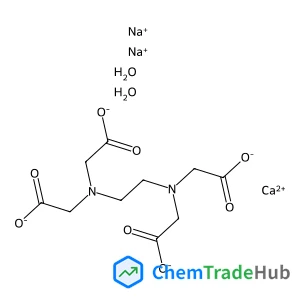
EthylenediaminetetraaceticacidcalciumDisodiumsalthydrate
CAS Number:
23411-34-9
Molecular Formula:
C10H16CaN2Na2O10
Recommended Suppliers




Disclaimer
This page provides academic journal information for reference and research purposes only. We are not affiliated with any journal publishers and do not handle publication submissions. For publication-related inquiries, please contact the respective journal publishers directly.
If you notice any inaccuracies in the information displayed, please contact us at support@chemtradehub.com. We will promptly review and address your concerns.