













Study on the icosahedral fullerene structure with ultra-light and pressure resistance character
Literature Information
Publication Date
2019-05-07
DOI
10.1039/C8CP07787H
Impact Factor
3.676
Authors
Yifan Zhao, Yin Lian, Huifeng Tan
View Original
Abstract
An ultra-light icosahedral fullerene structure is described having 12 pentagonal faces at the vertices of the regular icosahedron and 20 triangular faces, which are expanded by hexagonal faces that consist of carbon atoms. When its size exceeds a critical value, the density of the icosahedron becomes lower than that of air. Since the hollow structure deforms under atmospheric pressure, we proposed the addition of helium atoms as a means to obtaining a floatable icosahedral fullerene with pressure-resistant character. According to these requirements, the radius of the midpoint ball of the edge is 493.33 μm; the total density of the helium-filled structure is 0.18 kg m−3; and the buoyancy per cubic meter in the air is 10.88 N. Theoretical calculation and simulation are combined to explore a new approach to ultra-light materials.
Related Literature
Photoactive rose bengal-based latex via RAFT emulsion polymerization-induced self-assembly
Charlène Boussiron, Mickaël Le Bechec, Julia Sabalot, Sylvie Lacombe, Maud Save
2020-10-13
Paper
DOI: 10.1039/D0PY01128B
Natural cyclodextrins and their derivatives for polymer synthesis
Magdalena A. Przybyla, Gokhan Yilmaz, C. Remzi Becer
2020-11-12
Review Article
DOI: 10.1039/D0PY01464H
A supramolecular polymer with ultra-stretchable, notch-insensitive, rapid self-healing and adhesive properties
Lun Zhang, Dong Wang, Liqiang Xu, Aimin Zhang
2020-12-14
Paper
DOI: 10.1039/D0PY01536A
An ε-caprolactone-derived 2-oxazoline inimer for the synthesis of graft copolymers
Jungyeon Kim, Christopher Waldron, Beatrice Cattoz, C. Remzi Becer
2020-10-08
Paper
DOI: 10.1039/D0PY01092H
Cellulose-based polyacetals by direct and sensitized photocationic ring-opening polymerization of levoglucosenyl methyl ether
Kerem Kaya, Tapas Debsharma, Helmut Schlaad
2020-10-19
Communication
DOI: 10.1039/D0PY01307B
Photocycloreversions within single polymer chains
Modan Liu, Wolfgang Wenzel
2020-09-22
Paper
DOI: 10.1039/D0PY01062F
Visible-light reversible photopolymerisation: insights via online photoflow – electrospray ionisation – mass spectrometry
Matthias Van De Walle, Charlotte Petit, James P. Blinco, Christopher Barner-Kowollik
2020-09-30
Communication
DOI: 10.1039/D0PY01119C
Retracted Article: Non-thermal microwave effects in radical polymerization of bio-based terpenoid (meth)acrylates
Amaia Agirre, José M. Asua
2020-10-13
Paper
DOI: 10.1039/D0PY01192D
You might also like
Compound Q&A
What are the main uses of 1H-Indazole-6-carbonitrile (CAS: 141290-59-7)?
1H-Indazole-6-carbonitrile finds applications in pharmaceuticals, where it serve...
141290-59-71H-Indazole-6-carbon...
Compound Q&A
How should waste containing Dioctyl (2E)-2-butenedioate (CAS: 2997-85-5) be handled?
Waste containing Dioctyl (2E)-2-butenedioate (CAS: 2997-85-5) should be collecte...
2997-85-5Dioctyl (2E)-2-buten...
Compound Q&A
What industries use Sodium [(1,2-benzoxazol-3-ylmethyl)sulfonyl]azanide (CAS: 68291-98-5)?
Sodium [(1,2-benzoxazol-3-ylmethyl)sulfonyl]azanide is primarily used in pharmac...
68291-98-5Sodium [(1,2-benzoxa...
Compound Q&A
Are there alternatives to Dimethyl 4-(4,4,5,5-tetramethyl-1,3,2-dioxaborolan-2-yl)-2,6-pyridinedicarboxylate (CAS: 741709-66-0) in synthesis?
Dimethyl 4-(4,4,5,5-tetramethyl-1,3,2-dioxaborolan-2-yl)-2,6-pyridinedicarboxyla...
741709-66-0Dimethyl 4-(4,4,5,5-...
Compound Q&A
How should waste containing 2-Fluoro-6-hydrazinopyridine (CAS: 80714-39-2) be handled?
Waste containing 2-Fluoro-6-hydrazinopyridine (CAS: 80714-39-2) should be manage...
80714-39-22-Fluoro-6-hydrazino...
Compound Q&A
What is 6-Formyl-2-pyridinecarboxylic acid (CAS: 499214-11-8)?
6-Formyl-2-pyridinecarboxylic acid is an organic compound with the molecular for...
499214-11-86-Formyl-2-pyridinec...
Compound Q&A
What is the market or research trend for 3-(3,4-dimethoxyphenyl)-2,5-dimethyl-N-(2-morpholin-4-ylethyl)pyrazolo[1,5-a]pyrimidin-7-amine (CAS: 900874-91-1)?
Research trends for this compound indicate a focus on its potential applications...
900874-91-13-(3,4-dimethoxyphen...
Compound Q&A
How is 9H-Tribenzo[b,d,f]azepine (CAS: 29875-73-8) typically synthesized?
9H-Tribenzo[b,d,f]azepine is typically synthesized via a multi-step process invo...
29875-73-89H-Tribenzo[b,d,f]az...
Compound Q&A
How is 1-Cyclopropyl-7-ethoxy-6-fluoro-8-methoxy-4-oxo-1,4-dihydro-3-quinolinecarboxylic acid (CAS: 1797982-51-4) typically synthesized?
1-Cyclopropyl-7-ethoxy-6-fluoro-8-methoxy-4-oxo-1,4-dihydro-3-quinolinecarboxyli...
1797982-51-41-Cyclopropyl-7-etho...
Compound Q&A
How should waste containing Methyl 3-oxo-1,2,3,4-tetrahydro-6-quinoxalinecarboxylate (CAS: 671820-52-3) be handled?
Waste containing Methyl 3-oxo-1,2,3,4-tetrahydro-6-quinoxalinecarboxylate (CAS: ...
671820-52-3Methyl 3-oxo-1,2,3,4...
Source Journal
Physical Chemistry Chemical Physics

CiteScore:
5.5
Self-citation Rate:
10.3%
Articles per Year:
3036
Physical Chemistry Chemical Physics (PCCP) is an international journal co-owned by 19 physical chemistry and physics societies from around the world. This journal publishes original, cutting-edge research in physical chemistry, chemical physics and biophysical chemistry. To be suitable for publication in PCCP, articles must include significant innovation and/or insight into physical chemistry; this is the most important criterion that reviewers and Editors will judge against when evaluating submissions. The journal has a broad scope and welcomes contributions spanning experiment, theory, computation and data science. Topical coverage includes spectroscopy, dynamics, kinetics, statistical mechanics, thermodynamics, electrochemistry, catalysis, surface science, quantum mechanics, quantum computing and machine learning. Interdisciplinary research areas such as polymers and soft matter, materials, nanoscience, energy, surfaces/interfaces, and biophysical chemistry are welcomed if they demonstrate significant innovation and/or insight into physical chemistry. Joined experimental/theoretical studies are particularly appreciated when complementary and based on up-to-date approaches.
Recommended Compounds
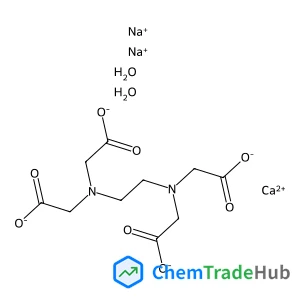
EthylenediaminetetraaceticacidcalciumDisodiumsalthydrate
CAS Number:
23411-34-9
Molecular Formula:
C10H16CaN2Na2O10

Recommended Suppliers






Disclaimer
This page provides academic journal information for reference and research purposes only. We are not affiliated with any journal publishers and do not handle publication submissions. For publication-related inquiries, please contact the respective journal publishers directly.
If you notice any inaccuracies in the information displayed, please contact us at support@chemtradehub.com. We will promptly review and address your concerns.