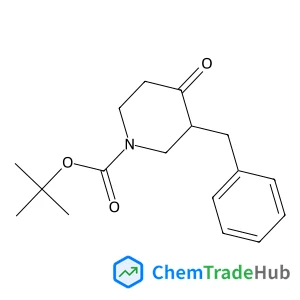
2-Methyl-2-propanyl 3-benzyl-4-oxo-1-piperidinecarboxylate
CAS Number:
193274-82-7
Molecular Formula:
C17H23NO3
Jiaxin Li, Eyoro Noah Nadine Joelle, Qian Yang, Feng Zheng, Wenyuan Liu, Jing Liu
Phenylhydrazines, which are important intermediates in pharmaceutical synthesis, are known as genotoxic or mutagenic impurities. They are only allowed to be present at trace levels in drug products and therefore their control is critical in pharmaceutical development. A conventional high-performance liquid chromatograph with an ultraviolet (UV) detector is always used for the test of phenylhydrazines in drugs, but the similar maximum UV absorption wavelengths of phenylhydrazines and the drug matrix or related substances make the method lack specificity. In this paper, a simple pre-column derivatization approach was applied to selectively move the maximum absorption wavelengths of residual phenylhydrazines in drug substances to the visible region, in which most drugs have little absorption. Phenylhydrazine was chosen as the model analyte for the establishment and validation of the method. Different derivatization reagents were systematically compared, and 4-nitrobenzaldehyde was finally selected as the most suitable choice. This was because the maximum absorption wavelength of its derivative had the largest redshift to 416 nm with a strong absorption intensity, which could not only reduce the matrix interference from drug substances and related substances, but also largely minimize the interference of the derivatization reagent itself. After optimizing the reaction conditions, the limits of detection and quantification were 0.008 μg mL−1 and 0.02 μg mL−1, respectively. This method was successfully applied for the determination of residual phenylhydrazine in antipyrine and indapamide, and 4-hydrazinylbenzenesulfonamide in celecoxib.
Nicholas T. Form, Benjamin J. Whitaker, Lionel Poisson, Benoît Soep
DOI: 10.1039/B602825J
Gabriella Pál-Borbély, Hermann K. Beyer
DOI: 10.1039/B211763K
Radhika S. Saksena, Leslie V. Woodcock
DOI: 10.1039/B407699K
Andreas Hallbrucker, John L. Finney, Erwin Mayer
DOI: 10.1039/B604360G
Andrew M. Smith, Hongwei Duan, Matthew N. Rhyner, Gang Ruan, Shuming Nie
DOI: 10.1039/B606572B
Paul A. Liddell, Gerdenis Kodis, Darius Kuciauskas, Joakim Andréasson, Ana L. Moore, Thomas A. Moore, Devens Gust
DOI: 10.1039/B412326C
DOI: 10.1039/B604333J
R. A. Jockusch, F. O. Talbot, N. Asano, G. W. Fleet, J. P. Simons
DOI: 10.1039/B413672A
E. Michaelis, D. Wöhrle, T. Yoshida, H. Minoura
DOI: 10.1039/B604352F
6-Bromo-2-methylimidazo[1,2-a]pyrimidine (CAS: 1111638-05-1) falls under various...
While there are no direct alternatives, similar compounds like 1-Pyrrolidineetha...
4-Methyl-2,6-bis(2-methyl-2-propanyl)phenyl methylcarbamate (CAS: 1918-11-2) is ...
2-(3-Bromo-4-fluorophenyl)-1,3-dioxolane (CAS: 77771-04-1) should be stored in a...
4,5,6,7-Tetrahydro-1H-indazole hydrochloride is a white crystalline solid with a...
(2R)-1-Methoxy-3-phenyl-2-propanamine is a chiral organic compound with the CAS ...
Ethyl 1-(1-phenylethyl)-1H-imidazole-5-carboxylate is used in various industries...
4-[(1E,3S)-1-(4-Hydroxyphenyl)-1,4-pentadien-3-yl]phenol (CAS: 17676-24-3) falls...
(S)-3-Amino-5-phenylpentanoic acid hydrochloride is primarily used in the pharma...
7-Methoxy-1-benzothiophene-2-carboxylic acid is typically synthesized by reactin...

Analytical Methods welcomes early applications of new analytical and bioanalytical methods and technology demonstrating the potential for societal impact. We require that methods and technology reported in the journal are sufficiently innovative, robust, accurate, and compared to other available methods for the intended application. Developments with interdisciplinary approaches are particularly welcome. Systems should be proven with suitably complex and analytically challenging samples. We encourage developments within, but not limited to, the following technologies and applications: global health, point-of-care and molecular diagnostics biosensors and bioengineering drug development and pharmaceutical analysis applied microfluidics and nanotechnology omics studies, such as proteomics, metabolomics or glycomics environmental, agricultural and food science neuroscience biochemical and clinical analysis forensic analysis industrial process and method development
![(3R)-4-(4-Chlorophenyl)-3-({[(2-methyl-2-propanyl)oxy]carbonyl}amino)butanoic acid structure](https://static.chemtradehub.com/structs/218/218608-96-9-f871.webp "(3R)-4-(4-Chlorophenyl)-3-({[(2-methyl-2-propanyl)oxy]carbonyl}amino)butanoic acid structure")