












Gas-phase structure and conformation of the glycosidase and ceramide glucosyltransferase inhibitorN-benzyl deoxynojirimycin
Literature Information
Publication Date
2004-10-22
DOI
10.1039/B413672A
Impact Factor
3.676
Authors
R. A. Jockusch, F. O. Talbot, N. Asano, G. W. Fleet, J. P. Simons
View Original
Abstract
The deoxynojirimycin (DNJ) family of imino sugars are glucose analogues with an NH group replacing the oxygen atom in the pyranose ring. They are powerful inhibitors of glycosidases and ceramide glucosyltransferases. The conformation of N-benzyl-DNJ, isolated in the gas phase, is studied using a combination of resonant two-photon ionization (R2PI), UV/UV hole-burn, and IR ion-dip spectroscopies in conjunction with electronic structure theory calculations. Three distinct conformers, one major and two minor, are present and all three are assigned to structures in which the exocyclic hydroxymethyl group is axial to the piperidine ring (gauche- to the ring nitrogen). This contrasts with the preferred equatorial (gauche+) orientation observed for simple glucosides and may well contribute to the stronger binding of some enzymes to DNJ-based inhibitors compared to their natural glucoside substrates.
Related Literature
Scaling and dynamics of “flow distributed oscillation patterns” in the Belousov–Zhabotinsky reaction
R. Tóth, V. Gáspár
2002-01-15
Paper
DOI: 10.1039/B107627B
Mechanism of the magnetic field dependence for the liquid phase photoreaction in the nanotube of MCM-41
Masaharu Okazaki, Kazumi Toriyama, Kiichi Oda, Toshio Kasai
2002-02-22
Paper
DOI: 10.1039/B110851D
A comparison of metallophilic attraction in (X–M–PH3)2 (M = Cu, Ag, Au; X = H, Cl)
Lilia Magnko, Marcus Schweizer, Guntram Rauhut, Martin Schütz, Hermann Stoll, Hans-Joachim Werner
2002-02-14
Paper
DOI: 10.1039/B110624D
Chemically induced oscillations in a pH-responsive hydrogel
Colin J. Crook, Andrew Smith, Richard A. L. Jones, Anthony J. Ryan
2002-03-18
Paper
DOI: 10.1039/B109977A
Theoretical study on mechanisms of the high-temperature reactions C2H3 + H2O and C2H4 + OH
Gui-xia Liu, Yi-hong Ding, Ze-sheng Li, Qiang Fu, Xu-ri Huang, Chia-chung Sun, Au-chin Tang
2002-02-15
Paper
DOI: 10.1039/B109758J
Mass-selected infrared photodissociation spectroscopy of V4O10+
K. R. Asmis, M. Brümmer, C. Kaposta, G. Santambrogio, G. von Helden, K. Rademann, L. Wöste
2002-02-27
Communication
DOI: 10.1039/B111056J
Synchrotron radiation studies of the kinetics of cBN crystallization in the NH4F–BN system
2002-02-06
Paper
DOI: 10.1039/B107483K
New phase phenomena in ternary systems at high pressures – Cosolvency and miscibility windows up to 100 MPa
Arndt L. Scheidgen, Gerhard M. Schneider
2002-02-12
Paper
DOI: 10.1039/B109224N
You might also like
Compound Q&A
What regulatory guidelines apply to 6-Bromo-2-methylimidazo[1,2-a]pyrimidine (CAS: 1111638-05-1)?
6-Bromo-2-methylimidazo[1,2-a]pyrimidine (CAS: 1111638-05-1) falls under various...
1111638-05-16-Bromo-2-methylimid...
Compound Q&A
Are there alternatives to 1-Pyrrolidineethanol, β-methyl-α-phenyl-, (αS,βR) (CAS: 123620-80-4) in synthesis?
While there are no direct alternatives, similar compounds like 1-Pyrrolidineetha...
123620-80-41-Pyrrolidineethanol...
Compound Q&A
Is 4-Methyl-2,6-bis(2-methyl-2-propanyl)phenyl methylcarbamate (CAS: 1918-11-2) safe?
4-Methyl-2,6-bis(2-methyl-2-propanyl)phenyl methylcarbamate (CAS: 1918-11-2) is ...
1918-11-24-Methyl-2,6-bis(2-m...
Compound Q&A
How should 2-(3-Bromo-4-fluorophenyl)-1,3-dioxolane (CAS: 77771-04-1) be stored?
2-(3-Bromo-4-fluorophenyl)-1,3-dioxolane (CAS: 77771-04-1) should be stored in a...
77771-04-12-(3-Bromo-4-fluorop...
Compound Q&A
What are the physical and chemical properties of 4,5,6,7-Tetrahydro-1H-indazole hydrochloride (CAS: 18161-11-0)?
4,5,6,7-Tetrahydro-1H-indazole hydrochloride is a white crystalline solid with a...
18161-11-04,5,6,7-Tetrahydro-1...
Compound Q&A
What is (2R)-1-Methoxy-3-phenyl-2-propanamine (CAS: 59919-07-2)?
(2R)-1-Methoxy-3-phenyl-2-propanamine is a chiral organic compound with the CAS ...
59919-07-2(2R)-1-Methoxy-3-phe...
Compound Q&A
What industries use Ethyl 1-(1-phenylethyl)-1H-imidazole-5-carboxylate (CAS: 56649-47-9)?
Ethyl 1-(1-phenylethyl)-1H-imidazole-5-carboxylate is used in various industries...
56649-47-9Ethyl 1-(1-phenyleth...
Compound Q&A
What regulatory guidelines apply to 4-[(1E,3S)-1-(4-Hydroxyphenyl)-1,4-pentadien-3-yl]phenol (CAS: 17676-24-3)?
4-[(1E,3S)-1-(4-Hydroxyphenyl)-1,4-pentadien-3-yl]phenol (CAS: 17676-24-3) falls...
17676-24-34-[(1E,3S)-1-(4-Hydr...
Compound Q&A
What industries use (S)-3-Amino-5-phenylpentanoic acid hydrochloride (CAS: 331846-97-0)?
(S)-3-Amino-5-phenylpentanoic acid hydrochloride is primarily used in the pharma...
331846-97-0(S)-3-Amino-5-phenyl...
Compound Q&A
How is 7-methoxy-1-benzothiophene-2-carboxylic acid (CAS: 88791-07-5) typically synthesized?
7-Methoxy-1-benzothiophene-2-carboxylic acid is typically synthesized by reactin...
88791-07-57-methoxy-1-benzothi...
Source Journal
Physical Chemistry Chemical Physics

CiteScore:
5.5
Self-citation Rate:
10.3%
Articles per Year:
3036
Physical Chemistry Chemical Physics (PCCP) is an international journal co-owned by 19 physical chemistry and physics societies from around the world. This journal publishes original, cutting-edge research in physical chemistry, chemical physics and biophysical chemistry. To be suitable for publication in PCCP, articles must include significant innovation and/or insight into physical chemistry; this is the most important criterion that reviewers and Editors will judge against when evaluating submissions. The journal has a broad scope and welcomes contributions spanning experiment, theory, computation and data science. Topical coverage includes spectroscopy, dynamics, kinetics, statistical mechanics, thermodynamics, electrochemistry, catalysis, surface science, quantum mechanics, quantum computing and machine learning. Interdisciplinary research areas such as polymers and soft matter, materials, nanoscience, energy, surfaces/interfaces, and biophysical chemistry are welcomed if they demonstrate significant innovation and/or insight into physical chemistry. Joined experimental/theoretical studies are particularly appreciated when complementary and based on up-to-date approaches.
Recommended Compounds
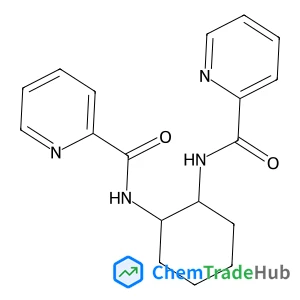
N,N'-(1R,2R)-1,2-Cyclohexanediyldi(2-pyridinecarboxamide)
CAS Number:
218290-24-5
Molecular Formula:
C18H20N4O2


Recommended Suppliers





Disclaimer
This page provides academic journal information for reference and research purposes only. We are not affiliated with any journal publishers and do not handle publication submissions. For publication-related inquiries, please contact the respective journal publishers directly.
If you notice any inaccuracies in the information displayed, please contact us at support@chemtradehub.com. We will promptly review and address your concerns.