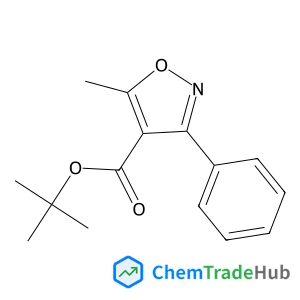
2-Methyl-2-propanyl 5-methyl-3-phenyl-1,2-oxazole-4-carboxylate
CAS Number:
211429-79-7
Molecular Formula:
C15H17NO3
A graphical abstract is available for this content
R. A. Evarestov, A. Senocrate, R. K. Kremer, J. Maier
DOI: 10.1039/C9CP06322F
Alexander Ostermann, Tobias M. Gasser, Thomas Loerting, Jörg Petrasch
DOI: 10.1039/C9CP04735B
Ruijing Wang, Haojie Liu, Qingzhong Li, Steve Scheiner
DOI: 10.1039/C9CP06648A
Luke W. Giles, Joshua B. Marlow, Calum S. G. Butler, Geosmin A. Turpin, Liliana de Campo, Stephen T. Mudie, Charl F. J. Faul, Rico F. Tabor
DOI: 10.1039/C9CP05463D
Liming Wang, Tatiana Zinkevich, Sylvio Indris
DOI: 10.1039/D0CP90046J
Zhong-Fei Xu, Guangwei Geng, Dongjun Wang
DOI: 10.1039/C9CP05273A
Yusuke Morino, Hisaya Hara, Ken-ichi Bando, Sakurako Ono, Akihito Imanishi, Yugo Okada, Hiroyuki Matsui, Takafumi Uemura, Jun Takeya
DOI: 10.1039/D0CP00149J
Susu Zhong, Kaifang Huang, Song Luo, Shuheng Dong, Lili Duan
DOI: 10.1039/C9CP06459A
DOI: 10.1039/C9CP05151A
Domonkos A. Tasi, Tibor Győri, Gábor Czakó
DOI: 10.1039/C9CP07007A
N-(4-Methoxybenzyl)-2-pyridinamine (CAS: 52818-63-0) is increasingly being used ...
When handling Ethyl 4-(2-chlorophenyl)-1,3-thiazole-2-carboxylate, appropriate p...
Diethyldiselane (CAS: 628-39-7) is classified under the Globally Harmonized Syst...
The market for oxocopper (CAS: 12053-18-8) is primarily driven by its use in cat...
The market for 5-{[(2-Methyl-2-propanyl)oxy]carbonyl}-5-azaspiro[2.4]heptane-7-c...
2-(1-Pyrrolidinyl)-4-pyridinamine is a chemical compound with the CAS number 359...
2-(3-Pyridinyl)-1-azabicyclo[2.2.2]octane (CAS: 91556-75-1) is a crystalline sol...
(S)-Alpha-allyl-proline hydrochloride is usually synthesized via a Wittig reacti...
3-Methyl-1,2-oxazole-5-carboxylic acid (CAS: 4857-42-5) is an organic compound w...
Lys-SMCC-DM1 is synthesized via a multi-step process involving the coupling of S...

Analyst publishes analytical and bioanalytical research that reports premier fundamental discoveries and inventions, and the applications of those discoveries, unconfined by traditional discipline barriers.