













A surface plasmon resonance enhanced photoelectrochemical immunoassay based on perovskite metal oxide@gold nanoparticle heterostructures
Literature Information
Publication Date
2019-08-14
DOI
10.1039/C9AN01395D
Impact Factor
4.616
Authors
Lijia Zhang, Zhongbin Luo, Lingshan Su, Dianping Tang
View Original
Abstract
An innovative visible light-driven photoelectrochemical (PEC) immunosensing system was reasonably established for the sensitive detection of prostate-specific antigen (PSA) by using perovskite metal oxide@gold nanoparticle heterostructures (BaTiO3/Au) as the photoactive materials. When plasmonic Au nanoparticles were directly decorated on BaTiO3, a several times surface plasmon resonance (SPR) enhancement of photocurrent density was induced via the injection of hot electrons from visible light-excited Au nanoparticles into the conduction band of BaTiO3, and the combination of BaTiO3 and Au nanoparticles was employed as a promising platform for developing a photoelectrochemical bioanalysis. As a proof of concept, PSA had been detected by the BaTiO3/Au nanocomposite-based PEC sensor. To design such an immunoassay protocol, a monoclonal anti-PSA capture antibody (cAb)-coated microplate and glucose oxidase/polyclonal anti-PSA detection antibody-modified gold nanoparticles (GOx–Au NP–dAb) were used as the immunoreaction platform and signal probe, respectively. Upon the addition of target PSA, a sandwiched immunocomplex was formed accompanying the immuno-recognition between the antigen and antibody, and then the carried GOx could oxidize glucose to produce H2O2. The photocurrent of the BaTiO3/Au nanocomposite-functionalized electrode amplified with increasing H2O2 concentration since H2O2 is considered as a good hole scavenger. On the basis of the above-mentioned mechanisms and the optimized conditions, the assembled PEC immunosensor was linear with the logarithm of the PSA concentration in the range of 0.01–40 ng mL−1 with a detection limit of 4.2 pg mL−1. It afforded rapid response, good precision, and high stability and specificity, implying its great promise in photoelectrochemical immunoassays. More generally, this system sets up an ideal PEC immunosensing system based on the BaTiO3/Au nanocomposites and represents an innovative and low-cost “signal-on” assay scheme for the practical quantitative screening of low-abundance proteins.
Related Literature
Surface binding vs. sequestration; the uptake of benzohydroxamic acid at iron(iii) oxide surfaces
Iria M. Rio-Echevarria, Fraser J. White, Euan K. Brechin, Peter A. Tasker, Steven G. Harris
2008-08-06
Communication
DOI: 10.1039/B808805E
Cyclometallated platinum(ii) complexes incorporating ethynyl–flavoneligands: switching between triplet and singlet emission induced by selective binding of Pb2+ ions
Pierre-Henri Lanoë, Jean-Luc Fillaut, Loïc Toupet, J. A. Gareth Williams, Hubert Le Bozec, Véronique Guerchais
2008-07-16
Communication
DOI: 10.1039/B806935B
Enhancement of the electrocatalytic activity of gold nanoparticlesvia NaBH4 treatment
Jagotamoy Das, Srikanta Patra, Haesik Yang
2008-07-29
Communication
DOI: 10.1039/B806984K
Low reactivity of non-bridging oxygen defects on stoichiometric silica surfaces
Said Hamad
2008-07-14
Communication
DOI: 10.1039/B807291D
Apoferritinprotein cages: a novel drug nanocarrier for photodynamic therapy
Fei Yan, Yan Zhang, Hsiang-kuo Yuan, Molly K. Gregas, Tuan Vo-Dinh
2008-08-21
Communication
DOI: 10.1039/B810949D
The convenient fluorescence turn-on detection of heparin with a silole derivative featuring an ammonium group
Ming Wang, Deqing Zhang, Guanxin Zhang, Daoben Zhu
2008-07-30
Communication
DOI: 10.1039/B808877B
Dynamic resolution of N-Boc-2-lithiopiperidine
Iain Coldham, Sophie Raimbault, Praful T. Chovatia, Jignesh J. Patel, Daniele Leonori, Nadeem S. Sheikh, David T. E. Whittaker
2008-08-08
Communication
DOI: 10.1039/B810988E
Cyclopropenyllithiums as a new source of 1,1-bismetalated cyclopropyl derivatives
Anat Levin, Ilan Marek
2008-07-16
Communication
DOI: 10.1039/B807635A
A self-propagating system for Ge incorporation into nanostructured silica
Aubrey K. Davis, Mark Hildebrand
2008-08-04
Communication
DOI: 10.1039/B804955F
Binary stacks of [CuC6F5]4 with arenes
Ami Doshi, Krishnan Venkatasubbaiah, Arnold L. Rheingold, Frieder Jäkle
2008-07-25
Communication
DOI: 10.1039/B807128D
You might also like
Compound Q&A
What precautions should be taken when handling 4-(2-Furylmethyl)thiomorpholine 1,1-dioxide (CAS: 79206-94-3)?
When handling 4-(2-Furylmethyl)thiomorpholine 1,1-dioxide (CAS: 79206-94-3), it ...
79206-94-34-(2-Furylmethyl)thi...
Compound Q&A
What precautions should be taken when handling 4-Chloro-N-[2-(4-morpholinyl)ethyl]benzamide (CAS: 71320-77-9)?
When handling 4-Chloro-N-[2-(4-morpholinyl)ethyl]benzamide (CAS: 71320-77-9), it...
71320-77-94-Chloro-N-[2-(4-mor...
Compound Q&A
How should waste containing 2-[2-(2-Methoxyethoxy)ethoxy]ethyl 4-methylbenzenesulfonate (CAS: 62921-74-8) be handled?
Waste containing this compound (CAS: 62921-74-8) should be handled according to ...
62921-74-82-[2-(2-Methoxyethox...
Compound Q&A
How should waste containing (S)-Methyl 2-amino-3-cyclohexylpropanoate be handled?
Waste containing (S)-Methyl 2-amino-3-cyclohexylpropanoate should be collected i...
40056-18-6(S)-Methyl 2-amino-3...
Compound Q&A
How is 5-({4-[(2S,4R)-4-Hydroxy-2-methyltetrahydro-2H-pyran-4-yl]-2-thienyl}sulfanyl)-1-methyl-1,3-dihydro-2H-indol-2-one (CAS: 166882-70-8) typically synthesized?
This compound can be synthesized using a multi-step process involving the conjug...
166882-70-85-({4-[(2S,4R)-4-Hyd...
Compound Q&A
Are there alternatives to (2E)-3-(3,4-Dichlorophenyl)acrylic acid (CAS: 7312-27-8) in synthesis?
There are several alternatives to (2E)-3-(3,4-Dichlorophenyl)acrylic acid in syn...
7312-27-8(2E)-3-(3,4-Dichloro...
Compound Q&A
How should Ethyl 6-(2-nitrophenyl)imidazo[2,1-b][1,3]thiazole-3-carboxylate (CAS: 925437-84-9) be stored?
Ethyl 6-(2-nitrophenyl)imidazo[2,1-b][1,3]thiazole-3-carboxylate (CAS: 925437-84...
925437-84-9Ethyl 6-(2-nitrophen...
Compound Q&A
How should waste containing 2-(1,3-Thiazol-2-yl)ethanamine (CAS: 18453-07-1) be handled?
Waste containing 2-(1,3-Thiazol-2-yl)ethanamine (CAS: 18453-07-1) should be coll...
18453-07-12-(1,3-Thiazol-2-yl)...
Compound Q&A
How is Methyl 5-iodo-2-methylbenzoate (CAS: 103440-54-6) typically synthesized?
Methyl 5-iodo-2-methylbenzoate can be synthesized through the iodination of meth...
103440-54-6Methyl 5-iodo-2-meth...
Compound Q&A
How is 5-Chloro[1,2,4]triazolo[1,5-a]pyridine (CAS: 1427399-34-5) typically synthesized?
5-Chloro[1,2,4]triazolo[1,5-a]pyridine is commonly synthesized via the condensat...
1427399-34-55-Chloro[1,2,4]triaz...
Source Journal
Analyst

CiteScore:
7.8
Self-citation Rate:
5.6%
Articles per Year:
653
Analyst publishes analytical and bioanalytical research that reports premier fundamental discoveries and inventions, and the applications of those discoveries, unconfined by traditional discipline barriers.
Recommended Compounds
![tert-Butyl N-[(2-chloropyridin-4-yl)methyl]carbamate structure](https://static.chemtradehub.com/structs/916/916210-27-0-9f95.webp "tert-Butyl N-[(2-chloropyridin-4-yl)methyl]carbamate structure")
tert-Butyl N-[(2-chloropyridin-4-yl)methyl]carbamate
CAS Number:
916210-27-0
Molecular Formula:
C11H15ClN2O2
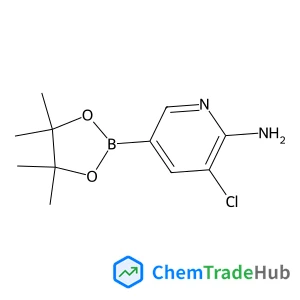
3-Chloro-5-(4,4,5,5-tetramethyl-1,3,2-dioxaborolan-2-yl)-2-pyridinamine
CAS Number:
1032758-99-8
Molecular Formula:
C11H16BClN2O2

Recommended Suppliers





Disclaimer
This page provides academic journal information for reference and research purposes only. We are not affiliated with any journal publishers and do not handle publication submissions. For publication-related inquiries, please contact the respective journal publishers directly.
If you notice any inaccuracies in the information displayed, please contact us at support@chemtradehub.com. We will promptly review and address your concerns.