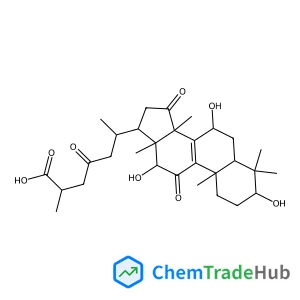
(3beta,7beta,12beta)-3,7,12-Trihydroxy-11,15,23-trioxolanost-8-en-26-oic acid
CAS Number:
98665-22-6
Molecular Formula:
C30H44O8
Iria M. Rio-Echevarria, Fraser J. White, Euan K. Brechin, Peter A. Tasker, Steven G. Harris
Benzohydroxamic acid is shown to be an unexpectedly good ligand for iron(III) oxides, favouring surface attachment to the formation of trisbenzohydroxamato complexes, which are known to have very high thermodynamic stability in solution.
You Wei, Qi-lun Zhang, Hui-jun Wan, Ying-nan Zhang, Shu-wen Zheng, Yong Zhang
DOI: 10.1039/C8CP02734J
Mali Zhao, Faisal Almarzouqi, Eric Duverger, Philippe Sonnet, Gérald Dujardin, Andrew J. Mayne
DOI: 10.1039/C8CP02113A
G. K. Gueorguiev, A. Kakanakova-Georgieva
DOI: 10.1039/C8CP02786B
Feng-Wei Gao, Hong-Liang Xu, Shabbir Muhammad, Zhong-Min Su
DOI: 10.1039/C8CP00416A
Anton Manakhov, David Nečas, Sergey Ershov, Zakhar Popov
DOI: 10.1039/C8CP01452C
DOI: 10.1039/C8CP01594E
Yingxiang Cai, Li Zeng, Yu Zhang, Xuechun Xu
DOI: 10.1039/C8CP03447H
Javor K. Novev, Richard G. Compton
DOI: 10.1039/C8CP91865A
Kevin G. Yager
DOI: 10.1039/C8CP02854K
When handling 4-(2-Furylmethyl)thiomorpholine 1,1-dioxide (CAS: 79206-94-3), it ...
When handling 4-Chloro-N-[2-(4-morpholinyl)ethyl]benzamide (CAS: 71320-77-9), it...
Waste containing this compound (CAS: 62921-74-8) should be handled according to ...
Waste containing (S)-Methyl 2-amino-3-cyclohexylpropanoate should be collected i...
This compound can be synthesized using a multi-step process involving the conjug...
There are several alternatives to (2E)-3-(3,4-Dichlorophenyl)acrylic acid in syn...
Ethyl 6-(2-nitrophenyl)imidazo[2,1-b][1,3]thiazole-3-carboxylate (CAS: 925437-84...
Waste containing 2-(1,3-Thiazol-2-yl)ethanamine (CAS: 18453-07-1) should be coll...
Methyl 5-iodo-2-methylbenzoate can be synthesized through the iodination of meth...
5-Chloro[1,2,4]triazolo[1,5-a]pyridine is commonly synthesized via the condensat...

ChemComm publishes urgent research which is of outstanding significance and interest to experts in the field, while also appealing to the journal’s broad chemistry readership. Our communication format is ideally suited to short, urgent studies that are of such importance that they require accelerated publication. Our scope covers all topics in chemistry, and research at the interface of chemistry and other disciplines (such as materials science, nanoscience, physics, engineering and biology) where there is a significant novelty in the chemistry aspects. Major topic areas covered include: Analytical Chemistry Catalysis Chemical Biology and medicinal chemistry Computational Chemistry and Machine Learning Energy and sustainable chemistry Environmental Chemistry Green Chemistry Inorganic Chemistry Materials Chemistry Nanoscience Organic Chemistry Physical Chemistry Polymer Chemistry Supramolecular Chemistry