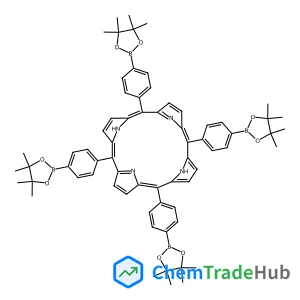
5,10,15,20-tetrakis(4-boronic acid pinacol ester phenyl) porphyrin
CAS Number:
1332748-00-1
Molecular Formula:
C68H74B4N4O8
Xinglin Wang, Xiaoyi Gao, Jiale He, Xiaochen Hu, Yunchao Li, Xiaohong Li, Louzhen Fan, Hua-Zhong Yu
Graphene oxide (GO)-based aptasensors are currently one of the most popular sensing platforms for the simple and rapid detection of various targets. Unfortunately, the GO-based aptasensors with long aptamer strands typically show unsatisfactory performance resulting from insignificant structural transformations upon target binding. We report herein the utilization of an aptamer-truncating strategy to combat such a challenge. Taking a pre-selected anti-aflatoxin B1 (AFB1) aptamer (P-AFB1-50) as a trial system, we sequentially remove the extraneous nucleotides within the aptamer by means of circular dichroism (CD) spectroscopy and binding affinity analysis. Particularly, the ratio of the quenching constants between the GO sheets and the truncated aptamers (labelled with fluorophores) in the absence and presence of the target was determined for each of the truncated aptamers to evaluate the optimal sequence. As a result, the truncated aptamer comprising 40 nucleotides was confirmed to show the highest FL output and the best detection limit upon conjugation with GO sheets. More importantly, we demonstrated that this truncating strategy is versatile, i.e., it can be easily extended to other aptamer systems (anti-ochratoxin A (OTA) aptamer, P-OTA-61, as an example) for extraneous nucleotide identification. Impressively, the two optimal truncated aptamers can work together on GO sheets to achieve a simultaneous detection of two different mycotoxins (i.e., AFB1 and OTA) in one single test. Essentially, this research opens a new avenue for the design and testing of aptamer-/GO-based-sensing platforms for rapid, low-cost and multiplex quantification of analytical targets of interest.
Shengmin Zhou, Lu Wang
DOI: 10.1039/C9CP06840F
Mathias Strauss, Carlos Alberto Rodrigues Costa, Cátia Crispilho Corrêa
DOI: 10.1039/C9CP05717J
Ellen C. Wrobel, Lucas S. de Lara, Taiza A. S. do Carmo, Patrícia Castellen, Márcio Lazzarotto, Sérgio R. de Lázaro, Alexandre Camilo, Jr, Luciano Caseli, Rolf Schmidt, Christine E. DeWolf, Karen Wohnrath
DOI: 10.1039/D0CP00432D
Natasha W. Pettinger, Jennifer M. Empey, Sascha Fröbel, Bern Kohler
DOI: 10.1039/C9CP06579B
Luke W. Giles, Joshua B. Marlow, Calum S. G. Butler, Geosmin A. Turpin, Liliana de Campo, Stephen T. Mudie, Charl F. J. Faul, Rico F. Tabor
DOI: 10.1039/C9CP05463D
Zhixiang Liu, Mengyuan Xiang, Yao Zhang, Huaiyu Shao, Yunfeng Zhu, Xinli Guo, Liquan Li, Hui Wang, Wanqiang Liu
DOI: 10.1039/C9CP06090A
Jun Li, Changjian Xie, Hua Guo
DOI: 10.1039/D0CP90032J
Lekshmi R. S., Gayathri B. Kurup, Sivaranjana Reddy Vennapusa
DOI: 10.1039/C9CP06857K
N-(4-Methoxybenzyl)-2-pyridinamine (CAS: 52818-63-0) is increasingly being used ...
When handling Ethyl 4-(2-chlorophenyl)-1,3-thiazole-2-carboxylate, appropriate p...
Diethyldiselane (CAS: 628-39-7) is classified under the Globally Harmonized Syst...
The market for oxocopper (CAS: 12053-18-8) is primarily driven by its use in cat...
The market for 5-{[(2-Methyl-2-propanyl)oxy]carbonyl}-5-azaspiro[2.4]heptane-7-c...
2-(1-Pyrrolidinyl)-4-pyridinamine is a chemical compound with the CAS number 359...
2-(3-Pyridinyl)-1-azabicyclo[2.2.2]octane (CAS: 91556-75-1) is a crystalline sol...
(S)-Alpha-allyl-proline hydrochloride is usually synthesized via a Wittig reacti...
3-Methyl-1,2-oxazole-5-carboxylic acid (CAS: 4857-42-5) is an organic compound w...
Lys-SMCC-DM1 is synthesized via a multi-step process involving the coupling of S...

Analyst publishes analytical and bioanalytical research that reports premier fundamental discoveries and inventions, and the applications of those discoveries, unconfined by traditional discipline barriers.