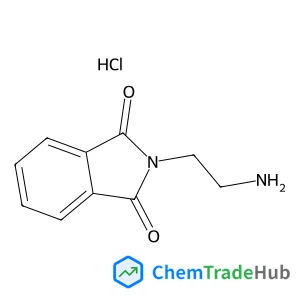
2-(2-Aminoethyl)-1H-isoindole-1,3(2H)-dione hydrochloride (1:1)
CAS Number:
30250-67-0
Molecular Formula:
C10H11ClN2O2
Dongsheng Mao, Tianshu Chen, Huinan Chen, Mengru Zhou, Xiaoli Zhu
In this work, we propose a novel concept and a proof-of-concept strategy for the fabrication of a pH-based immunoassay platform with a certain degree of universality and scalability to make it adaptable for different application scenarios. The immunoreactions for the target detection are converted to pH changes through an engineered and optimized isothermal nucleic acid amplification, named exponential amplification reaction (EXPAR). Thus, a variety of well-developed methods for pH analysis, e.g. pH indicators, pH-strips and pH meters, can be applied for immunoassay directly. Here, we show that this proof-of-concept strategy is applicable for both macromolecular and micromolecular antigens by adopting human platelet-derived growth factor-BB (PDGF-BB) and chloramphenicol (CAP) as the model targets, respectively. The detection can be achieved using a colorimetric pH indicator after a 15 min reaction of the immuno-triggered isothermal nucleic acid amplification. In addition, compared with the traditional enzyme-linked immunosorbent assay (ELISA), the performance of our strategy, especially the detection limits, is improved to varying degrees for different targets, making the strategy a promising alternative for diverse application scenarios of immunoassay.
DOI: 10.1039/C7CP06386E
Yong Zheng Luo, Ming Gang Zeng, Lei Shen, Yun Hao Lu, Jun Zhou, Shi Jie Wang, Iam Keong Sou
DOI: 10.1039/C7CP04583B
Jianzhong Chen, Jinan Wang, Weiliang Zhu
DOI: 10.1039/C7CP05418A
Manh-Hiep Vu, Chinh-Chien Nguyen, M. Sakar, Trong-On Do
DOI: 10.1039/C7CP06085H
DOI: 10.1039/C7CP05448C
J. Axel Zeitler, Timothy M. Korter
DOI: 10.1039/C7CP04666A
Benjamin Bouvier, Christine Cézard
DOI: 10.1039/C7CP04529H
Bo Richter, Dorthe B. Ravnsbæk, Manish Sharma, Alexandra Spyratou, Hans Hagemann, Torben R. Jensen
DOI: 10.1039/C7CP05565J
(1R,3S)-1,3-Cyclopentanediol finds applications in various industries. In the ph...
When handling N'-[4-(Dimethylamino)phenyl]-N,N-dimethyl-1,4-benzenediamine, it i...
There are several alternatives to 5-(2,4-Difluorophenyl)-2-methoxypyrimidine in ...
1-(3-Methoxyphenoxy)propan-2-ol (CAS: 382141-68-6) must comply with the Globally...
Tetrodotoxin Citrate is extremely dangerous and should be handled with extreme c...
2-Methyl-2-propanyl [(1R,3S)-3-hydroxycyclopentyl]carbamate (CAS: 225641-84-9) i...
Waste containing 4-(2-Hydroxyhexafluoroisopropyl)Benzoic Acid (CAS: 16261-80-6) ...
2-Methyl-2-proanyl {(2S)-1-[(benzyloxy)amino]-3-hydroxy-3-methyl-1-oxo-2-butanyl...
Benzeneethanamine, α-ethyl-, hydrochloride (1:1) is an organic compound with the...
In the synthesis of compounds similar to 3-{(E)-[4-(Dimethylamino)phenyl]diazeny...

Analyst publishes analytical and bioanalytical research that reports premier fundamental discoveries and inventions, and the applications of those discoveries, unconfined by traditional discipline barriers.
![N,N'-1,2-Ethanediylbis[2-(vinylsulfonyl)acetamide] structure](https://static.chemtradehub.com/structs/667/66710-66-5-b556.webp "N,N'-1,2-Ethanediylbis[2-(vinylsulfonyl)acetamide] structure")