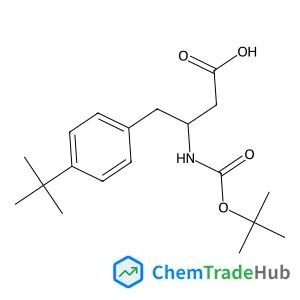
(S)-3-((tert-Butoxycarbonyl)amino)-4-(4-(tert-butyl)phenyl)butanoic acid
CAS Number:
403661-85-8
Molecular Formula:
C19H29NO4
M. L. Aguayo-López, E. de los Reyes-Berbel
Two simple boron-dipyrromethene-type fluorophore (azaBODIPYs) dyes are synthesized and tested for the determination of CO2 gas by an inner filter process. The indicators are noncovalently entrapped in suitable polymers according to their polarity, featuring absorption maxima at 620 nm and fluorescent emission maxima in the range 675–720 nm. Molar absorptivity and fluorescence quantum yield data were determined for these two synthesized azaBODIPYs. These indicators have high molar absorption coefficients of 7.1 × 10⁴ and 2.1 × 10⁴ M−1 cm−1 and quantum yields of 21 and 9%. The pKa values of the indicators are determined from absorbance and fluorescence measurements with values of 7.9 and 8.5, depending on the positioning of the substitution pattern of the electron-donating functionalities. The two azaBODIPYs present excellent photostability, making them suitable for long duration measurements. These azaBODIPY dyes act as fluorescent pH indicators in a polymeric sensing membrane along with microcrystalline powder of chromium-doped gadolinium aluminium borate as the luminophore, a transfer phase agent (tetraoctyl or tetramethyl ammonium hydroxide) and a plasticizer or surfactant to improve membrane permeability to gaseous CO2. The response time ranges from 42 to 60 s and recovery time from 103 to 120 s, with a detection limit of 0.04 and 0.57% CO2. The store time of the sensing membranes is longer than 570 days in the best case, and it does not need to be kept in any special atmosphere other than darkness.
Ranzhuo Huang, Tianxing Wang, Xianqi Dai, Shuyi Wei, Yaqiang Ma
DOI: 10.1039/C9CP06249A
DOI: 10.1039/D0CP00032A
Michele Guizzardi, Silvio Bonfadini, Ilka Kriegel, Luigino Criante
DOI: 10.1039/C9CP06839B
R. A. Evarestov, A. Senocrate, R. K. Kremer, J. Maier
DOI: 10.1039/C9CP06322F
Nguyen-Thi Van-Oanh
DOI: 10.1039/C9CP05095G
Ankita Katiyar, Julia C. Freire Sovierzoski, Paul B. Calio, Anthony A. Vartia, Ward H. Thompson
DOI: 10.1039/C9CP06874K
Xiaoyue Liu, Jueming Yang, Xingwu Zhai, Hongxia Yan, Yanwen Zhang, Long Zhou
DOI: 10.1039/D0CP00238K
Luke W. Giles, Joshua B. Marlow, Calum S. G. Butler, Geosmin A. Turpin, Liliana de Campo, Stephen T. Mudie, Charl F. J. Faul, Rico F. Tabor
DOI: 10.1039/C9CP05463D
N-(4-Methoxybenzyl)-2-pyridinamine (CAS: 52818-63-0) is increasingly being used ...
When handling Ethyl 4-(2-chlorophenyl)-1,3-thiazole-2-carboxylate, appropriate p...
Diethyldiselane (CAS: 628-39-7) is classified under the Globally Harmonized Syst...
The market for oxocopper (CAS: 12053-18-8) is primarily driven by its use in cat...
The market for 5-{[(2-Methyl-2-propanyl)oxy]carbonyl}-5-azaspiro[2.4]heptane-7-c...
2-(1-Pyrrolidinyl)-4-pyridinamine is a chemical compound with the CAS number 359...
2-(3-Pyridinyl)-1-azabicyclo[2.2.2]octane (CAS: 91556-75-1) is a crystalline sol...
(S)-Alpha-allyl-proline hydrochloride is usually synthesized via a Wittig reacti...
3-Methyl-1,2-oxazole-5-carboxylic acid (CAS: 4857-42-5) is an organic compound w...
Lys-SMCC-DM1 is synthesized via a multi-step process involving the coupling of S...

Analyst publishes analytical and bioanalytical research that reports premier fundamental discoveries and inventions, and the applications of those discoveries, unconfined by traditional discipline barriers.
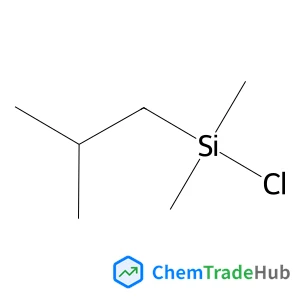
![(4aR,5S,6R,8aS)-5-[2-(3-Furyl)ethyl]-8a-(hydroxymethyl)-5,6-dimethyl-3,4,4a,5,6,7,8,8a-octahydro-1-naphthalenecarboxylic acid structure](https://static.chemtradehub.com/structs/184/18411-75-1-d4cd.webp "(4aR,5S,6R,8aS)-5-[2-(3-Furyl)ethyl]-8a-(hydroxymethyl)-5,6-dimethyl-3,4,4a,5,6,7,8,8a-octahydro-1-naphthalenecarboxylic acid structure")